Showing posts with label Netherlands. Show all posts

Monday, December 24, 2018

Cities of 2018

The past few years (e.g. here and here), I've been recording a list of all the cities outside NJ/NY that either I visited for work-related purposes, or that AA and I went to for a vacation. There is little doubt that the two most remarkable places we visited in 2018 were the furthest north and the furthest south I've ever been before: Iceland and Costa Rica. Both of these trips were remarkable for being very nature-oriented. 

Reykjavik is fine city, but it was our Golden Circle tour that brought us to Thingvellir National Park, where we saw the North American and Eurasian tectonic plates crashed against one another--a humbling experience--as well as the site where their Parliament met for over 1,000 years until they built an actual building in Reykjavik in 1930. The waterfalls and geysers were spectacular as well. Iceland is like being on another planet; it's completely desolate but remarkable for its unusual geological formations and hot springs. We missed the Northern Lights and the spa experience, so another visit is in order! Save money if you're thinking about going, though, because it's not cheap!


On the complete opposite spectrum, Costa Rica's southwestern Pacific coast was unlike anything I ever experienced, with spectacular views and wildlife that made me smile non-stop. Monkeys howl in the trees around you and greet you on your patio (and, yes, try to steal your food!), and there are giant iguanas, tropical birds, and actual crabs that walk right past you too. We went zip-lining while we were there, among other adventures--something I never thought I would do (picture at right, climbing stairs to the next zip!)--and I loved it. It was an incredible outdoorsy trip with a wonderfully relaxing hotel at the top of a mountain.

We also had wonderful opportunities to visit with family, and another great adventure happened in our own backyard when, in one day with AA's family, we toured NYC by boat (Circle Line), land (walking the streets), and air--a helicopter tour (photo at the top!). The helicopter tour was exhilarating...if also admittedly a tad frightening...but that's what these adventures are all about...pushing yourself just a little further to experience all that life has to offer. We always take stock and remember how fortunate we are to be able to travel, and we are forever grateful for these experiences of the world. Here are the Cities of 2018...


Amsterdam, The Netherlands
Athens/Atlanta, Georgia
Fairfield, Connecticut
The Hague/Delft, The Netherlands
Kansas City, Missouri (leaving for here tonight!)
Leamington Spa, England
Liverpool, England
London, England (2 visits)
Manuel Antonio/Quepos, Costa Rica
Montreal, Canada
New Haven, Connecticut
Ogunquit, Maine
Portsmouth, New Hampshire
Quebec City, Canada
Reykjavik, Iceland
St. Petersburg/Palm Harbor/Tarpon Springs, Florida (3 visits)

Sunday, October 7, 2018

Art Libraries at the Rijksmuseum


I was quite honored to be among the guest speakers for the recent 8th International Conference of Art Libraries, held at the Rijksemuseum in Amsterdam (facade of the building seen here). The conference itself had some very interesting papers and it helped inspire a few ideas in my head, which is always a good thing. I was surprised that so many people from the U.S. were presenting, but most of the audience members came from throughout Europe. Two speakers even presented about art libraries in Japan, which quickly reminded me that we need to stop thinking so Euro-centrically about all these things. 

My co-presenter (Melanie Wacker, also at Columbia; photo at left of us taken by Ann Lindell) and I gave a talk entitled "From Curatorial Files to Linked Open Data: Cataloging the Art Collection at Columbia University," discussing background on the art collection my department oversees and how our management of metadata and cataloging moved from traditional paper files to a metadata schema that we were then able to convert to MARC so as to be published in the Columbia Libraries online catalog, to convert for use in the soon-to-be-launched Digital Art Properties collection, and then used as the basis for a linked open data project that was a grant to test art for use in BIBFRAME, the future XML-based form of cataloging established by the Library of Congress that eventually will replace MARC. I realize much of what I just wrote there may seem like gibberish to anyone but IT specialists and librarians, but the point is that up until recently no one could search anything in the Columbia art collection, whereas now the art collection is now not just discoverable but available in digital format (highlights anyway) and is being used to establish new models of excellence for ways of cataloging art by libraries in the future. It's been a team effort that we are all proud of.

It was quite humbling to be presenting at the Rijksmuseum, one of the grandest collections of art in the world. This was my second visit there, the first time two years ago when AA and I traveled to Amsterdam. On this trip we also made a visit to The Hague where we visited the Maurithuis and I truly fell in love with Vermeer's Girl with a Pearl Earring, one of those examples of art where you have to see it in person to truly admire its majesty in terms of lighting, brushstroke, and overall composition. She is more modern in her appearance than I ever realized. We also visited Delft, Vermeer's home, which was an absolutely charming city. I also had an opportunity to visit the Hermitage Amsterdam and see the Neoclassicism exhibition with works from St. Petersburg; the Canova sculptures were just exquisite. I'm in London right now writing this, with a few other things to do here before heading home in a couple of days.

Sunday, April 2, 2017

MWA XLVII: Alma-Tadema's Rivals


Lawrence Alma-Tadema (1836-1912) is considered by most to be a British artist, but in fact he was born and raised in The Netherlands and did not emigrate to London until 1870. He was then a widower with two daughters trying to make a bigger name for himself in the commercial art capital of Britain. He succeeded, becoming one of the greatest names associated with the Aesthetic Movement, his London home a salon for artists, writers, musicians, composers, and actors to socialize and exchange ideas. His second wife and daughters were all painters too. What people love about Alma-Tadema today was his uncanny ability to capture imaginatively Greco-Roman lives from over 2,000 years ago as if they were people we saw in our daily lives today (or, for his contemporaries, in Victorian times). His critics, however, have a tendency to refer to his paintings pejoratively as nothing more than "Victorians in togas."

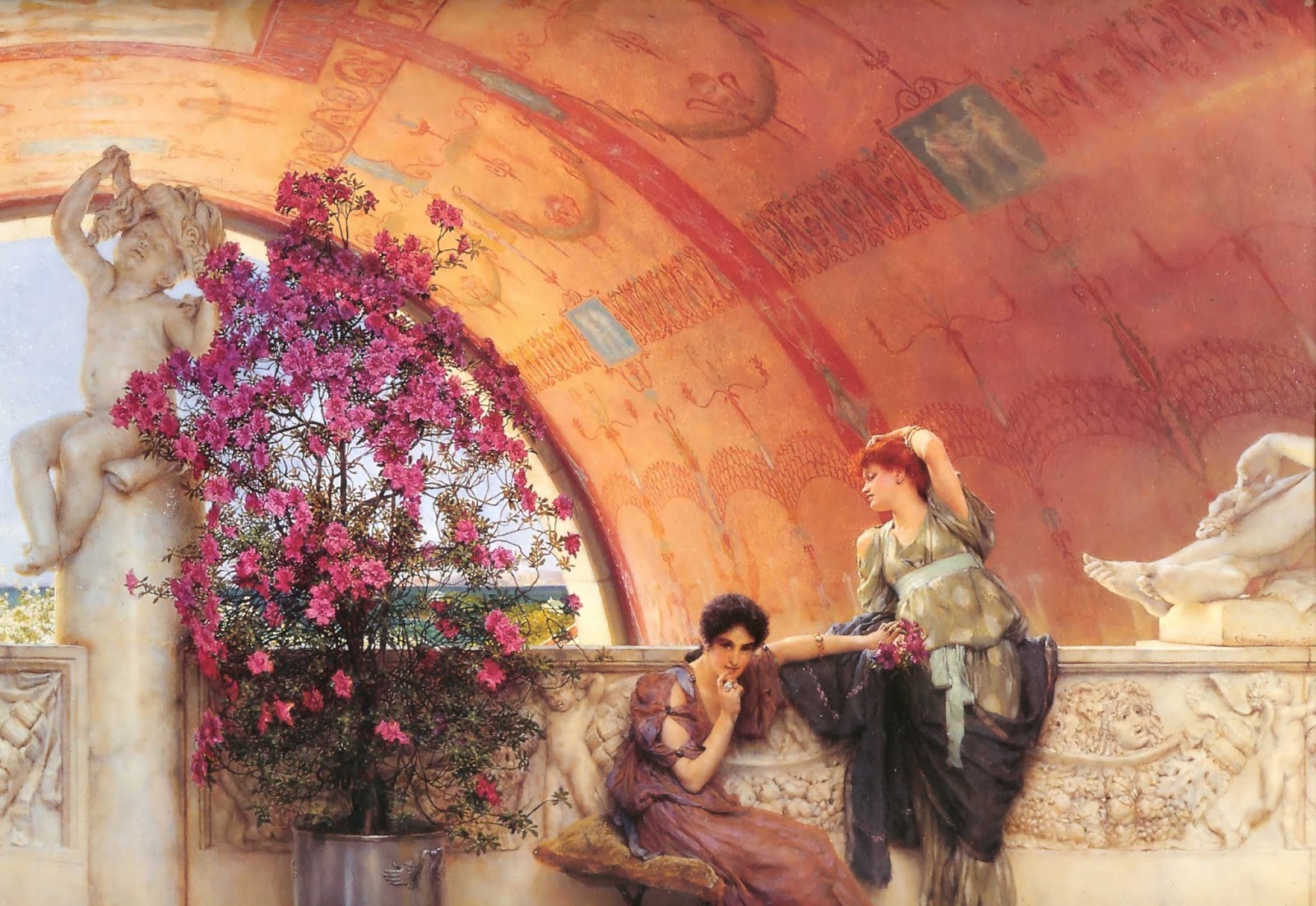
Last November, when AA and I were in Amsterdam, we took a day trip to Leeuwarden to see the new exhibition Alma-Tadema, klassieke verleiding (Alma-Tadema: At Home in Antiquity). My review of the exhibition has just been published in Nineteenth-Century Art Worldwide, which you can read here for free. One painting in the exhibition, that you see above, is Unconscious Rivals, 1893, from the collection of the Bristol Museum & Art Gallery. My own first exposure to Alma-Tadema was through  a reproduction poster of this painting in the mid-1990s, when my mother fell in love with it and we worked together at a framer getting it matted and framed. It thereafter hung in my parents' bedroom for about fifteen years. I was always fascinated by the incredible details in the picture: the glean of the marble benches; the vibrancy of the azaleas; the details in the barrel-vault ceiling. Even more intriguing, however, was the psychological relationship between the two women depicted. I remember my mother and I talking about this when we first saw it, and I think this was the added bonus, in addition to the exquisite details, that sold us on purchasing the poster and framing it.

Regardless of whether or not one likes Alma-Tadema's work, most agree that his attention to detail and ability to paint furniture, drapery, jewelry, architectural settings, etc., are noteworthy. As I write in my review of the exhibition, I was eager to see this particular painting in the show, more so because of my own personal connection to it through that poster. On first seeing Unconscious Rivals in person, however, I admit I was a little disappointed because it is smaller than I had anticipated. This is not an uncommon experience after first engagements through reproductions. But the more closely I examined the painting, the more I could see that it was a jewel of a picture with intricate details like the azaleas, which are almost too hyperrealistic in their depiction.

The scene shows two young women who respond differently to an unseen man with whom each of them, unbeknownst to the other, is in love. (The man, presumably a soldier, is represented by the legs and sword of an ancient statue of a seated gladiator.) This narrative in the picture was part of the tradition of nineteenth-century genre painting, which audiences of the day appreciated and understood well. However, while traditional genre painting offered a moral message, here aesthetics take precedence and the depiction of the two women is more a statement about beauty rather than morality. The viewer (then and now) can identify with them, sympathizing with the shy temperament of the brunette who gazes toward the picture plane with a sheepish smile, or responding sensually to the vivacious red-head (a Pre-Raphaelite trope of the femme fatale) flirting with the lover below the balcony. The painting is a reinterpretation of the allegorical sacred and profane that stretches backward to Titian and forward to Freud. Alma-Tadema’s Unconscious Rivals relies on this form of empathy that transcends time and nationalism to make its point. It appeals to audiences to identify with these women emotionally, regardless if the women or the viewer are ancient Roman, British Victorian, or twenty-first century Dutch or American. It is, indeed, a beautiful painting. You can see more of his paintings, and some gallery views from the exhibition, in my review.

Tuesday, January 10, 2017

Cities of 2016

Following up on last year's list of cities, here is the 2016 list. When I think back on the cities AA and I visited (or that I traveled to solo mostly for work-related reasons), the highlight of the year was related to the picture you see here. AA took this of me at the top of the Pyramid of the Sun in Teotihuacan, northeast of Mexico City. The temple was constructed over 1500 years ago and although one assumes it is related to the Aztecs, in fact it was constructed nearly a thousand years before the Aztecs rose to power. The views from the top at over 240 feet high were breathtaking. The height wasn't what made the climb so daunting; it was the steps that were treacherous and steep, with all these people clutching onto a rope ahead of you. If one person dropped, you knew in a moment all of you would be tumbling down the pyramid like a set of dominoes. I'm not exactly the most physical-fitness-oriented individual, so having reached the top was quite a challenge and it was a great personal triumph. Our long weekend trip to Mexico City over Memorial Day was really fantastic; I look forward to a return trip and to see other areas of Mexico.

The other vacation highlight of the year was our trip to Amsterdam and Copenhagen over Thanksgiving. These were two cities I had never been to before. I loved Amsterdam; the picture here is a selfie of us with one of the canals behind us. I have been jokingly referring to Amsterdam as Brooklyn with canals and 17th-century "brownstones." It's a very laid-back city, easy to get around, and everyone speaks English. The scent of marijuana floats through the air in different sections of the city, coming from the numerous coffee houses, so you can't help but be relaxed. It will be great to go back one Spring in the near future to see the tulips and windmills in other areas of the Netherlands. Copenhagen, in contrast, was quite posh (and expensive!), with one Neoclassical palazzo after another lining the streets. The New Harbor area is absolutely charming, and there is a great new food market and rising arts scene too. There was construction taking place everywhere in the city while we were there, which was frustrating, but on the positive side of things the Christmas markets were open and I drank a lot of glΓΈgg, which was delectable in the chilly weather.

Here's the list of the cities outside the NYC area I was fortunate to visit in 2016...

Amsterdam, The Netherlands
Charlotte, North Carolina
Copenhagen, Denmark
Leeuwarden, The Netherlands
Liverpool, England
London, England (2 visits)
Mexico City, Mexico
New Haven, Connecticut
Ogunquit, Maine
Philadelphia, Pennsylvania
Portland, Maine (2 visits)
Provincetown, Massachusetts
St. Petersburg/Palm Harbor, Florida (3 times to see family & friends!)
West Palm Beach, Florida

Tuesday, November 29, 2016

MWA XLIV: Roelofs's Windmill

Better late than never, as they say! I realize I've been offline with the blog the past few months, but it's largely because I have been so busy and working on a few writing projects in my non-job time. As I mentioned in a previous post, AA & I took a week-long vacation over Thanksgiving to go to Amsterdam and Copenhagen: two cities I had never visited before. It was quite a nice trip. The weather was cool and it rained a lot in Amsterdam, but I truly enjoyed the canals and the charming architecture in Amsterdam, and the majesty of the Nordic palazzo and upscale fishing village feel one finds in Copenhagen. We hit just about every major museum, not surprisingly. It was at the Rijksmuseum where I discovered this gem of a painting from the 19th century: Willem Roelofs, Meadow Landscape with Cattle, ca. 1880. We did not venture to the picturesque regions of The Netherlands where one can see old, working windmills such as the one in this painting, so this will have to suffice for me for the time being...until I get back and see them live.

Roelofs was a member of The Hague School, a group of artists who were inspired by the French Barbizon school of painters, such as Rousseau, Millet, and Corot. These artists began painting the naturalistic landscape of the French countryside as early as the 1830s but came into their own by mid-century, thereafter helping to alter the respectability of landscape painting from something dismissed as a lesser art in prior generations. This idea of depicting the naturalistic landscape as it actually appears, rather than as an idealized scene for a narrative event, arguably goes back to British artists such as Constable and Turner, but in The Netherlands the most obvious source of inspiration goes back even further to the 17th century with the naturalistic Dutch landscapes by artists such as Ruisdael. You can read more about The Hague School here.

While there is an incredible charm to this painting because of the windmill and the beautiful, soft lighting and fluffy clouds, what is striking is how the windmill dominates the space in this vertical painting. Normally one expects to see landscapes as horizontal compositions, panoramic views that show sweeping swathes of nature. Here, however, by reverting to a vertical format, Roelofs transforms the windmill into a portrait, or at least a narrative composition. The pyramidal structure of the windmill and its arms dominate the center point and then moving out diagonally toward the lower left and right lines, creating a pseudo-head-and-shoulders figure. Although the title references the cattle, both they and the man are diminished by the monumentality of the windmill itself, a man-made machine that for the 19th-century viewer demonstrated the development of technology, i.e. man's dominance over nature. Even the arms of the windmill seem to be moving the air and clouds themselves with a superior strength--which is exactly what they are meant to. This interpretation may seem rather droll because the painting is quite beautiful. But this is where Roelofs succeeds. He portrays the power of the windmill as an object of beauty, conveying both its picturesque qualities and the harmonizing of man with nature.

Sunday, October 4, 2015

MWA XXXV: Van Dyck's Greyhound

I have made a point to frequently blog about our canine friends whenever possible, particularly in art, so it seems only appropriate to make the latest Monthly Work of Art a dog-themed portrait in celebration of #WorldAnimalDay. (I suspect this day intentionally coincides with the Feast of St. Francis, but deemphasizes the Catholic association.) The work you see here is Anthony van Dyck's portrait of James Stuart (1612-1655), Duke of Richmond and Lennox, a stellar painting at The Metropolitan Museum of Art. This magnificent portrait represents a cousin of King Charles I, and as their catalog entry notes it likely was painted in 1633-34 because he wears the regalia of the Order of the Garter, which he received in 1633. Van Dyck is one of the most famous and arguably best portraitists in Western European art. The Frick Collection here in NYC will have an exhibition of his portraits opening in March, that I very much am looking forward to seeing. But for World Animal Day, it seems worth noting not so much the dashingly handsome human subject in this picture, but the beautiful greyhound who gazes up at his master lovingly with devoted eyes as the Duke caresses his head.

The dog's body is painted differently so as to distinguish him from the rich silk garments on the Duke and the billowing the drapery behind them. This gives the dog his own characteristics, but he also comes to represent along with these props the Duke's wealth and power. It's remarkable how van Dyck uses the dog's natural body position, with his front paws lower in the foreground, thus creating spatial depth and perspective and projecting the Duke forward into the viewer's space. His dog symbolizes fidelity, but the gestures between dog and owner also suggest the Duke's strength of character and his mastery over the beast.

Having played and petted my greyhound nephews, first George and now Winnie, on visits to see their mother SVH in Jacksonville, I can attest to the unusual weight of their large heads as it lays against your hip...and that adoring gaze! Their sinewy legs seem impossible to support their lanky, muscular bodies, but in fact these are incredibly balanced, nimble, and of course unbelievably fast dogs. It is a testament to van Dyck's skill that he was able to represent the dog so naturalistically, and one can see here his dynamic preparatory study for the greyhound, a work now in the collection of the British Museum. The artist used a series of strokes to develop and enhance the complicated muscles and contours of the greyhound's body. His attention to these details help make the beautiful dog an important presence in the Duke's portrait.

If you want to learn more about greyhounds and their imagery in art, you can watch Gary Tinterow's entertaining "Connections" video from The Met. Tinterow was then head of the Nineteenth-Century, Modern, and Contemporary Art department, but he is now Director of the Museum of Fine Arts in Houston. Having raised greyhounds himself, he has a personal interest as well in paintings such as this one by van Dyck.

Wednesday, February 4, 2015

The Passing of Walter Liedtke


The horrible news of the train crash on the Metro North railroad yesterday evening was tragic unto itself. This afternoon, however, the names of some of those who died were released and, like many others active in the art and museum world, I was startled and disturbed to discover that Walter Liedtke was among the deceased. Walter (as I and many others knew him) was a curator for 35 years at the Metropolitan Museum of Art, and an internationally renowned specialist in Dutch and Flemish paintings by famous artists such Rembrandt, Rubens, and Vermeer. I had the privilege of meeting Walter a number of times during the 7+ years I worked at the Metropolitan Museum of Art. I actually taught him (along with my colleagues) how to use PowerPoint for his art historical presentations, and he attended a few of my instructional sessions on digital imaging. Whenever he came into the Image Library, he would ask me about how my graduate work and dissertation was coming along and encouraged my pursuit of art history as a career. I doubt he would have remembered me outside of my former role at the Met; nevertheless, the news of his death has impacted me more than I expected.

When I think back over those years when I was in graduate school and working at the Met, Walter was one of the more significant curators who inspired me. His art historical scholarship was brilliant, easy to read but always insightful. His presentations were engaging. His exhibitions were thought-provoking in the most creative ways, even when they were at the simplest. He curated, for instance, the loan of a single painting from the Rijksmuseum, Vermeer's Milkmaid, and combined with it a selection of paintings, works on paper, and decorative arts from across the Met's collections, exploring not only Vermeer's genius with this painting but the hidden symbolism behind what ordinarily would be seen otherwise as merely a genre scene. (I blogged about the show at the time.) It opened my eyes to the notion that one could successfully launch an informative show that focused on a single work of art. Similarly, his exhibition of paintings by Frans Hals from the Met's collection was fascinating because he wasn't afraid to move outside his comfort zone of the 17th century and demonstrate how Hals's brushstroke influenced modernist artists such as Manet and Sargent in the 19th and 20th centuries. His work on Rembrandt was legendary, and his Vermeer and the Delft School was always championed as a masterful exhibition and catalogue, although regretfully I never saw the show. Beyond his brilliance and creativity, there was an incredible charm and wit to him that always made one smile. Indeed, I learned from his example as a person how one could balance the international accolades of recognition for scholarship with a down-to-earth persona that could put anyone at ease. The Met has a few video segments and features in which Walter appears, but I think this one video, "Living with Vermeer," does a lot to help viewers understand not only the curator as a scholar but the curator as a man, mirroring the quotidian existence one finds in the Dutch and Flemish paintings he admired and taught so many people how to enjoy. I urge you to watch the short video by clicking here.

Tuesday, December 24, 2013

MWA XX: David's Nativity


Although I've never had the opportunity to study in-depth "Northern Renaissance art" (i.e. paintings by Netherlandish painters such as Jan van Eyck and Hans Memling), like others I find them to be some of the most beautiful paintings in the history of art. The crisp linearity and precision of draftsmanship is complemented by rich jewel-like colors, making so many of these paintings among the most precious in European art. Many of the works are altarpieces and Catholic in nature, as they pre-date the spread of the Protestant Reformation and thus the removal of Christian imagery (idolatry as it was called) in favor of the Word (Bible) alone. The Metropolitan Museum of Art holds a number of these works, largely because they were collected by Gilded Age industrialists at a time when a number of these early painters were barely known. Gerard David (ca. 1455-1523), born in the Netherlands and active in the now-Belgian city of Bruges, was but one of these highly-respected and talented painters of their day.

His scenes, such as this work from the Met, The Nativity with Donors and Saints Jerome and Leonard, ca. 1510-15, focus on traditional Christian imagery, but often reveal the secrets of his own interest in landscape painting. Just look in this detail over the shoulder of Joseph and you can see the shepherds peering through the window with an exquisite landscape stretching into the distance. The birth of Christ is the subject of the triptych, but the angels positioned beside the open window together echo the connections between God and nature. It's a powerful image, with many layers of meaning. According to the curators, "despite the joyful moment depicted, the figures all wear somber expressions, foreshadowing Christ's eventual suffering and sacrifice." The saints on the two end panels are Jerome and Leonard, but the donors kneeling before them remain unidentified, reminding us how much more we have to learn about the history and reception of these gems in Western painting. Gerard David himself was lost to history and only rediscovered in the mid-1800s. For more about his extensive life and work, see the Met's Heilbrunn Timeline of Art History.

And to all my bklynbiblio readers, MERRY CHRISTMAS!!

Tuesday, September 15, 2009

The Milkmaid

The Rijksmuseum in Amsterdam has loaned to The Metropolitan Museum of Art one of its most popular paintings, Johannes Vermeer's The Milkmaid. Painted from about 1657-8, it is truly one of the best examples of Dutch painting. I'm not an expert on the Dutch masters, but I can say that Vermeer is one of my favorite painters. Then again, who wouldn't like Vermeer? His handling of light and color with such simple subject matter reveals the hand of a master at work. The painting itself it actually much brighter than the digital image you see here (this is a detail of the painting and the cover of the small exhibition catalogue). In the painting, the colors pop from the canvas and you get the sense that you've approached the milkmaid at a particular moment when the sunlight coming through a window has illuminated her. It creates a sensual, luminous effect that is difficult to find elsewhere in the history of painting. The small exhibition has been curated by Walter Liedtke, a noted expert on Dutch painters from Vermeer to Rembrandt, and includes paintings, drawings, prints, and decorative art from the Met's collection to complement and contextualize Vermeer's picture. Perhaps most interesting is the theme on which Vermeer borrowed: that of the milkmaid's "reputation for amorous predispositions," according to the exhibition's website, which means that there is a tradition in Dutch painting of busty milkmaids being seen as sexual objects. (Hm...that Christmas song where 'maids-a-milking' are followed by 'lords-a-leaping' now suddenly makes sense...) What Liedtke is arguing then is that this picture has subtle hints that suggest a conscious romantic theme beyond a genre scene. In later art, certainly the sexuality-labor theme runs true to form. In her groundbreaking essay on Morisot's painting of her daughter and wet nurse, Linda Nochlin has written about the visual associations of mothers and breastfeeding with animals and labor. In the essay, she cites Segantini's painting The Two Mothers, 1889, which shows the pairing of a human mother and a cow both with their newborns, as an example of this conjunction of women's role as animalistic laborer. It is a picture that can be seen as sentimental, but it also demonstrates the perception of women as beasts of burden and, by implication, their social status beneath men, as it was understood at that time. Indeed, if you think about it, the theme of the milkmaid has direct connections with cows and the production of milk, both as a form of labor and in women's biological construct as a mother or wet nurse, so Nochlin's 19th-century example certainly has historical precedents in Dutch genre scenes such as this Vermeer painting. If you're in NYC this fall season, make a point to see the exhibition, as you'll be rewarded by the painting's beauty. If you're interested in learning more about Vermeer, check out the website Essential Vermeer that my friend PR just happened to pass along to me the other day. Also, if you haven't seen the film The Girl with a Pearl Earring, starring Scarlett Johannson and Colin Firth, I recommend it as an art film that captures the essence of light and simplistic beauty that makes Vermeer's paintings so exquisite.