Showing posts with label reviews. Show all posts

Saturday, January 4, 2020

Projects of 2019

Here's my annual list of professional "projects" that I was involved in and overseeing during 2019. (You can read previous lists here and here.) As I've mentioned in the past, it's good to take stock of these accomplishments because it helps remind me how busy things have been, particularly as I have a tendency to always move on to the next project and forget what I've already done. The photo you see here is of me giving the introductory remarks at an event I coordinated in April, an "Evening at Avery: British Portraiture", to coincide with the exhibition I co-curated (more on that below; no idea whose head that is in the photo!). The event had a surprisingly good turn-out, and our two speakers were Mateusz Mayer, PhD student in art history, who co-curated the exhibition with me, and Dr. Meredith Gamer, assistant professor of art history at Columbia who gave a riveting talk about alternative concepts of 18th-century British portraiture for those who are often forgotten by history and society.

Here is the 2019 list...

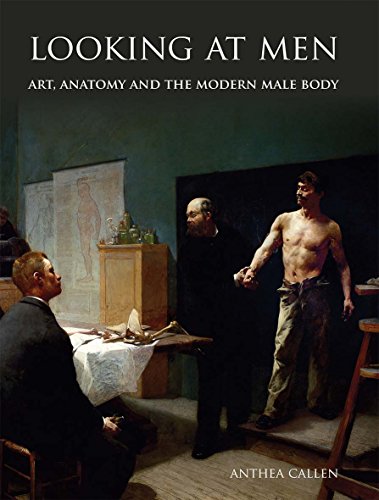
  • I published two book reviews, which I mentioned about in my Books of 2019 post as well. The first was a short review on Beyond the Face: New Perspectives on Portraiture, about which I posted even more. The second was a review essay in Nineteenth-Century Art Worldwide on Anthea Callen's new book Looking at Men: Art, Anatomy and the Modern Male Body.
  • I curated at work a summer exhibition entitled Animalia: The Essence of Animals in Art, with artwork from the permanent collection dating from 3rd-century Mexican dog sculptures to contemporary Inuit sculptures. During the winter/spring, I co-curated the exhibition Hoppner, Beechey, Fisher, Lavery: Researching Columbia's Portraits with M. Mayer, and we published online a catalogue of the exhibition with essays by both of us, which you can download and read here. My staff and colleagues at work deserve lots of credit for all their help in making these exhibitions possible.
  • I acted as curatorial project manager with Dr. Frederique Baumgartner on the "MA in Art History Presents" exhibition at Columbia entitled Clodion (1738-1814) and "Clodion Mania" in Nineteenth-Century France, which has a fantastic online exhibition component you can see here.
  • Tomas Macsotay and I co-chaired a panel session entitled "Transnationalism and Sculpture in the Long Nineteenth Century (ca. 1785-1915)" at the annual conference of the College Art Association in February in NYC.
  • I served on the selection committee & jury for the 16th annual graduate student symposium co-sponsored by the Association of Historians of Nineteenth-Century Art and the Dahesh Museum of Art in March in NYC.
  • I was the guest speaker at a Columbia Alumni Association of New Mexico event, where I spoke about the collections and our educational programs to alumni. This took place in Santa Fe, New Mexico in September.
  • Columbia's Department of Art History and Archaeology had received a small grant to coordinate an international project called Parallel Heritages, with some of their students and students at The Sorbonne, Univ. Paris I, for an international research project on archaeological objects in both collections. I gave presentations at both components, in NYC in March, and in Paris at The Sorbonne in November.
  • I also gave a paper entitled "British Portraits at Columbia University: Opportunities for Object-Centered Learning" at the annual Understanding British Portraits seminar, held at the National Portrait Gallery in London in November.
  • I participated in the annual conference of the Association of Academic Museums and Galleries in June in Minneapolis, Minnesota.
  • Totally not work-related, but worth documenting... in February AA & I took a fantastic wine-tasting class that was incredibly informative (we are doing a repeat, focused version on Italian wines later this month), as well as a fun cocktail making class in December. We also went to go see the opera The Magic Flute at the Metropolitan Opera and Moulin Rouge on Broadway.
All in all, another incredibly productive and fulfilling year!

Tuesday, December 31, 2019

Books of 2019

This morning, AA said to me by text, "Aren't you going to blog about your Books of 2019?" And so here I am doing it, while he's on an airplane heading back home so we can celebrate New Year's Eve just in time with a glass of prosecco. Normally I write this post soon after the annual 100 Notable Books from The New York Times comes out, but we were away at that time and . . . well, that thing called daily life just kept delaying things. Over the last few years, though, I've discovered that not all of the books on the list are among my favorites once I actually read them. Case in point: last year, Tana French's The Witch Elm and Lisa Halliday's Asymmetry were on their list, and I was eager to read them, but to be frank I didn't find either book to be "best" reads. In my opinion, French's book was too dense with excessive details for that type of book (mystery/thriller), so by the time you started getting into the actual mystery, the suspense wasn't there for me. Halliday's book, in turn, was creative as a writing experiment (two novellas that seem to have nothing to do with one another, then somehow become linked in a coda-story), so it wasn't as if I didn't like the book, but it just wasn't what I would consider to be a favorite. All that said, I had commented last year about looking forward to reading Michelle Obama's autobiography, and that was great--inspiring even! I guess I'm biased, but what made it such an enjoyable read was that it felt like she was talking to you the entire time, telling you not just about her life but the lessons she learned from her experiences.

The image you see above is undoubtedly my favorite novel that I read this year. Colson Whitehead's new book was published in 2019 and I bought and read it immediately. I loved The Underground Railroad, as painful as that book was to read, so while The Nickel Boys wasn't "magically realistic" as components of his previous book was, the pain and anguish, and the lessons we have to learn still about America's history of racism and abuse of power, were remarkably strong with completely different types of stories. Whitehead has this uncanny ability in these two books to create a narrative voice that allows you to feel the pain of his characters, but still keep yourself at a distance so you can process it objectively. I see him as an heir to Toni Morrison in some ways. I have no doubt that these two books will be models of a new American literature for generations to come, much the same way Harper Lee's To Kill a Mockingbird has been. That was a book I also finally read earlier this year for the first time. I discovered the Icelandic author Sjón this year with his fairy-tale-with-a-twist The Blue Fox, and I thoroughly enjoyed, both as a mystery and a meta-novel, Anthony Horowitz's clever The Word Is Murder. I should add that a year ago when I did my last books post, I was worried that Persuasion wasn't going to end well, but I'm pleased to say that it was in fact probably my favorite Jane Austen novel of them all. I read somewhere that if you loved Pride and Prejudice as a young person, Persuasion is the book you read as a mature adult to find satisfaction in her writing. It is so true.

In the world of non-fiction, I enjoyed and learned a lot from Richard Holmes's group biography The Age of Wonder, on the history of science and Romanticism around the years 1800. I read the collection of essays Beyond the Face, providing new interpretations on portraiture in the history of art of the United States and beyond, and published a book review of it which you can read here as well as my blog post here where I add more about the artist Carrie Mae Weems. I also read Anthea Callen's new art history/anatomy book Looking at Men, and published an extended book review essay in Nineteenth-Century Art Worldwide, which you can read here. Right now, my bedtime read is Robert K. Massie's biography of Catherine the Great, and my subway reading is Joseph Conrad's Heart of Darkness, which I read back in college (almost 30 years ago!), but decided to revisit all these years later.

It seemed like a good idea to actually share the full list of the 30 books I've read this year. This is the order in which I finished them, and I've included the publication year in brackets, and my star rankings (5-stars is highest!) to help anyone along if they decide they want to read these. Here's to 2020 and more books to read!


  • Persuasion by Jane Austen [1818] (*****)
  • To Kill a Mockingbird by Harper Lee [1960] (*****)
  • The Age of Wonder: How the Romantic Generation Discovered the Beauty and Terror of Science by Richard Holmes [2008] (*****)
  • Beyond the Face: New Perspectives on Portraiture by Wendy Wick Reaves, ed. [2018] (****)
  • Arctic Chill by Arnaldur Indridason, trans. B. Scudder & V. Cribb [2005] (****)
  • The Blue Fox by Sjón, trans. V. Cribb [2004] (*****)
  • Rogues’ Gallery: The Rise (and Occasional Fall) of Art Dealers, the Hidden Players in the History of Art by Philip Hook [2017] (***)
  • The Assassination of Margaret Thatcher: Stories by Hilary Mantel [2014] (***)
  • The Body in Three Dimensions by Tom Flynn [1998] (***)
  • Troubling Love by Elena Ferrante, trans. Ann Goldstein [1999] (****)
  • Looking at Men: Art, Anatomy and the Modern Male Body [2018] (***)
  • Becoming by Michelle Obama [2018] (*****)
  • The Death of Mrs. Westaway by Ruth Ware [2018] (***)
  • The Body in Pieces: The Fragment as a Metaphor of Modernity by Linda Nochlin [1994] (****)
  • Serpents in Eden: Countryside Crimes by Martin Edwards, ed. [2016] (****)
  • Model and Supermodel: The Artist's Model in British Art and Culture by J. Desmarais, M. Postle & W. Vaughan, eds. [2006] (****)
  • Bloomsbury at Home by Pamela Todd [1999] (****)
  • Asymmetry by Lisa Halliday [2018] (****)
  • Duncan Grant and the Bloomsbury Group by Douglas Blair Turnbaugh [1987] (***)
  • The Child’s Child by Barbara Vine [2012] (***)
  • The Nickel Boys by Colson Whitehead [2019] (*****)
  • The Sparsholt Affair by Alan Hollinghurst [2017] (****)
  • Harm Done by Ruth Rendell [1999] (****)
  • Bacchante and Infant Faun: Tradition, Controversy, and Legacy by Thayer Tolles [2019] (****)
  • 30 Favorites Celebrating 30 Years by Stacia Lewandowski & Zaplin Lampert Gallery [2017] (***)
  • The Stonewall Reader by Jason Baumann, ed. [2019] (***)
  • Teaching in the Art Museum: Interpretation as Experience by Rika Burnham & Elliott Kai-Kee [2011] (****)
  • Losing Helen: An Essay by Carol Becker [2016] (*****)
  • The Witch Elm by Tana French [2018] (***)
  • The Word Is Murder by Anthony Horowitz [2018] (*****) 

Sunday, April 14, 2019

The Social Media Phenomenon (aka Naked Men)

24 hours ago, I was in Chelsea to see two exhibitions: Jeff Miller's show "Through the Looking-Glass: Alter Egos & Others" at the Atlantic Gallery; and "The Young and Evil" curated by Jarrett Earnest at David Zwirner. Soon afterward, I posted on my Instagram account pictures showing installation views and object shots from both shows. Whenever I post on Instagram, the norm for me is about 50-60 likes. Occasionally, it goes up to the 80+, and I've had about 4 posts that were liked by over 100 people. Let's face it: despite some personal "fans" (you are reading this right now!), I'm not a social media phenomenon, nor have I ever aspired to be. So you can probably imagine my complete shock and surprise how--only 24 hours later--I now have over 1,300 likes on my Instagram post about the exhibition at David Zwirner. I am literally stunned by this and--dare I say--even a little disturbed by it. I said to AA at least twice today "post a picture of a painting of a naked man..." Clearly that has something to do with it. But there has to be something else going on. I wonder if it is some sort of algorithm, pushing the image higher in the search for people or coming up randomly on people's Instagram posts because friends-of-friends-of-friends are liking it, and it's growing exponentially as a result. I don't think my hashtags (e.g. #queerart #stonewall50 etc.) are that special, but maybe I'm wrong. It has occurred to me that perhaps the gallery is somehow actively pushing the feed, but I don't see how they could do that. In any case, it's all completely bizarre how over 1,300 people I have never met, who live everywhere in the world, are liking these pictures. A few have commented and asked questions, so I've helped identify the works and responded to them. Some have started following me now, which is how this is supposed to work I imagine, and I in turn have chosen to follow a few back.

What is fantastic about the exhibition (which has now closed--yesterday was the last day) is that it presents a number of pictures never published before and rarely, if ever, seen by the public, all depicting works of art by a group of gay male artists (and women close to them) who were all active in the 1930s and 1940s in New York City.  The artists on view include Paul Cadmus, Jared French, George Platt Lynes, George Tooker, and so on. The style of art is largely figurative, somewhat surrealist, frequently provocative (and unapologetically so), and using older painting techniques out of favor at the time (e.g. tempera paint). Ultimately, it presents an alternative canon of American art, and it challenges the modernist tendencies that lean towards abstraction and social realism--art movements almost completely dominated by heterosexual men, culminating in the mid-century, uber-macho-modernity of Abstract Expressionism (i.e. Jackson Pollock, Mark Rothko, etc.). One of the artists who has been underappreciated and clearly comes to the foreground in the show is the Russian-born artist Pavel Tchelitchew (1898-1957). The image you see above is by him: The Lion Boy, 1936-37, gouache on paper mounted onto canvas. The stark hyperrealism of the muscular, blonde youth whose mane-like hair bursts from his body even more strongly than that from his head is without a doubt incredibly startling to see. The fact that it is uncomfortable for some to even see it now, or the fact that so many others are enamored of it because of its eroticism, reinforces how unusual such images are in our society. Would anyone have reacted the same way if it was a painting of a nude woman with blonde hair? I doubt it. Even if it were a spectacular painting, I can't imagine that it would have generated over 1,300 likes just 24 hours after I had posted the picture.

Going back to Jeff Miller's show, if you're in the NYC area, you should go see his show too before it closes next week. Like the other exhibition profiling gay male artists, Miller exhibits his own interpretation of the idealized male body. His drawings have a fascinating energy to them, and his hyperrealistic sculptures play with ideas of ego and superego in their doubling effect. So far, though, the post of his pictures on Instagram has only generated about 40 likes in 24 hours. The thing is, that is actually a great number! But when compared to the other post, it just demonstrates that there is something more going on that has to explain how the other post has literally shot through the social media roof.

Saturday, March 16, 2019

Review: Beyond the Face (and Carrie Mae Weems)

Earlier this month, ARLIS/NA Reviews published my short review on the new book Beyond the Face: New Perspectives on Portraiture, which was published in 2018 by the Smithsonian Institution, National Portrait Gallery, as part of its 50th anniversary celebration. Edited by curator emerita Wendy Wick Reaves, the book includes her introduction and sixteen essays by junior and established scholars on aspects of American portraiture. You can read my review here. The book truly does offer new insights into thinking about American portraiture, historical and modern/contemporary, with a particular emphasis on non-white artists and representations thereof. The essays on photography were among the most interesting, and I mentioned in the review that one scholar's take on a photograph by Carrie Mae Weems was brilliant. I thought I would engage with that a little more here.

Nikki A. Greene's essay, "Habla LAMADRE: Maria Magdalena Campos-Pons, Carrie Mae Weems, and Black Feminist Performance," focused on these two women artists, but more importantly engaged with the way that women of color have been excluded historically as makers of art from the great museum collections and exhibition programs. Weems's 2014 exhibition at the Guggenheim Museum was unprecedented, as she was the first African-American woman to have a show there. I remember the exhibition well; it was incredibly moving and powerful. Weems's photographs from her Museums series position the artist as a Ruckenfigur, displaying her body shrouded in black to the viewer as she stands outside the great cultural institutions and museums worldwide as an outsider. In her essay, Greene writes of the image you see here, Guggenheim Bilbao, 2006, as follows:
Weems journeyed to northern Spain ... to encounter the seduction of the sweeping, undulating, titanium walls of the Guggenheim Museum Bilbao, designed by Frank Gehry and completed in 1997. In the photograph Guggenheim Bilbao, Weems stands as a dark silhouette in her black, long-sleeved dress with her back to the viewer .... Weems stretches her arms outward to rest her hands on a white railing that heightens the chasm between her and the museum as water gently ripples below her. The framing of this photograph plays on the building's ship-like forms, with stern-like triangular peaks making Weems appear as if she is viewing the museum across a body of water from her own ship. Weems's serenity in the face of the immensity of the museum's presence grounds the viewer, encouraging a pause as the two ships purportedly confront each other. This moment of recognition of each other's position in space acknowledges their unreachability. (pp. 294-95)
What Greene also intimates with this ship-like allusion is the history of the transatlantic slave trade and the ongoing legacy of slavery as a hindrance to people of color, in this instance in an art world dominated by white privilege and the 1%. Greene's reading of this image is wonderfully intuitive.

The next book I'm scheduled to review for a publication is this: Looking at Men: Art, Anatomy and the Modern Male Body by Anthea Callen (2018). The book focuses on the nineteenth century. It should prove an interesting read, incorporating issues of science and medicine along with artistic practice, framed by the development of heterosexual, homosocial, and homosexual identities over the course of the century. Or so I hope!

Sunday, April 2, 2017

MWA XLVII: Alma-Tadema's Rivals


Lawrence Alma-Tadema (1836-1912) is considered by most to be a British artist, but in fact he was born and raised in The Netherlands and did not emigrate to London until 1870. He was then a widower with two daughters trying to make a bigger name for himself in the commercial art capital of Britain. He succeeded, becoming one of the greatest names associated with the Aesthetic Movement, his London home a salon for artists, writers, musicians, composers, and actors to socialize and exchange ideas. His second wife and daughters were all painters too. What people love about Alma-Tadema today was his uncanny ability to capture imaginatively Greco-Roman lives from over 2,000 years ago as if they were people we saw in our daily lives today (or, for his contemporaries, in Victorian times). His critics, however, have a tendency to refer to his paintings pejoratively as nothing more than "Victorians in togas."

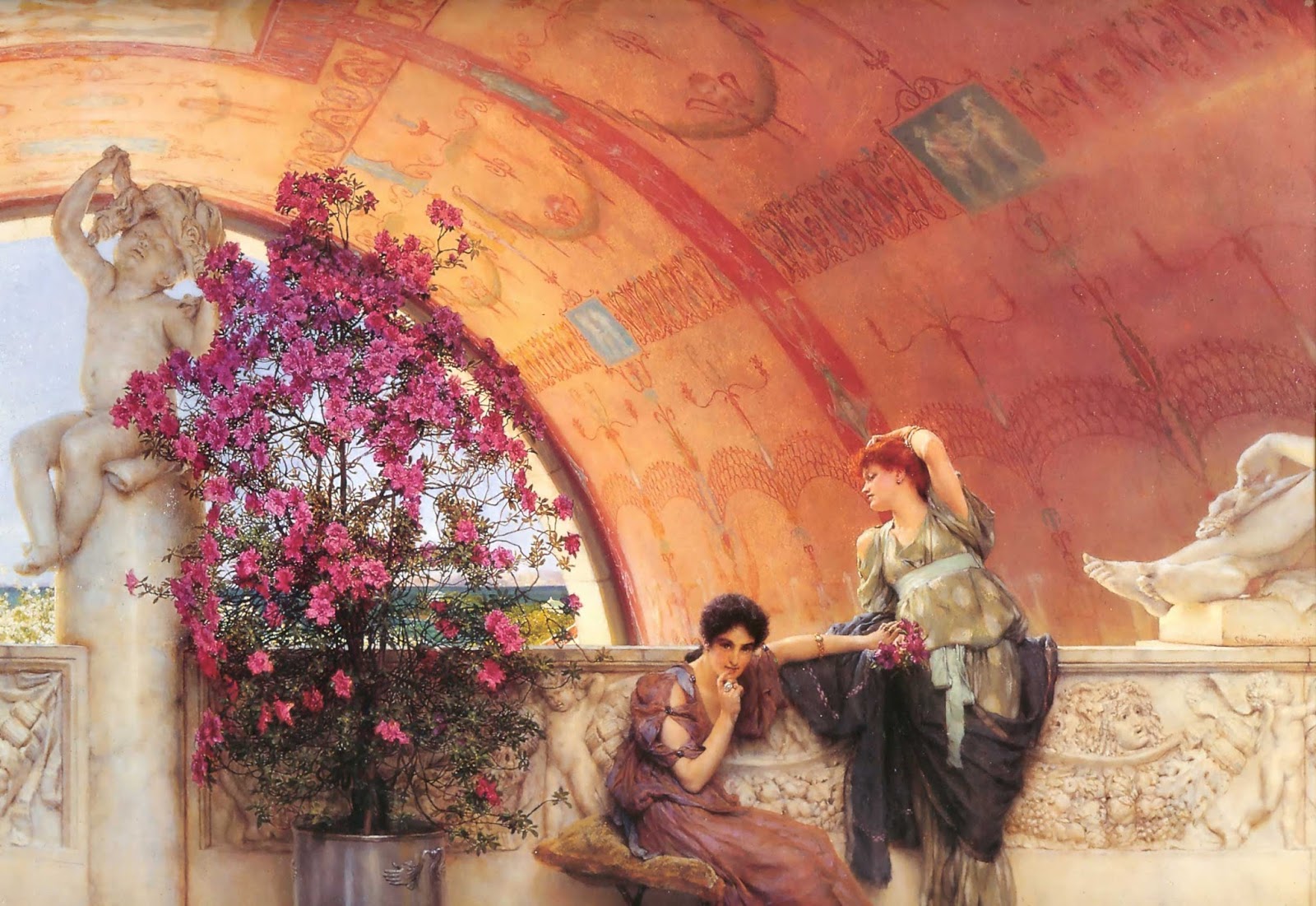
Last November, when AA and I were in Amsterdam, we took a day trip to Leeuwarden to see the new exhibition Alma-Tadema, klassieke verleiding (Alma-Tadema: At Home in Antiquity). My review of the exhibition has just been published in Nineteenth-Century Art Worldwide, which you can read here for free. One painting in the exhibition, that you see above, is Unconscious Rivals, 1893, from the collection of the Bristol Museum & Art Gallery. My own first exposure to Alma-Tadema was through  a reproduction poster of this painting in the mid-1990s, when my mother fell in love with it and we worked together at a framer getting it matted and framed. It thereafter hung in my parents' bedroom for about fifteen years. I was always fascinated by the incredible details in the picture: the glean of the marble benches; the vibrancy of the azaleas; the details in the barrel-vault ceiling. Even more intriguing, however, was the psychological relationship between the two women depicted. I remember my mother and I talking about this when we first saw it, and I think this was the added bonus, in addition to the exquisite details, that sold us on purchasing the poster and framing it.

Regardless of whether or not one likes Alma-Tadema's work, most agree that his attention to detail and ability to paint furniture, drapery, jewelry, architectural settings, etc., are noteworthy. As I write in my review of the exhibition, I was eager to see this particular painting in the show, more so because of my own personal connection to it through that poster. On first seeing Unconscious Rivals in person, however, I admit I was a little disappointed because it is smaller than I had anticipated. This is not an uncommon experience after first engagements through reproductions. But the more closely I examined the painting, the more I could see that it was a jewel of a picture with intricate details like the azaleas, which are almost too hyperrealistic in their depiction.

The scene shows two young women who respond differently to an unseen man with whom each of them, unbeknownst to the other, is in love. (The man, presumably a soldier, is represented by the legs and sword of an ancient statue of a seated gladiator.) This narrative in the picture was part of the tradition of nineteenth-century genre painting, which audiences of the day appreciated and understood well. However, while traditional genre painting offered a moral message, here aesthetics take precedence and the depiction of the two women is more a statement about beauty rather than morality. The viewer (then and now) can identify with them, sympathizing with the shy temperament of the brunette who gazes toward the picture plane with a sheepish smile, or responding sensually to the vivacious red-head (a Pre-Raphaelite trope of the femme fatale) flirting with the lover below the balcony. The painting is a reinterpretation of the allegorical sacred and profane that stretches backward to Titian and forward to Freud. Alma-Tadema’s Unconscious Rivals relies on this form of empathy that transcends time and nationalism to make its point. It appeals to audiences to identify with these women emotionally, regardless if the women or the viewer are ancient Roman, British Victorian, or twenty-first century Dutch or American. It is, indeed, a beautiful painting. You can see more of his paintings, and some gallery views from the exhibition, in my review.

Sunday, January 3, 2016

Art Exhibitions of 2015


The end of each calendar year brings out all the art critics to write about the best art exhibitions they experienced that year. Because we live in the NYC area, with an incredibly rich cultural scene, we are fortunate that there is so much to see. Here, for instance, is the link to Holland Cotter and Roberta Smith's article on the best in the art world in 2015, which is quite comprehensive if thematic in its arrangement. Conscious of geography and its limitations to lists, I like that Hyperallergic does separate reviews for NYC and other parts of the world in their annual rankings, to create a more level playing field, it would seem. As for me, since I don't have the luxury, liberty, or time to see every exhibition in NYC, let alone in the world, I can only base my list on what I have been fortunate to see. This year I did see a lot, including a number of new museums and collections for the first time, listed at the end of this post. Below is my annual summary of what I felt were the best shows I saw this year (here is last year's post). And, for the record, I should note that I have not yet seen Picasso Sculpture at MOMA, partly because going to see an exhibition there is a total nightmare. Fortunately, it closes in about a month from now, so I still have time.

I still am surprised that no one I have encountered, read, or spoken to, ever saw what I consider to have been one of the best shows of 2015. Entitled Body and Soul: Munich Rococo from Asam to Günther, this exhibition (installation view above) brought together over 160 sculptures in polychrome wood, terracotta, silver, and stucco, as well as drawings and paintings and prints by a number of largely unknown sculptors based in Bavaria during the 1700s (hence the eponymous Asam brothers, Cosmas Damian and Egid Quirin Asam, working early in the century, to Ignaz Günther at the end). This exhibition was installed at the Kunsthalle in Munich, a space for rotating special exhibitions. The installations of many of these works was simply stunning. The exhibition was ecclesiastic in its focus (Bavaria, unlike the rest of Germany, historically remained Catholic), so one saw mostly angels and saints in the show. Normally installed in churches, cathedrals, and chapels, these works typically are part of elaborate, intricate architectural settings and interior spaces. Removing them and putting them on exhibition in this way, however, gave the viewer the opportunity to appreciate them as individualized works of art, with an emphasis on the sculptural quality of these figures, i.e. their materiality and craftsmanship, and occasionally their hyperrealistic theatricality. At the same time, removing them from their usually-ornate environments, the viewer appreciated how their contorted, exaggerated forms make them seem proto-surreal and modern. The image you see above was just one of the many rooms in which the stunning display of larger-than-life figures impressed viewers. It is unfortunate that this exhibition did not get more attention internationally. Despite the national focus, I suspect it is because it was largely religious in nature, and religion does not usually do so well with audiences today.

Two other sculpture shows that are high on my list derive from the ancient and contemporary art worlds. In Florence I saw at the Palazzo Strozzi the exhibition Power and Pathos: Bronze Sculpture of the Hellenistic World, which showcased intricate and often naturalistic works of art crafted from the period between Alexander the Great's death in 323 BCE and the foundation of the Roman Empire in 31 BCE (image left: Victorious Athlete, 300-100 BCE, bronze and copper, Getty). Drawn from collections worldwide, many of the objects were presented with interesting didactic panels that provided a broad context from how the bronze figures were made to their socio-economic and political uses. The exhibition was co-organized with The J. Paul Getty Center, and is currently still on show at present at the National Gallery in Washington, DC until March.

In contrast to this ancient survey, the exhibition of works by Doris Salcedo at the Guggenheim here in NYC was absolutely worth visiting. I was first introduced to Salcedo a few years ago when she did the infamous "crack" Shibboleth in the floor of the Tate Modern Turbine Hall, which had some interest but seemed to rely too much on the conceptual for my taste. This year, however, the exhibition of a selection of her work clearly revealed her focus on her heritage growing up in Colombia during turbulent years in its history. Her works address violence, racism, and misogyny, but they also fool the mind with their use of unusual materials and the juxtaposition of hard and soft media that confuses the mind. The installation view seen here shows a series of historical wooden pieces of furniture that have had concrete poured into them. Making them useless as furniture, they take on a new function as archaeological monoliths that question ideas about the domestic sphere. An installation piece that changes with each space, these incredibly heavy objects challenge one's ideas about what constitutes space itself, then, and in the spirit of sculpture-as-objects the viewer is forced to engage with them in a way that blocks your entry and exit. Their monumentality and gravitas were provocative and almost tangible. The two criticisms I had about this exhibition, however, was that it was spread out through the galleries at the Guggenheim in a way that I found disconcerting and fractured. Secondly, it was absurd of the designers not to make the wall texts and panels bilingual. In this day and age in America, curators and designers have a responsibility to create Spanish texts in addition to English texts whenever they exhibit a Latino/a artist. (Brooklyn Museum successfully did this with their Francisco Oller exhibition, but alas I was not as thrilled about that show overall.)

Shirin Neshat: Facing History was on exhibition at the Hirshhorn Museum in Washington, DC, when AA and I visited there in June. Like with Salcedo, I had seen a few of Neshat's photographs and one film in the past, and was intrigued by her work, but this retrospective was amazing. I would go so far as to say it is #2 on my list of the best exhibitions I saw this year. Born in Iran in 1957, Neshat left in 1975, and her art work since then has addressed the turbulent politics of Islam and Iran's relationship with the West. She has staged historical recreations of important political events, uses multiple cameras to personify the divided worlds of men and women, and hand-manipulates exquisite black-and-white and color photographs with Persian texts, all in to draw attention to the crises we face in our ongoing political battles between Iran and the West to this day. Neshat is one of those artists whose work continues to have more relevance with each passing year as jihadists in the Near East continue to strike fear in the hearts of everyone--Christian, Muslim, Jew, Buddhist, everyone--in the world. The image you see here is a manipulated photograph from her 1993 series I Am Its Secret (Women of Allah) [Photo: Plauto © Shirin Neshat].

On my list, I would next say that #3 is Archibald Motley: Jazz Age Modernist. On display at the new Whitney Museum of American Art, this show was an absolute delight. African-American of mixed-race heritage, Motley (1891-1981) was trained academically, but was influenced by modernist trends after World War I. His portraits of blacks, whites, and mixed-race people emphasize the wide array of complexions and social standings that exist in our world. He celebrated the advancements and opportunities that jazz gave to blacks in America and Paris, and clearly loved music and dance. The painting you see here, Tongues (Holy Rollers), 1929, is an exploration of the spirituality endemic in some black communities, but you also can see in the movement of their bodies that this is a dance, a paean to life-as-spirituality, and how jazz is influencing even how one can think about religion. This exhibition taught me about an American artist whose work I had little exposure to before now, and showed me beautiful paintings that made me go through the exhibition more than once to absorb all the colors, forms, compositions, and sensations. It made me appreciate yet again how incredibly fascinating the 1920s were in American art, a statement I have been making ever since I saw the incredible show Youth and Beauty: Art of the American Twenties at Brooklyn Museum in 2011. To wrap up this section, I should add that the Whitney Museum also deservedly gets kudos for the new Renzo Piano building in the Meatpacking District. They have done an amazing job of integrating public and private space, outdoor and indoor space, in one building, and in so doing have unexpectedly also created a charming new community in a neighborhood that culturally was on the rise but now has taken off.

To wrap up this post here are a few other honorable mentions from exhibitions I saw this year:

  • I was delighted I had the opportunity to see Flaming June by Frederic, Lord Leighton, at The Frick (image right). This painting is one of those great pictures from posters and postcards that first inspired people to look anew at Victorian painting (even I had a poster of it!). Seeing this picture in person reminded me that Leighton is painterly and has a lush brushstroke, even though images make him seem to be a slick, linear classicist. Viewers love this painting for its sensual depiction of the young woman in her diaphanous draperies, and it does not disappoint in person. I also liked how the Frick installed the picture by two of their ladies by J. A. M. Whistler, cleverly demonstrating how the two were part of the Aesthetic Movement, which emphasized beauty in art without subject or moral meaning, but painted so differently.
  • At the Metropolitan Museum of Art this year, one of their big successes has been Kongo: Power and Majesty, which I saw not too long ago. It is indeed an excellent installation and does a good job of not only showcasing beautiful examples of African art in numerous media, but also engaging well with issues such as slavery and post-colonialism with the Portuguese trade of this area from the 1600s to the 1900s. 
  • Another great Met Museum exhibition was Sargent: Portraits of Artists and Friends, not because it was a wonderful installation, but because everyone just loves gazing at and revelling in John Singer Sargent's bravura of a brushstroke. 
  • In contrast, Navigating the West: George Caleb Bingham and the River was not necessarily a beautiful exhibition, but it was very interesting learning more about this 19th-century painter based in Missouri drawn from scientific analysis of his paintings and looking more closely at his contemporary sources. 

I will close this post by noting that I was fortunate to visit a few museums for the first time this year. These were, in no particular order: the Nelson-Atkins in Kansas City; the Barnes Foundation and the Pennsylvania Academy of Fine Arts in Philadelphia; the Galleria Nazionale dell'Arte Moderna in Rome (amazing unknown 19th-century art); the Guildhall Art Gallery in London (Victorian pictures galore!); and Dia:Beacon in upstate New York (whole new appreciation for Sol LeWitt's wall murals). I also had a great research trip to Boston and visited for the first time the Isabella Stewart Gardner Museum and the reconstituted Harvard Art Museums, and revisited for the first time in almost twenty years the Museum of Fine Arts, Boston. Amazing art, collections, installations, and exhibitions in these places...2015 was quite a great year.

Monday, March 16, 2015

Review: Sculpture Victorious

Toward the end of December, I had included in my annual round-up of favorite art exhibitions Sculpture Victorious: Art in an Age of Invention, 1837-1901, aka the long-awaited Victorian sculpture exhibition. It was held in New Haven at the Yale Center for British Art, and currently is on show at Tate Britain. I'm actually a little frustrated because I wanted to see the exhibition again when I go to London in a few months from now, but the show is scheduled to close a week before I arrive. In any case, I'm very glad I had the opportunity to see it in its version at Yale, and I'm pleased to share that my exhibition review in the Spring 2015 issue of Nineteenth-Century Art Worldwide has just been published. This open-access, peer-reviewed journal is free to read, so you can see my review by following this link: http://www.19thc-artworldwide.org/index.php/spring15/ferrari-reviews-sculpture-victorious-art-in-an-age-of-invention.

The image you see above is one of the smaller, technical marvels in the exhibition, a hand-sized figurine of Queen Victoria made by a machine, a work that was but one of the many in the show that celebrated the union of man and technology during the Victorian age. Here is what I wrote about it: "Displayed in vitrines to the left and along the wall [in the entrance] were miniature, mass-produced representations of Victoria available to middle-class consumers, derived from official images of the monarch such as the busts [seen nearby]. One amazing feat of artistic, technical ingenuity, developed early in Victoria's lifetime, was the sculpture-reduction machine. Prototypes had been designed and utilized by James Watt and John Isaac Hawkins, but by 1828 Benjamin Cheverton had launched the most commercially viable machine. His replica of [Sir Francis] Chantrey's bust of the queen, in ivory on a stone socle, measures about 7 inches and dates from 1842. The carving arguably reveals its mechanical origins, but the delicacy in its handling and details is still extraordinary." (Image: Victoria and Albert Museum)

Wednesday, March 5, 2014

Review: Modernity of Ancient Sculpture

This book review that I wrote last year, transcribed below, was scheduled to be published in the final 2013 issue of Art Libraries Journal (vol. 38, no. 4), but for some reason I still haven't seen a copy of the journal issue (print copy lost in the mail? electronic not released yet?). In any case, word has it that it was actually published in that issue, so I thought I would share what I submitted here as well.

***************************************

The Modernity of Ancient Sculpture: Greek Sculpture and Modern Art from Winckelmann to Picasso by Elizabeth Prettejohn (London; New York: I. B. Tauris, 2012).

Reviewed by Roberto C. Ferrari, Columbia University

The long-standing ‘march-to-modernism’ approach seen in art history textbooks has begun to break down due to new approaches and interpretations that appreciate the art of the past for its own value and contribution to its own time period. Postmodernist discourse began to disrupt this ideology decades ago, but there has been a persistent block among modernists that in order to be ‘modern’ one had to overthrow the dominant art form of the past: classicism. That is, to be avant-garde one had to be anti-academic/anti-classical. In art museums, only very recently have exhibitions begun to challenge this notion. Chaos and Classicism: Art in France, Italy,and Germany, 1918-1936 at the Guggenheim (2010-11), and Modern Antiquity: Picasso, de Chirico,Léger, and Picabia in the Presence of the Antique at the Getty (2011-12), are just two examples of such shows that offered refreshing views of twentieth-century art as embracing classicism as part of modernism. Elizabeth Prettejohn’s latest book The Modernity of Ancient Sculpture: Greek Sculpture and Modern Art from Winckelmann to Picasso thus is timely in its publication. She cites these catalogs in her text, but she expands upon them in other ways, ultimately proposing that modernism and classicism are inextricably linked.

Focusing on the period 1750-1950, Prettejohn argues that the histories of antiquity and modernism not only were written parallel to one another during this period of time, but they also share methodologies and artistry. The basis for her study is ancient Greek sculpture, specifically its changing perception and appreciation over time: Roman copies (misidentified by Johann Joachim Winckelmann as Greek works); the Elgin Marbles; the Venus de’ Milo; Praxiteles’ Dionysus with the Infant Bacchus; and Archaic-style works pre-dating all of these. She discusses the discovery of these works and their reception by critics and artists. Readers expecting a iconographic analysis of the Apollo Belvedere and Aphrodite of Knidos repurposed in modern art, however, may be disappointed in this book. Unlike the aforementioned exhibition catalogs, Prettejohn’s primary interest is reception theory, not iconology. She does bring in examples of ways artists visually repurposed ancient sculptural imagery in their art, but her underlying interest is exploring why artists were aware of these classical works at a specific time and how their consideration of these works defined modern taste in art. Prettejohn argues that reception theory is critical to understanding the intersection between ancient and modern art, and in fact encourages the reader to see ancient sculptures themselves as modern because they first appeared (i.e. were excavated) during the formation of modernity.

As a specialist in nineteenth-century art, particularly of Britain (having published books and essays on Pre-Raphaelite and Aesthetic Movement artists and critics), Prettejohn in this text seems most comfortable when writing about figures such as Frederic Leighton and Walter Pater, discussing how they saw and interpreted antiquity. For example, her comparative discussion of Rodin’s Age of Bronze, 1877-80, Adolf von Hildebrand’s Standing Youth, 1881-84, and Leighton’s Sluggard, 1886, is fascinating. She argues that they are modern reinterpretations of then-discovered works by Praxiteles, Polykleitos, and Lysippos. She shows that the physical characteristics of each modern work, from contrapposto to muscular attenuation, mirror the different styles from ancient art that classicists have described as evolutionary in their naturalistic development over two centuries. Then, in an interesting twist, she notes how these modern works were all made in a short period of time, leaving the reader to speculate whether the ancient works themselves should be seen as evolutionary. After all, little evidence survives to correctly attribute works to these ancient sculptors or to the dates assumed for their creation.

Arranged into an introduction and three lengthy essays, the book resembles in format the author’s earlier Beauty and Art, which surveyed art and aesthetics of the same period in time. In the introduction of Modernity, Prettejohn proposes her argument about the linking of antiquity and modernism to one another and their simultaneous interactive developments. Rightfully so, she begins her discussion with Winckelmann, demonstrating how his reception of ancient sculpture through texts and surviving examples inspired ekphrasis-like writing, teaching others how to appreciate ancient and modern art, and establishing the idea of an art historical canon. Her first chapter discusses the Elgin Marbles as the nineteenth-century’s first awareness of actual Greek marble statues, and discusses their critical reception by scholars such as G.W.F. Hegel. The chapter continues with the discovery of the Venus de’ Milo (image: left) about this time, which gives Prettejohn the opportunity to explore ways this statue has been analyzed and received by classicists, artists, and scholars over time. Chapter two focuses on the Romantic idea of the individual artist as it related to antiquity. With the discovery of more ancient statues during the 1800s, the historical placement of specific ancient sculptors and their works were secured. But here Prettejohn exposes the weaknesses in these attributions, often with biased nationalistic tendencies, and instead emphasizes the importance of the afterlife of these works rather than their inherent ancient histories. ‘Modernism’, the subject of chapter three, will appeal to scholars of twentieth-century art for its emphasis on ancient sculptures from the Archaic period and the parallel interest in primitivism seen in the work of Picasso, Modigliani, and others. Prettejohn focuses on the importance of carving over modeling as a modern ideology, but traces its connections with the rising interest in the stiff, geometric figures from ancient Greece that were carved directly from blocks of marble by unidentified artists’ hands. Prettejohn ends the chapter and book with an examination of works by Picasso that do not specifically draw on any one particular ancient statue but, in a democratized, modernist appreciation of antiquity, shows how Picasso ignored the classical canon but used multiple aspects of antiquity for inspiration.

Prettejohn’s book is part of the ‘New Directions in Classics’ series based at the Institute of Greece, Rome and the Classical Tradition at the University of Bristol, where the author previously worked. The intent of this series is to move beyond traditional views of Greco-Roman culture and offer new methodological approaches and interpretations about antiquity. One might assume, then, that the intended reader for this text would be classical scholars. Indeed, much of Prettejohn’s text relates to archaeological discoveries and the scholarship that helped establish a framework for the study of classical sculpture itself. But the student and scholar of modern art will find the text useful as well, for Prettejohn frames ideas about nineteenth- and twentieth-century modern art as it was influenced by these discoveries from antiquity.

This text is appropriate for academic and museum libraries with researchers interested in expanding beyond traditional approaches to ancient and modern art, and is perhaps most useful for postgraduates, professors, and museum curators. It is not overpriced for an art book (£57.50 hardcover, £18.99 paperback), although all 51 illustrations are reproduced in black-and-white. This is not uncommon for sculpture books. Because Prettejohn’s focus is on methodology and not the aesthetic appreciation of these objects, black-and-white images do make sense, especially that they help keep the price of the book lower. Ultimately, the future success of this book rests in how it is received by scholars, mirroring Prettejohn’s own emphasis on reception theory for ancient sculptures. In reading it I found myself inspired by ways in which her ideas could be incorporated into art history seminars and used as the basis for small art exhibitions. Her numerous ideas about rethinking and merging antiquity and modernism certainly invite responses, and frequently the text reads like a dialogue with half the conversation waiting to be spoken. It will be fascinating to see how in fact her text may influence ideas about how aspects of antiquity and modernism are retaught or rethought. Indeed, if scholars are open to rethinking the development of the history of art itself, then this book will have accomplished its mission.

Friday, February 7, 2014

Review: The Hare with Amber Eyes


I just finished reading a superb book some of you may know: The Hare with Amber Eyes by the ceramics artist Edmund de Waal. It was highly recommended by a former student of mine who was of retired age, and I'm so glad she recommended it. The book is the story of the author's family's ownership of 264 netsuke, including the work you see here, a beautiful ivory hare with eyes inlaid with amber buffalo horn. For those who don't know what netsuke are, they are finely carved and polished Japanese figurines and sculptural objects no bigger than the size of your hand. Often carved in ivory or boxwood, they were originally made as toggles to hold the string that attached a purse/satchel to the Japanese kimono and obi. (You can download for free the Met Museum's excellent collection catalogue of netsuke here.) By the late 1800s, they had become collector's items not only in the West through the influence of japonisme but also in Japan as a form of its cultural past. De Waal's story recounts how his ancestors first acquired the netsuke from a dealer in Paris in the 1870s, and then continues the story of the netsuke as they passed on to relatives in Vienna during the World Wars, then post-War Tokyo, and modern-day London. But the story is not just about these netsuke. It's a cultural biography of his Jewish ancestors, the Ephrussi family from Russia, how they made their fortune and settled throughout Europe, and how they engaged with the art and literature of their day. It's not all high life society, however. The author also tells with pathos the trials his family endured in a world of anti-Semitism and Nazism, and how his family lost everything because of Hitler and the persecution of Jews at the time.

This book is one of those rare stories that beautifully links art and culture with personal experience. De Waal asks questions such as how people from the past felt about life and art, and how they felt to hold these beautifully carved netsuke generation after generation, hand-to-hand, a symbol of a family saga that reaches backward to the unknown makers of these figures, and forward to the author's own children. His personal experience as a craftsman and artist make his telling of the story even more poignant. To quote de Waal: "How things are made, how they are handled and what happens to them has been central to my life for over thirty years. ... How objects embody memory--or more particularly, whether objects can hold memories--is a real question for me. This book is my journey to the places in which this collection lived. It is my secret history of touch." To learn more about Edmund de Waal, his writing, and his exquisite minimalist ceramics and installation pieces, go to his website at http://www.edmunddewaal.com/.

Monday, May 6, 2013

MWA XIV: Furse's Diana

Few people know much about Charles Wellington Furse. I certainly never heard of him until very recently. British-born, he died in his mid-30s, soon after painting the work you see here, Diana of the Uplands, 1903-04. The model for the picture was his wife Katherine, and according to the Tate's website she recorded that her step-mother-in-law helped create the wind effect, and the greyhounds were hired specifically for the picture (one black dog and one white dog, although Furse combined their coloring). The title refers to classical imagery of the ancient Roman goddess Diana, who was depicted in art as a huntress accompanied by dogs. This genteel woman is meant to be a modern-day Diana, one who may lead the dogs to a hunt in the Highlands, but who would never carry a bow-and-arrow or a rifle to actually hunt, as that is the work of men. This is a modern-day portrait of opulence and refinery, a Gilded Age homage to womanhood among the British upper middle classes. The color palette and brushstroke, as well as the portrait style, clearly shows the influence of Furse's contemporary, the American society portraitist John Singer Sargent. But there also is a feeling of Grand Manner portraiture that reaches back to the eighteenth-century style of Thomas Gainsborough. The loose brushstroke captures the wind-swept feel of the hills around the woman, and her taught arm reaches out to show her struggle to restrain the dogs, eager to hunt. Indeed, the dogs looking outside the frame for prey creates a perpendicular sense of vision that contrasts with "Diana" gazing at the viewer, bringing you the viewer into the hunt scene as well. It is a fascinating, introspective-yet-staged portrait that suggests a particular moment in time.

I never would have chosen this picture as this month's MWA had I not gone this past Friday to see the exhibition Edwardian Opulence: British Art at the Dawn of the Twentieth Century at the Yale Center for British Art. The exhibition is ambitious, arranged on two floors, and incorporates paintings, sculptures, drawings, prints, photographs, decorative arts, fashion, and audio/video works. It ties in well with the popularity of Downton Abbey, but that is a coincidence, as this exhibition was planned long before the show ever aired. In the US, however, how many actually know what "Edwardian" means? It is exclusively British in that it refers to the short reign of King Edward VII (Queen Victoria's heir) from 1901-10, although it stretches Edwardian back to the mid-1890s and up to World War I. Much as the term "Victorian" is fraught with problems because it lasted 64 years, "Edwardian" equally is problematic because, for such a brief period of time, the world and cultural world expanded in ways too difficult to define by a single style. Indeed, one problem with the exhibition itself is attempting to define what Edwardian even means. I left feeling more confused because all the thematic arrangements and numerous works of art demonstrate the diverse approaches artists took with different ideas and the lack of centralization that is "Edwardian." But then again that was perhaps the curators' point, to problematize that idea and move beyond it. I also was surprised that, despite the text-based acknowledgment of the British Empire reaching its height during the Edwardian period, there is very little international art or cultural objects to demonstrate the global impact of British imperialism and its subjects. Nor is there a sense of the working classes or anyone other than the highest echelons of society (hence the "opulence" part of the exhibition). What does make the exhibition exciting and refreshing, however, is the introduction of new ideas, artists, and works that were popular a century ago in the London art world, such as Furse and the portrait above. The pictures by Sargent shine (as always, he was a brilliant artist). Photography is brought in beautifully with rare autochromes (earliest glass-based color photographs) and the thematic arrangement of society photos showing off the first motor cars like equestrian portraits of the past. All in all, the exhibition is interesting in showcasing heretofore little-known works and artists, and putting together a large number of themes that show how many ways the Edwardians celebrated their cultural life. If this exhibition accomplishes anything, hopefully it will be the opening up to future scholarship further examination of the areas and ideas not seen in the exhibition, so as to better demonstrate how fascinating this world just before the outbreak of World War I actually was. Indeed, the charm of Downton Abbey isn't so much what's happening upstairs, but what's happening downstairs and outside the walls of the estate too.

Friday, March 22, 2013

Reviews: Other Oz Stories


Last weekend was St. Patrick's Day, and even though I did nothing Irish (well, I did imbibe a few cocktails), I had a rather "green"-faced weekend. On the Saturday night, I got together with my friends JM and DC to see Oz the Great and Powerful. Now, I should explain that going to the movies in NYC is a bit of an investment: $15 to be exact, for one person. So I'm rather cheap and get very selective about what movies I will see in the theater. This was one that I thought would be fun and worth seeing on the big screen. It's now been the #1 at the box office for a few weeks now, and you can see it in digital projection, IMAX, and 3D formats (which of course cost even more). We stuck with basic digital projection. And it was fine. I mean, even the movie was fine. In other words, it wasn't as great as I thought it would be. Maybe I had high expectations. It wasn't bad though. The first half was a bit hokey; the second half had more action and kept you going. James Franco is adorable as the fallible con-artist Oz who inadvertently falls into Oz during a tornado and winds up leading a rebellion. (Side note on Franco: I love-envy-hate him now that he's an actor-writer-artist-activist-model-filmmaker-anythinghislittleheartdesiresperformer). Rachel Weisz is one of my favorite actresses. Michelle Williams is quirky as Glinda. Mila Kunis...how is it possible that someone that sexy has such a whiny voice that every time I see her I cannot help but envision her cartoon role of Meg from Family Guy? In any case, the movie's overall story is fine, special effects and computer animation a bit over-the-top, but enjoyable nonetheless. It's an alternative, prequel to the Dorothy Gale story, and you see where the story is going based on how this movie ends. Disney's website for the movie is actually pretty sleek, with a neat 3D effect that is quite cool.

The surprise of the weekend, however, was that on Sunday I (finally!) got to see Wicked on Broadway. I was meeting my friend BC and one of his friends, who were visiting from TX, and I had no idea they were getting tickets for a matinee. I literally got out of the subway and met up with them having just bought the tickets from someone outside the box office, with less than 2 minutes to spare before the show started. (And since they got the tickets last-minute, they paid almost nothing, and they wound up treating me, which was a delightful surprise.) Now, I realize this show has been around for a while and traveling, so I'm probably one of the last gay men to see it. Regardless, I loved it! (Like that's a surprise.) I had read Gregory Maguire's book Wicked years ago, and I did not like it. The musical version is exactly what his novel should have been, a revision of the story of the witches of Oz, but one that entertained you, not bored you. Elphaba, the green-skinned witch, is a social outcast, and anyone who has ever felt different and struggled with fitting in (can you say gay?) knows first-hand why her story is so moving. For me, what makes it even more moving is her fight to help the animals who are being forced to suppress their ability to talk through rather cruel tortures. There's friendship, love and romance, magic, and comedy (Galinda--"The 'a' is silent!"--is hilarious). I now can see how and why Kristin Chenoweth as Glinda and Idina Menzel as Elphaba were such a fabulous team in the original Broadway production. In the version I saw, the same roles were performed by Alli Mauzey and Willemijn Verkaik, and they both did admirable jobs. And then there's the musical numbers...


The score is performed throughout the show, and it pushes the storyline along very quickly as a result, making it easy to enjoy. In that sense, it's perfect for modern audiences who are used to non-stop Internet gadgets and televisions with 10,000 channel options to flick through. It's not an easy musical score, however. There are dissonant harmonies and difficult passages for singing at times. I could definitely hear the influence of Stephen Sondheim on Stephen Schwartz (music and lyrics). Everyone would agree that the most powerful and moving song of the show is "Defying Gravity," the song in which Elphaba makes the final decision to become "wicked," for a good cause, and in the process learns to fly (hence the scene shot seen here). "Defying Gravity" takes on the double meaning of fighting for your dreams, so it's also a powerful song for those who believe in fighting for a cause and standing up for what you believe in. The song ends Act I, which I have to confess confused me because it's so powerful I thought the show was over. As a result, Act II seems a bit of a let-down, but that's of course the act in which everything "Dorothy Gale"-related happens, leading up to some surprising plot twists toward the end, so it's definitely worth staying around for Act II. My other favorite song was in that act as well. This was "For Good," a ballad on friendship between Elphaba and Glinda. I confess it made me cry. It has one of the most beautifully simple lines: "Because I knew you, I have been changed for good." (To a couple of my dearest friends--you know who you are--I send that sentiment out to you.) Yes, without a doubt, I would definitely see Wicked again.

Friday, December 7, 2012

Review: The Development of the Art Market in England

In the most recent issue of the UK-based Art Libraries Journal (vol. 38, no. 1, 2013), you will find my review of the book The Development of the Art Market in England: Money as Muse, 1730-1900 by Thomas M. Bayer and John R. Page (London: Pickering & Chatto, 2011). Because of limitations with the number of words, however, I had to edit down my review. This is normal practice, so there certainly were no concerns about that. Below is the full version as I initially wrote it, going into a little more depth about the individual chapters and other areas. I've added images as well as they relate to various components of the book. The first image below is William Hogarth's 3rd print from the series A Rake's Progress, 1735; the second below is William Powell Frith's The Derby Day, 1856-58, one of the most commercially successful paintings of the 19th century (both from Tate Britain). The image you see here, James Durden's A Country Auction, has nothing to do with the book, but I thought it provided a nice visual summary about the book.

*********************

Art history today is arguably more pluralistic and wide-ranging in its methodologies than ever before. Therefore, it is surprising that in the introduction to Thomas M. Bayer and John R. Page’s book The Development of the Art Market in England they perceive a ‘persistent prejudice that commoditization is inherently damaging to the aesthetic merit and quality of art products’.(1) For traditional connoisseurs who focus on an art object’s uniqueness and the artist’s inherent genius, this may be true. But few in the field of art history and criticism today would challenge Bayer and Page’s hypothesis, that art is a commodity, and key to its economic value is the role of the art dealer as the middleman between artist as producer and collector as consumer. Indeed, Bayer and Page’s text is an important, if occasionally faulty, contribution to art history. Their work is especially valuable to those who study British art, as it helps advance serious scholarship in a discipline often considered sub-standard to the study of French and Italian art.

Bayer and Page focus on England from about 1700 to 1900 because it was during this time that Britain experienced an increasing economic growth due to the industrial revolution and worldwide colonization. Moreover, because Britain was free from civil wars and outside incursions at this time—events that decimated large parts of the European continent—the country was able to maintain a level of economic stability and thus generate a steady market for the sale of art. The authors contend that the old idea that art follows wealth is no longer valid, that in fact these two principles worked reciprocally, supporting and nurturing one another, with the art dealer the fulcrum in this exchange. They focus almost exclusively on paintings, and their primary research comes from the extant records of dealers such as Agnew’s and Arthur Tooth. To this they extracted quantitative data from the scholarship of Algernon Graves and George Redford, as well as Christie’s auction catalogs, to create a statistical and econometric analysis of how and what types of paintings sold in England in the eighteenth and nineteenth centuries.(2)

This book then is about production, commodity, and consumption, and thus favors business, finance, and economics over art history. It is part of Pickering & Chatto’s ‘Financial History’ series. This is not to say that the art history student cannot glean something from it, for indeed the authors have much to offer those who wish to learn more about how the London-based art world evolved in the eighteenth and nineteenth centuries. When it comes to Bayer and Page’s actual research, however, with their numerous tables and charts, the art historian accustomed to images and interpretations of works of art will be disappointed. Yet, in reading closely a text which argues that art dealers and the commoditization of paintings directed taste and stylistic developments in England, the art historian will find him/herself with a refreshing take on how the art world developed over this time period.


The first chapter is a discussion of the art market in seventeenth-century Netherlands and serves as the model for the commoditization of art. By 1700 this market shifted to London, then the largest and richest city in Europe. The early art market dealt exclusively with Old Masters, and it was only later in the century that an increase in the sale of contemporary native English artists overtook that of Old Masters, a paradigm shift that would swing back and forth for art dealers over the course of the two centuries. The next three chapters focus on the different ways native art established itself in England: instructional and theoretical manuals on painting published in London by authors such as Jonathan Richardson, William Hogarth, and Joshua Reynolds; the first art schools and commercial galleries such as Vauxhall Gardens, ultimately culminating in the establishment of the Royal Academy in 1768; and the role of art criticism and auction houses in establishing ideas about taste.

Chapter five is one of the more interesting. From their original research, the authors determined that during the eighteenth century art dealers used auctions exclusively to sell paintings, but this practice changed drastically from the 1830s on, when art dealers became the largest consumers of paintings at auction, in order to resell the pictures at inflated costs. The primary reason for this shift was the power of the reproductive print. The success of the print market in England began with Hogarth and helped nurture support for contemporary native English painters. Through the sale of prints after paintings, the public had the opportunity to own a piece of the painting, while the actual picture could be owned by one person or reinvested in the art market. Chapters six, seven, nine, and ten focus on the Victorian art market’s taste for native English painters. Whereas art dealers in the eighteenth century were less stable in their businesses, during the Victorian period many (Agnew’s, Colnaghi, Gambart, Tooth, etc.) rose to power as stakeholders in the production and sale of art. These art dealers asserted their power when they purchased from artists not only their pictures but their copyright, enabling the dealers to ensure future success through reproductive prints and traveling exhibitions. The last of these chapters discusses how the art market began to fail at the end of the Victorian period with the introduction of new international styles (e.g. Impressionism), the failure of touring pictures due to new cinematic experiences, and the development of cheap photographic reproductions which obviated the once successful market for high-quality prints.

The strength of the authors’ work is most evident when they provide specific case studies. For instance, chapter eight focuses on the auction house Christie’s and its sale practices over the centuries. Other close studies include discussion of dealers (e.g. Arthur Tooth & Sons, pp. 113-17), commercial enterprises (e.g. Grosvenor Gallery, pp. 191-201), and successful painters (e.g. William Powell Frith, pp. 154-58).(3) Their work on the Victorian period itself is substantial and thus more useful than that of the eighteenth century. This is partly because more archival material survives from that period, but also because the book is taken from Bayer’s 2001 doctoral dissertation on the Victorian art market.(4) Bayer is an interdisciplinary art historian with related studies in history and economics, and Page is a certified public accountant and professor of accounting at Tulane. As specialists in the world of financial history, they certainly seem qualified to write on this topic.

Unfortunately, a surprising number of grammatical and spelling errors appear frequently in the text, suggesting poor proofreading at times, and over-editing with the appearance of double words and incorrect phrasing.  These errors continue onto the website (http://artmarket.tulane.edu) designed to complement the text with images that are not in the book.  The painter John Singleton Copley, for instance, appears frequently on the website as Copely.  The quality of the images on the website, arranged by chapter, are low resolution files and often poor in quality, so they serve little use.  For a book priced at £60 ($99), the authors could have arranged for black-and-white images in the text of just a few of the most frequently discussed paintings.  More appropriately, they should have published prints after these paintings, since that is such a critical part of their thesis.

The website includes a promising link at the bottom that reads ‘Is the Art Market Like the Stock Market?’  It opens to a series of hyperlinks that relate to PowerPoint slides, but not a single link works, making the entire site worthless.  The closest one comes to thoughts on their analogy to the stock market is when the authors, in the book, propose that ‘painters are firms which produce products …, dealers are specialists and brokers, critics are analysts and the auction house is the stock exchange’.(5) Although thought provoking, missing from this analogy is the collector as consumer/investor.  Bayer and Page have authored a text that offers a close analysis of the painting market, and spend ample time discussing the art dealer, artist, and auction house, but in ignoring the collector, they have omitted a vital part of this stock market analogy.  For those interested in the collector, particularly during the Victorian period, Dianne Sachko Macleod’s superb work Art and the Victorian Middle Class offers an interesting parallel by focusing on how certain industrialists operated as private collectors.(6)

Despite these criticisms, Bayer and Page’s text contributes to the literature in art history and financial history, and also could be consulted by researchers working on an array of related subjects, from British socio-economic history to marketing strategies over time. Although the publisher’s website suggests the text is intended for the general reader, it is for advanced undergraduates, graduate students, and academics. The scholarly apparatus seems ample and well-documented, with thirty-four pages of endnotes, a bibliography of archival, primary, and secondary sources, and a full index. The book itself has a sturdy hard cover and sewn binding that holds up well to regular use, and seems to be an appropriate purchase for college and university libraries, particularly with school programs in international studies, art history, and business/finance/marketing. Bayer and Page have not have written a perfect book on the history of the art market in eighteenth- and nineteenth-century England, and scholars inevitably will have more questions than answers based on their research. However, they have opened the door to an understudied area, upon which future scholars will be able contribute and thus expand, as it were, a new market on the commoditization of art.

NOTES
1. Bayer and Page, 7.
2. Algernon Graves, Art Sales from Early in the Eighteenth Century to Early in the Twentieth Century, 3 vols (London, 1918-21); George Redford, Art Sales: A History of Sales of Pictures & Other Works of Art (London, 1888).
3. The section on Tooth was previously published as a longer essay by the authors, ‘Arthur Tooth: A London Art Dealer in the Spotlight, 1870-71’, Nineteenth-Century Art Worldwide 9, no. 1 (Spring 2010), http://www.19thc-artworldwide.org/index.php/spring10/arthur-tooth.
4. Thomas M. Bayer, ‘Money as Muse: The Origin and Development of the Art Market in Victorian England, a Process of Commodification’, Diss. Tulane University, 2001.
5. Bayer and Page, 143.
6. Dianne Sachko Macleod, Art and the Victorian Middle Class: Money and the Making of Cultural Identity (Cambridge: Cambridge University Press, 1996).