Showing posts with label Victorian. Show all posts

Wednesday, October 17, 2018

Statue of a Countess

I am pleased to share the news that my latest article, "Between Venus and Victoria: John Gibson's Portrait Statue of the Hon. Mrs. Murray, Later Countess Beauchamp," has just been published in Nineteenth-Century Art Worldwide (along with a number of other very interesting essays by some colleagues I know that I look forward to reading). My essay discusses for the first time the portrait statue you see here that Gibson made for the 3rd Baroness Braye of her widowed daughter Catherine, who later married Earl Beauchamp (pronounced "Beecham").

The statue was commissioned in 1842 when the Baroness and members of her family were on their grand tour in Rome, and it was completed in 1846. Gibson exhibited the marble statue at the Royal Academy that year, where it received mostly positive feedback, but one critic rather surprisingly compared it to the Hottentot Venus. (You'll have to read the article to learn why!) The Baroness and her daughter were friends with Gibson for many years, and he often visited them at their London home and at Stanford Hall, where the statue is on view as part of the family's art collection to this day. What makes the story of this statue even more remarkable is that Catherine made the bold decision to have Gibson tint it while it was still in the early days of his own experiments with polychrome sculpture (i.e. Tinted Venus). As I discuss in my essay, she received sharp criticism afterward for having done this, but Gibson urged her to "fight it out" and not give in to the critics. (Wise words I need to remember myself many days!)

I am incredibly grateful to the current Baroness Braye and her family for their generosity and hospitality in giving me access to unpublished family papers and their homes, and to the staff at Stanford Hall for responding to all my inquiries along the way. Without their encouragement and support, this article never could have come to fruition.

Thursday, July 12, 2018

New Solomon Records


For those of us who love and appreciate Simeon Solomon's paintings and drawings, yesterday and today were major days in the auction world. Yesterday, 26 Solomon drawings and watercolors went up for auction from a single collection at Christie's London, all of them selling in the range of £2,600 to £38,000. Today, though, at Sotheby's London, there was a sale of nine Solomon paintings and drawings in the Victorian sale. These works came from two different collections, and the sale broke not just one but two sale records. Up to now, the record was held by the sale two years ago of his watercolor A Prelude by Bach (A Song), 1868, which sold for £182,500. The painting you see above, Habet!, has broken that record. 

This painting has often been considered his best work, not so much by reviewers at the time, but by his colleagues and friends like William Michael Rossetti and Algernon Charles Swinburne, and subsequent art historians. Painted and then exhibited at the Royal Academy in 1865, the picture depicts a group of ancient Roman women having different reactions to a gladiator fight in the arena. The painting's first owner was Charles P. Matthews, a brewer who had homes in London and Essex, England, and it was sold at the auction of his estate after his death at Christie's London on June 6, 1891. It was sold then for 21 guineas. Around a century ago, it was purchased by the grandparents of the owner who sold it today, and surprisingly was actually "lost" for most of the 20th century, having only been "found" in the mid-1990s. Today that same family sold the painting, and it earned £370,000 including premium. As I've mentioned in the past, as compared to his fellow Pre-Raphaelite and Victorian painters, this is still relatively low (some major paintings by Edward Burne-Jones and Dante Gabriel Rossetti go for over £1m these days). Nevertheless, this was a satisfactory acknowledgment of his work and has helped reaffirm his importance in this canon of Victorian painters.

Also by Solomon up for sale today was this picture, the 1867 watercolor version of Bacchus, that he painted when he was in Rome, finishing it in London once he was home. In some ways this painting best epitomizes Solomon's style and subject matter, showing the god of wine as a sensual youth half-dressed, basking in the sun. The homoerotics of this painting are self-evident, and in many ways has become an important subject in discussing Solomon's own homosexual identity and how he frequently depicted youthful males as objects of beauty at this time. The picture was estimated to sell for £50,000-£70,000, but I knew it would sell for much more. It set the record for the second-highest work by Solomon sold at auction, coming in at £237,500 including premium. Two works on paper did not sell at today's auction, because they didn't meet their minimum estimate, but I think between these two big-ticket items and all the works sold yesterday at Christie's there was a sense of exhaustion. I don't think there's ever been this many Solomons up for sale at the same time, so this certainly made for an interesting two days of sales. To read more posts on this blog about the Solomon family painters, click here.

Sunday, April 2, 2017

MWA XLVII: Alma-Tadema's Rivals


Lawrence Alma-Tadema (1836-1912) is considered by most to be a British artist, but in fact he was born and raised in The Netherlands and did not emigrate to London until 1870. He was then a widower with two daughters trying to make a bigger name for himself in the commercial art capital of Britain. He succeeded, becoming one of the greatest names associated with the Aesthetic Movement, his London home a salon for artists, writers, musicians, composers, and actors to socialize and exchange ideas. His second wife and daughters were all painters too. What people love about Alma-Tadema today was his uncanny ability to capture imaginatively Greco-Roman lives from over 2,000 years ago as if they were people we saw in our daily lives today (or, for his contemporaries, in Victorian times). His critics, however, have a tendency to refer to his paintings pejoratively as nothing more than "Victorians in togas."

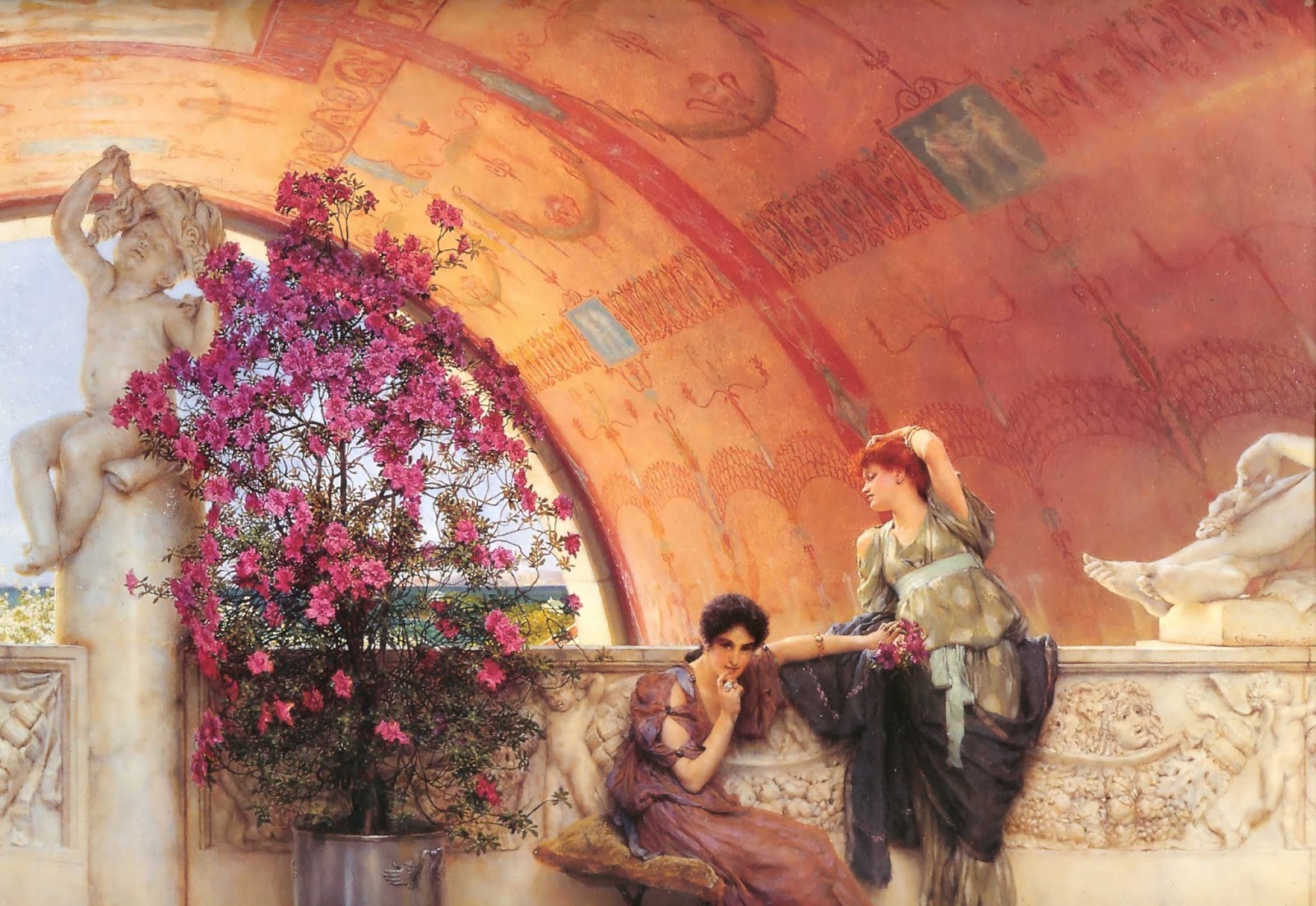
Last November, when AA and I were in Amsterdam, we took a day trip to Leeuwarden to see the new exhibition Alma-Tadema, klassieke verleiding (Alma-Tadema: At Home in Antiquity). My review of the exhibition has just been published in Nineteenth-Century Art Worldwide, which you can read here for free. One painting in the exhibition, that you see above, is Unconscious Rivals, 1893, from the collection of the Bristol Museum & Art Gallery. My own first exposure to Alma-Tadema was through  a reproduction poster of this painting in the mid-1990s, when my mother fell in love with it and we worked together at a framer getting it matted and framed. It thereafter hung in my parents' bedroom for about fifteen years. I was always fascinated by the incredible details in the picture: the glean of the marble benches; the vibrancy of the azaleas; the details in the barrel-vault ceiling. Even more intriguing, however, was the psychological relationship between the two women depicted. I remember my mother and I talking about this when we first saw it, and I think this was the added bonus, in addition to the exquisite details, that sold us on purchasing the poster and framing it.

Regardless of whether or not one likes Alma-Tadema's work, most agree that his attention to detail and ability to paint furniture, drapery, jewelry, architectural settings, etc., are noteworthy. As I write in my review of the exhibition, I was eager to see this particular painting in the show, more so because of my own personal connection to it through that poster. On first seeing Unconscious Rivals in person, however, I admit I was a little disappointed because it is smaller than I had anticipated. This is not an uncommon experience after first engagements through reproductions. But the more closely I examined the painting, the more I could see that it was a jewel of a picture with intricate details like the azaleas, which are almost too hyperrealistic in their depiction.

The scene shows two young women who respond differently to an unseen man with whom each of them, unbeknownst to the other, is in love. (The man, presumably a soldier, is represented by the legs and sword of an ancient statue of a seated gladiator.) This narrative in the picture was part of the tradition of nineteenth-century genre painting, which audiences of the day appreciated and understood well. However, while traditional genre painting offered a moral message, here aesthetics take precedence and the depiction of the two women is more a statement about beauty rather than morality. The viewer (then and now) can identify with them, sympathizing with the shy temperament of the brunette who gazes toward the picture plane with a sheepish smile, or responding sensually to the vivacious red-head (a Pre-Raphaelite trope of the femme fatale) flirting with the lover below the balcony. The painting is a reinterpretation of the allegorical sacred and profane that stretches backward to Titian and forward to Freud. Alma-Tadema’s Unconscious Rivals relies on this form of empathy that transcends time and nationalism to make its point. It appeals to audiences to identify with these women emotionally, regardless if the women or the viewer are ancient Roman, British Victorian, or twenty-first century Dutch or American. It is, indeed, a beautiful painting. You can see more of his paintings, and some gallery views from the exhibition, in my review.

Sunday, August 14, 2016

MWA XLI: Solomon's Song


If it were not for Dinah Roe's post on Twitter, I might have missed today as the 111th anniversary of Simeon Solomon's death in London. Tragically, he died after living in and out of workhouses and on the street, impoverished and in a destitute state, on August 14, 1905, despite having at one time tremendous success as an artist. As discussed and noted on this blog and on the Simeon Solomon Research Archive that I co-manage with Carolyn Conroy, it was after Solomon's arrest in 1873 for homosexual crimes that his public career largely ended, although he did have ups and downs over subsequent decades depending on his health and the support he was receiving from family and friends. A report of the inquest into his death appeared in the Times on August 18, 1905, and reads as follows:
Mr. Walter Schroder held an inquest at St. Giles's Coroner's Court yesterday regarding the death of Simeon Solomon, aged 63, bachelor, an oil-painter, who was described as of the pre-Raphaelite school and at one time an associate of Rossetti and Burne-Jones. Solomon, according to his cousin, Mr. G. J. Nathan, of late years had led an intemperate and irregular life. The witness last saw him alive in May, when he gave him an outfit of clothes and money. He also gave him a commission for a drawing which was never executed. People highly placed in society would have liked him to paint pictures for them, but he could not be relied on to execute any commission. Other evidence showed that Solomon had been "off and on" an inmate of St. Giles's Workhouse during the past five years. On Wednesday, May 24 last, after the visit to his cousin, he was found lying on the footpath in Great Turnstile, High Holborn. He complained of illness and was conveyed to King's College Hospital, whence he was transferred to St. Giles's Workhouse. He was then suffering from bronchitis and alcoholism. He remained in the house, and on Monday morning last suddenly expired in the dining hall from, as Dr. A. C. Allen, the medical officer testified, heart failure consequent on aortic disease of that organ and other ailments. The jury returned a verdict accordingly. It was stated that a picture by the deceased recently sold at Christie's realised 250 guineas and that in former days several of his paintings were exhibited at the Royal Academy.
It's interesting that the author laments that a picture by him had sold recently for 250 guineas at Christie's, considering just last month at the same Christie's, a record was broken when the picture above by Solomon sold for £182,500 ($242,500), the highest price ever paid for one of his pictures. Compared to his contemporaries, the aforementioned Rossetti and Burne-Jones whose works now sell in the millions of pounds, this amount is still a small sum. Nevertheless, considering Solomon was still barely acknowledged as a significant figure in the Pre-Raphaelite circle just fifteen years ago, this shift in the sale of his work is an incredible change in the market and appreciation for his work.

Painted in 1868, measuring 17 x 25 in., entitled A Prelude by Bach, Solomon's watercolor was first exhibited at the Dudley Gallery in London in February 1869 under the more generic title of A Song. It was largely disregarded by critics, the Times dismissing it as "a bevy of young men and maidens in the Watteauish costumes ... grouped round a lady at the piano," suggesting a subject that was either in the spirit of an 18th-century a fete galante or had randy Regency tendencies. Whatever the costumes, the picture seemed to be overtly sensual in its presentiment and lacking in the moral meaning preferred by those critics interested in mid-century Victorian narrative paintings. (To be clear, she is playing a harpsichord, not a piano, a perhaps important historical point if she is playing a Prelude by J.S. Bach.) 

A Song was exhibited with Solomon's (now-lost) Sacramentum Amoris and A Saint of the Eastern Church (Birmingham Museums and Art Gallery, image right), single-figure works that respectively celebrated pagan and Christian rituals, all done in watercolors, a medium with which most always agree Solomon excelled. Both the Saint and the Amoris carry myrtle branches, as does the boy in A Song. Clearly this suggests there was intent to unite them as a trinity with meaning, but that understanding now seems to be lost. Indeed, the problem with A Song at the time of its exhibition was its lack of meaning, either grouped with the other two pictures or on its own. The 1860s were a time of transition in British art, as the radical medievalism and social consciousness of the Pre-Raphaelites evolved into the luscious Venetian colors and subjects of the Aesthetic Movement, subjects and meaning typically dissipated in favor of sheer expressions of beauty. Another key shift in this transition was the merging of the arts so that one form could express that of another, i.e. art with music, poetry with art, music with poetry. This stylistic development appeared not just in Solomon's pictures but also those of his colleagues and friends Rossetti, Albert Moore, and J.A.M. Whistler (think Symphony in White, No. 1). These pictures blended the arts, poetry/music/painting united in subject-less works. Whistler arguably succeeded in this goal more than his colleagues and friends, to the point that he took the critic John Ruskin to court for libel and defended what this aesthetic sensibility actually meant. And yet, after all this time, viewers today still seek out meaning in pictures such as these.

In the 2005 Solomon exhibition catalogue, Colin Cruise argued that A Prelude by Bach echoed the representation of figures in Botticelli's Primavera, with the lady at the harpsichord substituting Venus, and the boy on the left representing Mercury, holding instead of the caduceus a myrtle branch. I'm not convinced this interpretation is completely accurate, because Solomon made a number of pictures throughout his career depicting groups of people arranged as if they were part of a bas-relief, and I'm not sure this one is any different from the others that it is less or more like the Primavera. That said, I do agree with Cruise that the depiction of the two women embracing in Solomon's picture conveys another instance of his exploration of lesbian desire, something he began exploring at least five years earlier with his pictures of Sappho. I would go even further and say that almost all of the couplings depicted in this work exhibit a sense of decadent sensuality. Their lassitude suggests post-coital intercourse, as if listening to the Prelude has somehow satiated their sexual drives. The power of music indeed.

This picture is a simple work upon first seeing it, but gazing at it in more depth, and attempting to read the imagery, symbols, and pairings more closely, it leads to that deeper enigma that one finds in so many of Solomon's pictures. His was a coded language all his own, and one wonders if we will ever be able to fully comprehend all the meaning in his works. Sadly, he died 111 years ago today taking most, if not all, of those secrets with him to his grave.

Saturday, July 30, 2016

MWA XL: Turner's Burning


Few would disagree that one of the greatest painters of the nineteenth century was Joseph Mallord William Turner (1775-1851). An artist who specialized in landscapes that ranged from the classical to the sublime, he so impressed his contemporaries with his work as a young man that he was elected an Associate of the Royal Academy in 1799 and a full member in 1802. He excelled both in oil paintings and watercolors, and could paint in the spirit of the Old Masters while also introducing something new for his own modern world. Later in life Turner was criticized for his eccentricities in subjects and painting techniques, and the recent biopic Mr. Turner reportedly makes him a bit of a bumbling idiot rather than an eccentric painter (I have not seen the movie yet). During the last twenty years of his life he failed to impress most viewers, and he was often derided for his paintings because of their seemingly slipshod compositions and abstractions of color. His one defender late in life was the conservative art critic John Ruskin, who saw in Turner (perhaps surprisingly) the epitome of the principle of "truth to nature." Today, Turner is recognized as a master, and retroactively appreciated as a key figure who influenced many of the modernist tendencies in painting from the Impressionists through Abstract Expressionism.

I've selected as this Monthly Work of Art Turner's painting The Burning of the Houses of Lords and Commons, October 16, 1834, which he painted from 1834-35 and now is in the collection of the Philadelphia Museum of Art. AA and I saw the painting once again on a visit there a few weeks ago, and it still continues to impress me every time. On the night of October 16, 1834, a tremendous conflagration burned down the Houses of Parliament in London. (The neo-Gothic building and Big Ben were the replacement buildings that stand today.) Hundreds, if not thousands, of spectators flocked to the shores of the Thames to watch the massive fire. Turner was among them, and he recorded on the spot a series of watercolor sketches that he later used to create two different oil paintings in his studio. This is one of them; the other is in the Cleveland Museum of Art. All of these works were cleverly brought together in 2007 when the National Gallery of Art in Washington, DC hosted the exhibition J.M.W. Turner. I remember to this day how much I loved this one particular room that demonstrated Turner's understanding of energy and light and color in his watercolors and the oil paintings recording this cataclysmic event.

Christopher Riopelle writes in the PMA's handbook about this painting that Turner watched the blaze from the south bank of the Thames: "Here he exaggerates the scale of Westminster Bridge, which rises like a massive iceberg at right and then on the opposite bank seems to plunge down and dissolve in the blaze. At the dazzling heart of the flames is Saint Stephen's Hall, the House of Commons, while beyond the towers of Westminster Abbey, which would be spared, are eerily illuminated. Turner was drawn to depictions of nature in cataclysmic eruption, and here in the middle of London he confronted a scene of terrifying force and drama that he recorded in several watercolor sketches and two paintings."

Turner's vibrant palette of color and the swirls of energy emanating from the fire make this a magnificent painting. Even the smoke takes on a life of its own as it rushes like a wave into the night sky. One can understand why people today often see Turner as a proto-abstract painter. I am reading at present Jonathan Crary's Techniques of the Observer: On Vision and Modernity in the Nineteenth Century, and a passage recently caught my eye (no pun intended) that made me think of this painting again from my visit to Philadelphia a few weeks ago. Crary's interest in this book is demonstrating how advances in physiology and socio-philosophical theory during the first half of the nineteenth century impacted the world of painting and the development of photography thereafter. Rather than reinforce the paradigmatic argument that modernist painters, from the Impressionists on, were so radical in how they saw the world as artists, he contends that their sense of the world was a natural development because of changes in the understanding of how people actually saw and perceived the world around them through scientific discoveries and hypotheses made earlier in the century. This led some to want to understand the essence of the "innocent" eye, what one sees before the brain interprets the imagery. Crary writes: "Ruskin was equally able to employ [this theory] in suggesting the possibility of a purified subjective vision, of an immediate and unfiltered access to the evidence of this privileged sense. But if the vision of Ruskin, Cezanne, Monet, and others has anything in common, it would be misleading to call it 'innocence.' Rather it is a question of a vision achieved at great cost that claimed for the eye a vantage point uncluttered by the weight of historical codes and conventions of seeing, a position from which vision can function without the imperative of composing its contents into a reified 'real' world." (pp.95-96)

What strikes me is that if we believe Crary's argument (and I confess I am doing a hack job summarizing it; read the book), then why do we have to leave it to the Impressionists in the 1870s to receive the credit for a new interpretation of this understanding of vision? Surely other artists experimented with these discoveries earlier? Indeed, Turner paints what his eye sees, not necessarily a photorealistic representation of what the viewer expects to see. He painted swirls of color as the eye sees them, but before the brain's interpretation of what they are. While this seems most apparent in the color and brushstroke of the background and upper left quadrant, other components of visual acuity are evident here too: the bridge, with its warped foreshortening and perspective. As the eye focuses on the rising flames of orange, yellow, and red, peripheral vision skews the natural alignment of the bridge. Similarly, the people in the foreground along the banks lack any physical features; they are shrouded in smoke and the night sky, and are only visible again in Turner's periphery. This painterly demonstration of what Turner "saw" relates well, then, to Ruskin, who praised Turner for his "truth to nature" approach in his art. It is not so much that his paintings capture a verisimilitude of the landscape; rather, his paintings convey an unadulterated understanding of what his eye saw. Such is the genius of Turner.

POSTSCRIPT 8/6/16: When I wrote this blog post, I was only just more than half-way through Crary's Techniques of the Observer. I should have glanced ahead. In his last chapter, Crary discusses Turner as exactly the prime example of artist who utilized new principles of vision in his art. He discusses briefly two of Turner's paintings from the 1840s that emphasize the vortex of light as their subjects. These paintings and Turner's late color/light-filled experiments are among those works most find inspiring today, largely because of their foreshadowing of abstraction yet to come. But for Crary it was the natural development of the understanding of a subjective sense of vision that made this possible. He writes: "Seemingly out of nowhere, [Turner's] painting of the late 1830s and 1840s signals the irrevocable loss of a fixed source of light, the dissolution of a cone of light rays, and the collapse of the distance separating an observer from the site of optical experience. ... Turner's direct confrontation with the sun ... dissolves the very possibility of representation that the camera obscura was meant to ensure. His solar preoccupations were 'visionary' in that he made central in his work the retinal processes of vision." (138-39) Crary thus utilizes Turner as the grande finale to his thesis. Fortunately, this coincides with my observation above: that one need not wait for the 1870s and the Impressionists to assume that scientific understandings in the subjectivity of vision manifested themselves in art. They were happening simultaneously.

Saturday, February 20, 2016

Art Details: 6 to 10


Image Credits: All images taken by bklynbiblio/Roberto C. Ferrari. Top to bottom:
  1. Dying soldier from east pediment, Temple of Aegina, Greece, late 5th century BCE, marble, Glyptothek, Munich.
  2. Frederic, Lord Leighton, The Music Lesson, 1877, oil on canvas, Guildhall Art Gallery, London.
  3. Jean-Léon Gérôme, Moorish Bath, 1870, oil on canvas, Museum of Fine Arts, Boston.
  4. Claude Monet, Boulevard des Capucines, 1873-74, oil on canvas, Nelson-Atkins Museum of Art, Kansas City.
  5. Botticelli, Madonna of the Magnificat, late 15th century, oil on canvas, Uffizi Gallery, Florence.

Saturday, December 19, 2015

Auction Sales of 2015


Record-high prices from the art auction world continued to astound people this year, even those of us who work in the art industry. Of course, this is in modern/contemporary art, where prices for a handful of artists from the past 140 years (mostly 20th-century) continue to garner often shocking prices in the millions and alter the landscape (no pun intended) in the valuation of art. For instance, in May of this year, Christie's set a new record bringing in for the first time over $1 billion in a single week of sales: $658.5 million from their postwar/contemporary sale and $705.9 million from their 20th-century sale, each a few days apart from one another. Then, in November, Christie's made news with the record-breaking sale of the painting you see above, Amedeo Modigliani's Nu Couché (Reclining Nude), 1917-18. This picture sold for $170.4 million (with fees) to Chinese collector Liu Yiqian, a former taxi-driver, now billionaire, with a private museum in Shanghai. This record-breaker has earned the painting the number 2 spot on the most expensive works ever sold at auction (a Picasso also sold this year as number 1). Now, I like Modigliani's work a lot, but this nude...not so much. These other Modigliani nudes at the Met Museum and the Courtauld (the second one of my favorite paintings of the nude) are far superior in their execution than this one. I also think Modigliani's portraits are hauntingly fantastic, such as this portrait of Paulette Jourdain that sold this year at Sotheby's for $42.8 million (with fees) from the collection of their former CEO A. Alfred Taubman (a highly controversial figure himself). This record-breaking sale of a Modigliani has now effectively escalated the overall appreciation of his entire oeuvre. That may not seem to be a bad thing, because he is a great modernist, but this escalation in value also has skewed the market for his work in a way that costs museums and private collectors more money to insure his art works in their collections. On the surface this may not seem like a big deal, but when museums want to organize exhibitions, it costs them more to ship and insure these paintings, and as a result these costs trickle down to the average museum-goer in the form of higher ticket prices, book and merchandise sale increases, and other costs. The impact factor of these auction sales go beyond what a wealthy Chinese collector is willing to pay for a particular work of art.

Here is my new list of the Top 5 Auction Sales of Works of Art, which is an update of my 2013 post on this with extracted information from sites such as theartwolf and Wikipedia. (Keep in mind that this list is specific to auction sales and does not consider private sales, the most expensive of which is now in the range of $300 million for Paul Gauguin's painting Nafea Faa Ipoipo [When Will You Marry?].)
  1. Pablo Picasso, Les Femmes d'Alger (The Women of Algiers) ['Version O'], 1955, oil on canvas, sold May 2015, Christie's New York, $179.4m
  2. Amedeo Modigliani, Nu Couché (Reclining Nude), 1917-18, oil on canvas, sold November 2015, Christie's New York, $170.4m
  3. Francis Bacon, Three Studies of Lucian Freud, 1969, oil on canvas in three parts, sold November 2013, Christie's New York, $142.4m
  4. Edvard Munch, The Scream, 1895, pastel on board, sold May 2012, Sotheby's New York, $119.9m
  5. Pablo Picasso, Nude, Green Leaves and Bust, 1932, oil on canvas, sold May 2010, Christie's New York, $106.5m

In the world of British art, the picture you see here is of one of the more significant sales this year. The picture (taken by AA) shows me examining John Constable's The Lock, ca. 1824-25, when we visited Sotheby's New York in November to see the exhibition of upcoming works for auction. No, we weren't in the market to purchase it, as its estimate was in the millions of pounds/dollars range. This particular painting was number 5 of 6 in a series of Constable's famous "Six-Footer" paintings, i.e. landscapes that were elevated to the status of history paintings, but lacking a narrative. His paintings changed the history of art from the 1820s on when he exhibited them, as they opened up a new appreciation for the natural landscape as a large-scale, viable subject for artists and collectors. Constable's painting sold at Sotheby's London for £9.1m or $13.7m (with fees). (Note that another version of this same subject actually holds the record for Constable at auction, selling in 2012 £22.4m or $35.2m.). The sale of this painting now means that only two more major works by him are left in private hands.

Also in British art, I was pleased to see that this work, Simeon Solomon's Priestess of Diana Offering Poppies, 1864, which has been on the market and in private sales over the years, sold for £43,750 or $65,800 this past week. This isn't a record for Solomon, as his 1871 oil painting Rabbi Holding the Scrolls of the Law sold for £142,400 or $280,460 in 2006, but this latest sale is a demonstrated strength in the market for Solomon's oeuvre overall. For an artist long-maligned because of his homosexual crimes, Solomon has come into his own as an important figure among the Pre-Raphaelite and Aesthetic artists of the Victorian period, and is now eagerly sought by collectors in this area. (You can see my Solomon blog posts here, and always remember to check the award-winning Simeon Solomon Research Archive which is co-managed by Carolyn Conroy and me.)

To wrap up this auction post, I must comment on what I consider to be one of the most bizarre sales of the year, another painting AA and I had the opportunity to see in person at Sotheby's: Carl Kahler's My Wife's Lovers, 1891. This was a commission to paint San Francisco socialite Kate Johnson's favorites cats from among her 350 of them. I am not making this up. The end result is mind-boggling painting to behold. It measures approximately 6 x 8 1/2 feet in size and is in an incredibly ornate frame. One can appreciate the attention to detail and emphasis on animal physiognomy, Kahler succeeding in capturing the characteristics of each individual cat. But the painting borders on the eccentric. The estimate price was $200,000-$300,000. It sold for $868,000 (with fees). All I keep thinking about this painting is that someone with a lot of empty wall space must really, really love cats. Here is Sotheby's video about the painting, which also shows you how popular in the press the picture was when it was completed almost 125 years ago.

Wednesday, December 2, 2015

Gibson the Designer


One of the articles I have been working on for the past few months has now been published in electronic format. Although e-journals still have not garnered the respectability of print journals, particularly in academia, one of their advantages is that the process of writing to publication is much faster than in the traditional print world. (Indeed, another essay I started on back in 2010 still has yet to be released in print format!) A second advantage, in this particular case, is that the article is freely available to the public and is part of the open-access trend in academia, where few ever receive payment or compensation for their scholarly work. bklynbiblio readers will recall my last post about my article in Nineteenth-Century Art Worldwide, another free, open-access e-journal. This latest article is entitled "John Gibson, Designer: Sculpture and Reproductive Media in the Nineteenth Century" (available here for free) and it has just been published in the December issue of the peer-reviewed Journal of Art Historiography. At 50 pages with 138 footnotes, clearly there was much to say; fortunately, e-journals make it easier to publish lengthier essays. This essay discusses the sculptor John Gibson (about whom I have blogged before) by re-contextualizing his body of work from the perspective of reproduction--the making and dissemination of multiples rather than single, unique works of art. In the nineteenth century, it was more common for artists to make copies and repetitions of works (read the article to discover the difference between copies and repetitions) than it is today, although sculpture by its very nature, as numerous scholars have noted, is a reproductive media and needs to be studied as a multiple, taking into consideration every part of the work in various media. Taking this premise further, I demonstrate in the essay how Gibson emphasized his role as a designer by the mid-1800s, enabling his drawings (but conceptually also his ideas) to be reproduced by others in the forms of porcelain statuary, cameos, and engravings. In emphasizing his role as a designer over that of a sculptor (i.e. a maker just of works in stone), Gibson was able to disseminate his subjects to a wider audience with different socio-economic backgrounds, reinforcing his role as one of the most famous sculptors of the nineteenth century.

Back in February 2013 I had written up MWA XII: Gibson's Cupid. Since then, I have made more discoveries about his sculpture Cupid Disguised as a Shepherd Boy, and these are included in the article as a compendium. This statue was commissioned in marble at least 9 times, making it one of the most popular (quantitatively) of all nineteenth-century sculptures. The image you see above, however, is but one example of a work designed by Gibson but made by someone else, in this case the cameo maker Tommaso Saulini. This shell cameo was produced after 1850 and depicts Gibson's design of Phaeton Driving the Horses of the Sun, the original drawing for which is in the Royal Collection, signed and dated 1850. He also made a marble relief sculpture with the same design for Earl Fitzwilliam, and an engraving was made of this design in 1851. A copy of this cameo was exhibited in London at Saulini's booth at the International Exhibition of 1862, for which the cameo maker won a medal. The subject tells the story of Phaeton, the son of Apollo, the sun god, who asked permission to guide the chariot of the sun across the heavens. Apollo feared for the boy's safety and begged him not to do this, but Phaeton insisted. He did his best to control the horses, but inevitably the boy was unable to handle the reins, and he plummeted from the heavens to his death on earth. For the ancient Greeks this myth taught a lesson about obedience and hubris. For Gibson, the story provided him with an opportunity to depict a dynamic scene and spread the idealism of Greek art to his contemporaries, not through a large sculpture but through a work of art that would have been worn by women in their diadems or comb mounts.

(Image: Phaeton Driving the Horses of the Sun, carved by Tommaso Saulini after design by John Gibson, after 1850, shell cameo, approx. 2 x 4 in., London: British Museum)

Wednesday, September 16, 2015

Elizabethan II Period?

Last week, Queen Elizabeth II became the longest-reigning monarch in the history of the United Kingdom, beating the previous record-holder, her great-great-grandmother Queen Victoria. (Who holds the previous second, now third? Victoria's grandfather, King George III, who reigned from 1760-1820, although the last 10 years he was technically incapacitated and his son ruled as Regent.) After being on the throne now for 63 years and 224 days (as of today, but who's counting?), one wonder if someone should give her reign an official name. After all, cultural historians refer to the Victorian period and the Georgian period, so why not the Elizabethan? Partly because there already was an Elizabethan period when Queen Elizabeth I ruled from 1558-1603 (think Shakespeare). But, in truth, there is much more of a consciousness about the limitation of power and influence Elizabeth II has had on world culture when compared to her predecessors. Nevertheless, she is a stalwart to a sense of traditionalism and nationalism that has made her a historical icon. I think the picture seen here of the Duke of Edinburgh and her together, from when she came to the throne and most recently, was a charming image. (I thought it came from the Guardian newspaper, but now I can't find it again.) If you want to see more of how HRH has changed over time, then you must check out this online photo gallery showing her picture every year from her accession to the throne in 1953 up to now. You must admit, the woman really has the most amazing hats and she knows how to wear them. But that turban in 1975 is just fabulous!

Wednesday, April 29, 2015

Talks in Rome, New York, Oxford, and Pittsburgh


I've just returned from an amazing two-week vacation in Italia, as I mentioned would be happening during my birthday post. I may write about some of the details of that trip if I have time over the next few weeks. For now, however, I wanted to blog briefly about a series of talks that already have, and will take place, over the next few months. I am fortunate to have been invited to give talks in three of these locations, and the fourth was only just announced to me as an acceptance of my conference proposal. It's definitely going to be a busy couple of months!

One of the things I did not mention about my trip to Italia was that I was invited to speak at the Keats-Shelley House in Rome on April 23rd. This fascinating institution on the Piazza di Spagna is set up as a memorial with a library and archive of materials associated with the British Romantic poets John Keats, Percy Bysshe Shelley, and Lord Byron. I gave an hour-long talk there about the life and works of John Gibson, the sculptor about whom I have spoken and published in the past, entitled "From Mars and Cupid to the Tinted Venus: The Sculptor John Gibson and His Studio in Rome." As far as we know, Gibson never met any of these poets in person, but he did know well the painter Joseph Severn, who traveled to Rome with Keats and was with him when he died (and later buried beside him). Like Gibson he remained in Rome for a number of years as an expatriate artist.

Next week, on May 7th at 6:30pm, I am giving a talk at the Dahesh Museum of Art gallery/shop here in NYC, as part of their monthly Salon Thursdays. My talk is entitled "Jewish Artists in Victorian London: Abraham, Rebecca, and Simeon Solomon" and will encompass aspects of the life and times of the Solomons, as well as highlight important paintings from their careers. The image you see above is by the eldest brother Abraham, Second Class, The Parting, 1854, which will be among the works discussed both as a genre painting and part of the contemporaneous interest in that new mass transit invention, the railroad. The talk is free and open to the public. (You can read more about my posts on the Solomons by clicking here.)

Then, in early June, I am giving an invited talk at a conference to be held at the Ashmolean Museum, Oxford University. The conference is about object-centered learning and the use of museum collections in education. (I confess that I cannot find anything online about this, but it is a conference open to registrants, and is scheduled for June 5 and 6.) My paper is yet to be titled, but will relate to the work we have been doing at Columbia using art works for curricular integration, and comes as a nice follow-up to the object-centered symposium we hosted in February this year. I've discovered also that an exhibition of British drawings will be on while I'm there, so I look forward to seeing that.

And, finally, in October, I will be part of a panel session on globalism in 19th-century art at the annual Southeastern College Art Conference (SECAC), to be held in Pittsburgh (their first conference north of the Mason-Dixon Line). bklynbiblio readers may recall that I gave a talk about Gibson and polychrome sculpture at last year's SECAC in Sarasota. This year, however, my paper will be based on a rather new project: the visual culture of Anglo-Persian relations around the time of the Napoleonic Wars. One of the more distinct images associated with this, then, will be the image you see here. This is a portrait of Mirza Abul Hassan Khan (1776-1845), painted 1809-10 by William Beechey. The mirza was the Persian ambassador from the Qajar Shah of Iran to the court of King George III at the time this was painted. The painting is in the collection of the British Library. Here is the brief abstract I submitted for my paper, which will take place in about 6 months from now.

James Justinian Morier and Mirza Abul Hasan Khan:
Anglo-Persian Diplomacy in British Art, ca. 1810-20
by Roberto C. Ferrari, Columbia University

Columbia University’s art collection includes a heretofore unknown 1818 portrait attributed to George Henry Harlow of the writer and diplomat James Justinian Morier (1782-1849) dressed in Persian clothing. The painting seems to falls in line with contemporaneous Orientalist portraits showing Western sitters wearing Eastern garb. However, an exploration into Morier’s life and times shows that this label disregards the painting’s association with the global politics of its day. Indeed, this painting is an important part of the visual culture of Anglo-Persian diplomacy during the Napoleonic wars. Morier is best known today for his Romantic novel The Adventures of Hajji Baba (1824), but he also wrote and illustrated two travelogues (published 1812 and 1818) about his years in Persia as part of a British diplomatic mission.

Equally important in the context of Anglo-Persian diplomacy is a consideration of Mirza Abul Hasan Khan (1776-1845), who in 1809-10 traveled with Morier to England as the Persian ambassador with orders from the Qajar shah to finalize the treaty between the two nations. An exotic arrival in Georgian London, the mirza had his portrait painted by Thomas Lawrence and William Beechey, and he kept his own travel journal known as the Hayratnamah, or Book of Wonders. The mirza’s experiences in London can be seen as a counterpoint to Morier’s life in Persia, an opportunity to understand—and misunderstand—each other’s cultures in the pursuit of diplomacy. This paper will consider these portraits and travelogues as documentation of Anglo-Persian diplomacy in British art during the Napoleonic wars.

Monday, March 16, 2015

Review: Sculpture Victorious

Toward the end of December, I had included in my annual round-up of favorite art exhibitions Sculpture Victorious: Art in an Age of Invention, 1837-1901, aka the long-awaited Victorian sculpture exhibition. It was held in New Haven at the Yale Center for British Art, and currently is on show at Tate Britain. I'm actually a little frustrated because I wanted to see the exhibition again when I go to London in a few months from now, but the show is scheduled to close a week before I arrive. In any case, I'm very glad I had the opportunity to see it in its version at Yale, and I'm pleased to share that my exhibition review in the Spring 2015 issue of Nineteenth-Century Art Worldwide has just been published. This open-access, peer-reviewed journal is free to read, so you can see my review by following this link: http://www.19thc-artworldwide.org/index.php/spring15/ferrari-reviews-sculpture-victorious-art-in-an-age-of-invention.

The image you see above is one of the smaller, technical marvels in the exhibition, a hand-sized figurine of Queen Victoria made by a machine, a work that was but one of the many in the show that celebrated the union of man and technology during the Victorian age. Here is what I wrote about it: "Displayed in vitrines to the left and along the wall [in the entrance] were miniature, mass-produced representations of Victoria available to middle-class consumers, derived from official images of the monarch such as the busts [seen nearby]. One amazing feat of artistic, technical ingenuity, developed early in Victoria's lifetime, was the sculpture-reduction machine. Prototypes had been designed and utilized by James Watt and John Isaac Hawkins, but by 1828 Benjamin Cheverton had launched the most commercially viable machine. His replica of [Sir Francis] Chantrey's bust of the queen, in ivory on a stone socle, measures about 7 inches and dates from 1842. The carving arguably reveals its mechanical origins, but the delicacy in its handling and details is still extraordinary." (Image: Victoria and Albert Museum)

Sunday, March 15, 2015

MWA XXXIII: Millais's Spring


This has been a tediously long, cold winter, and as I think back to January's Monthly Work of Art, Winter by Houdon, it seems only appropriate to shift to the upcoming season of Spring, which we are all looking forward to in the NYC area. As such, the latest MWA is by the Pre-Raphaelite painter John Everett Millais (1829-1896), and is appropriately titled Spring (Apple Blossoms), 1856-59 (image: Lady Lever Art Gallery, Port Sunlight, England). Although we are still officially in Winter, I perceive this painting as positive reinforcement of warm weather on its way. (By strange coincidence, as I'm writing this, I'm drinking Twinings Winter Spice tea, which is described as "a comforting apple flavoured camomile tea spiced with cinnamon, cardamom and cloves." Interesting convergence of associated symbols...)

I first saw Millais's painting a number of years ago when I first visited the Lady Lever with my cousin HA. This museum is not far from Liverpool and has an amazing collection of Pre-Raphaelite paintings (among other great works of art). I also saw this painting in Fall 2007 when the Tate Britain hosted the well-displayed monographic exhibition of the works of Millais, curated by Alison Smith and Jason Rosenfeld. In this painting the delicacy and refinement in the eight young women, their vibrant clothes, their outdoor tea party, and the beautiful flowers and grass about them, all create a Victorian-themed fete-galante. But it is that one young woman in vibrant yellow who stares out both innocently and seductively from the lower right, and it is her presence that makes this painting erotic and disturbing at the same time. I will quote Rosenfeld, whose catalogue entry on this painting reveals all.

This painting was part of a small group of pictures Millais painted "equating new ideas of female beauty with natural and human mortality. Low and wide, they are landscape format, on a large scale. ... The girls pose on a lawn, with a low stone wall separating them from a verdant landscape filled with blooming apple trees. The resulting design is claustrophobic ... and the frieze of colourfully clad girls pushes out of the composition. ... The girl in yellow on the far right, ... posed by Alice Gray [sister-in-law of the artist], lounges on her back, a blade of grass between her lips, and looks out of the canvas in a come-hither pose. ... Only the recumbent girl on the far right looks out at the viewer; she is in a prone position and directly engages the deeper theme of the picture, hence the scythe above her. This traditional memento mori, or symbol of mortality, makes plain the meaning of the picture, that human and natural beauty will fade. The scythe is the farming implement the girls have used to cut their flowers, and also alludes to seasonal transitions, as the blossoms of the trees will ripen into fruit to be harvested. In Spring, the garden wall keeps out the wider world, but only for so long; in this season sexuality comes earlier to some than others, and along with it an awareness of its power. The girl in yellow is 'blooming', a term Millais used in his correspondence of this period to refer to young girls in maturation. ... Ultimately the figure is risque."
-- Jason Rosenfeld and Alison Smith, Millais (London: Tate, 2007), p. 136.

Saturday, December 13, 2014

Art Exhibitions of 2014

Yesterday, I had an opportunity to go to the Metropolitan Museum of Art for a few hours so I could finally see a number of exhibitions they have on at present. I confess I felt rather nostalgic walking through the galleries, remembering fondly my 7 years of having worked there, reinforced by lunch with my curatorial friend JD and coffee with my former library colleagues and friends CD & SP. The current exhibitions are all excellent. The Renaissance tapestry show of the work of Flemish artist Pieter Coecke van Aelst will blow your mind when you turn the corner and see all the gorgeous tapestries installed down a long corridor. Death Becomes Her: A Century of Mourning Attire is luxurious and fascinating for what could be a morbid topic. The room-installation of Thomas Hart Benton's 1930-31 mural America Today is amazing--you can almost hear jazz playing as the characters sway from one American scene to another. But the greatest part of my day was the exhibition on the Venetian sculptor Tullio Lombardo's Adam, seen here, fully restored. In 2002 the pedestal for the sculpture collapsed and, horrifyingly, the ca.1490-95 sculpture shattered. After 12 painstaking years of intensive study, and utilizing new technologies, the object conservators were able to restore this life-sized statue to near-perfect condition. The sculpture is an exquisite piece, clearly an influence on Michelangelo's David, and important as an early idealized male nude sculpture in Renaissance art. The videos on the website and in the gallery amaze you to see how they successfully conserved and restored the sculpture.

This year the best exhibitions for me were all on sculpture. In addition to the Adam just mentioned, the Met put on two excellent sculpture exhibitions. One was on the works of Jean-Baptiste Carpeaux (1827-1875), who reinvigorated French sculpture during the Second Empire with a Baroque-style energy that excited and scandalized people of the day. Running earlier in the year at the Met was another sculpture exhibition, The American West in Bronze, 1850-1925, an excellent show that aesthetically changed one's mind about works you once might have considered to be little more than living room kitsch. At Columbia's Wallach Art Gallery, a great sculpture show was put on about Anna Hyatt Huntington (1876-1973), about which I blogged here. Finally, at the Yale Center for British Art, the long-awaited Victorian sculpture exhibition there brought together about 130 works that changed one's mindset about what defines sculpture and how it can be made. The show also demonstrated the power of the curatorial eye with a fine selection of finely-crafted statues, reliefs, and decorative objects in an array of media. The first work one encountered in the exhibition, as seen in my photo here, exemplifies the surprises of the show. This is a Minton ceramic elephant measuring 84 inches in height, part of a pair, that was first exhibited at the 1889 Exposition Universelle. I have a review of this exhibition being published in the spring, so I will share more when it comes out, but for now, here is what I wrote about this gorgeous majolica elephant: "The elephant reveals a high degree of craftsmanship that demonstrates the successful union of man and industry, but it also has a deeper meaning. Displayed as part of a cultural parade, its empty howdah decorated in Mughal textile designs and awaiting a royal occupant, the tamed elephant represents the jewel in Queen Victoria’s crown: India and all its riches. This work in the foyer thus foreshadowed others in the galleries of Sculpture Victorious: masterpieces of human and industrial design, and socio-political symbols of the British Empire."

If I had to choose my favorite exhibition of the year, however, it would be, without a doubt, Kara Walker's sugar-sculpture installation at the Domino Sugar Factory in Williamsburg, Brooklyn: A Subtlety: or, the Marvelous Sugar Baby. Walker is one of my favorite contemporary artists, and in this work she went beyond anything she had done before. Commissioned by Creative Time as a temporary installation, before the building was scheduled to be demolished, Walker designed a massive, sugar-coated, sphinx-like creature with the body and facial features of an "Aunt Jemima" type, to remind visitors of the intricate ties between the West's love of sugar and its intertwined history of slavery. The work was powerful and had lines of people waiting to get in. A group of friends of mine all went together to see it in June, and we were mesmerized. There are numerous images online that people took, so I'm only sharing here one I took to show the scale of the sculpture in the warehouse and the diminutive nature of the people around it. As time passed, the sugar gradually changed color, and the surrounding molasses "little black Sambo" boys melted and fell apart. After you were in the warehouse a while, the smell of the sugar and molasses became so sickeningly sweet you had to leave and get fresh air. This was all part of the artist's intent, to create a temporal, multi-sensory sculptural environment. When the show closed, most of the sculpture was destroyed (what had not disintegrated on its own already), although there is at present at Sikkema Jenkins an after-show that exhibits her sketches and designs, and an arm Walker kept as her own personal souvenir. This sculptural installation was truly a tour de force of artistic achievement, for the artist and the audience.

Aside from sculpture exhibitions, one major art exhibition highlight for me was Golden Visions of Densatil: A Tibetan Buddhist Monastery at the Asia Society. This historical monastery and its Buddhist treasures was constructed in the 12th century but destroyed during China's Cultural Revolution. The installation included discovered and recovered treasures alongside historical photos, but the most amazing part of this exhibition was having the opportunity to witness the monks make a sand mandala. This was an ongoing event for 5 days with 5 monks. You would expect it to be solemn, quiet, and peaceful. On the contrary, the monks were very engaging with visitors, including taking photos with them. They often laughed too, but then quickly would return to their back-breaking, eye-straining work of constructing this mandala. The most amazing moments were when they would help one another, knowing that one had more expertise than another, and they could share in the responsibility of building this sand mandala together. Their humanity made this a very spiritual experience. You can watch a great time-lapse video of them making the sand mandala here.

Other exhibitions from this year worth noting included:
** Pre-Raphaelite Legacy at the Met Museum, a small but groundbreaking show for them to finally acknowledge the accomplishments of these Victorian artists;
** Beauty's Legacy: Gilded Age Portraits in America at The New-York Historical Society, about which I blogged here;
** At the Guggenheim Museum, the fantastic multi-media exhibition on Futurism, Italy's modernist art movement, and the riveting photographs of African-American feminist artist Carrie Mae Weems;
** Florine Stettheimer at the Lenbachhaus in Munich (although I guess technically I have only seen it "in process" and will have to wait until early January to see the final, full exhibition!);
** And my dear friend and colleague Meera Thompson at Atlantic Gallery.

I would be remiss if I forget to mention my own two small, curated exhibitions--15 Minutes: Andy Warhol's Photographic Legacy and Off the Grid: Beyond the Noise--both of which I thought were rather well done...if I may say so myself.

UPDATE (12/14/14): One of the blockbuster exhibitions of the year, that previously had opened in London and is now on here in NYC is Henri Matisse: The Cut-Outs. Everyone I know who has seen it loves the show, and it has been on my "must see" list, but I dread going to MOMA because of the crowds so I wasn't sure what to expect. Fortunately, AA and I decided to make the trek there today and it actually wasn't as bad of a crowd as I anticipated. The exhibition is very good, demonstrating well how Matisse used paper cut-outs and collage as a form of painting unto itself. It is a smart show about materiality, color, composition, and artistic technique. We also had a chance to pop into the Robert Gober exhibition. He is one of those contemporary artists I typically don't appreciate much, but this retrospective helped change my mind a bit with his theme-and-variation sculptural objects and large-scale installation spaces. It was all rather tongue-in-cheek and clever, I must say, so I do have a better appreciation for Gober now.

Sunday, November 23, 2014

Fanny Eaton: The "Other" Pre-Raphaelite Model

Art historians and lovers of the Pre-Raphaelite painters and their works know well the names and lives of many of the female "stunners" (as they called them) who modeled for them. These include names like Lizzie Siddall, Jane Morris, Annie Miller, Keomi, Maria Zambaco, and so on. But another model about whom little historically has been known, yet who frequently appears in Pre-Raphaelite art from the late 1850s through the late 1860s, is Fanny Eaton (1835-1924). Born in Jamaica the daughter of a former slave, Eaton is a fascinating study in the art and social politics of Victorian Britain. Her mixed-race identity allowed her to be an exotic in the theatrical sense, enabling her to be depicted in different cultural roles in a number of their paintings. The image you see above is by Joanna M. Boyce Wells (1831-1861). It is a portrait study of Eaton dated 1861 that was meant to be a larger work of her depicted as a sibyl, had the artist not died suddenly (image: Yale Center for British Art). The image below shows Eaton as an Indian ayah in Rebecca Solomon's A Young Teacher, also 1861 (private collection), about which I have blogged before (see my post here).

I am pleased to announce that my article about Eaton, discussing her life and her role as a model, has been published in the Summer 2014 issue of the PRS Review, and the response so far from has been quite positive, leading to the discovery in private collections of a few heretofore unknown drawings depicting Eaton as a model, and a number of "retweets" and "favorites" on Twitter. I have now uploaded a PDF version in the Academic Commons of Columbia University Libraries, so it can be downloaded and read for free by all (available here). I owe Brian Eaton, great-grandson of the model, my gratitude for sharing with me his family research material and for supporting my article on his great-grandmother.

My interest in Eaton stems from her role as a model for Simeon Solomon, most notably his painting The Mother of Moses, 1860, about which I spoke at the Pre-Raphaelitism: Past, Present and Future conference at Oxford University in September 2013 (see blog posts here and here). Biographer and curator Jan Marsh previously had written about Eaton in her Black Victorians exhibition catalogue, and has added a few updates on her blog as well (here and here), the latter highlighting a newly discovered drawing of Eaton by the little-known artist Walter Fryer Stocks. I am hopeful that my article will continue to help increase the identification of Eaton in the works of these and other artists, but more importantly will add to the important dialogue about the role of blacks, slavery, and cultural diverse during the global 19th-century world.