Showing posts with label Roman. Show all posts

Sunday, April 2, 2017

MWA XLVII: Alma-Tadema's Rivals


Lawrence Alma-Tadema (1836-1912) is considered by most to be a British artist, but in fact he was born and raised in The Netherlands and did not emigrate to London until 1870. He was then a widower with two daughters trying to make a bigger name for himself in the commercial art capital of Britain. He succeeded, becoming one of the greatest names associated with the Aesthetic Movement, his London home a salon for artists, writers, musicians, composers, and actors to socialize and exchange ideas. His second wife and daughters were all painters too. What people love about Alma-Tadema today was his uncanny ability to capture imaginatively Greco-Roman lives from over 2,000 years ago as if they were people we saw in our daily lives today (or, for his contemporaries, in Victorian times). His critics, however, have a tendency to refer to his paintings pejoratively as nothing more than "Victorians in togas."

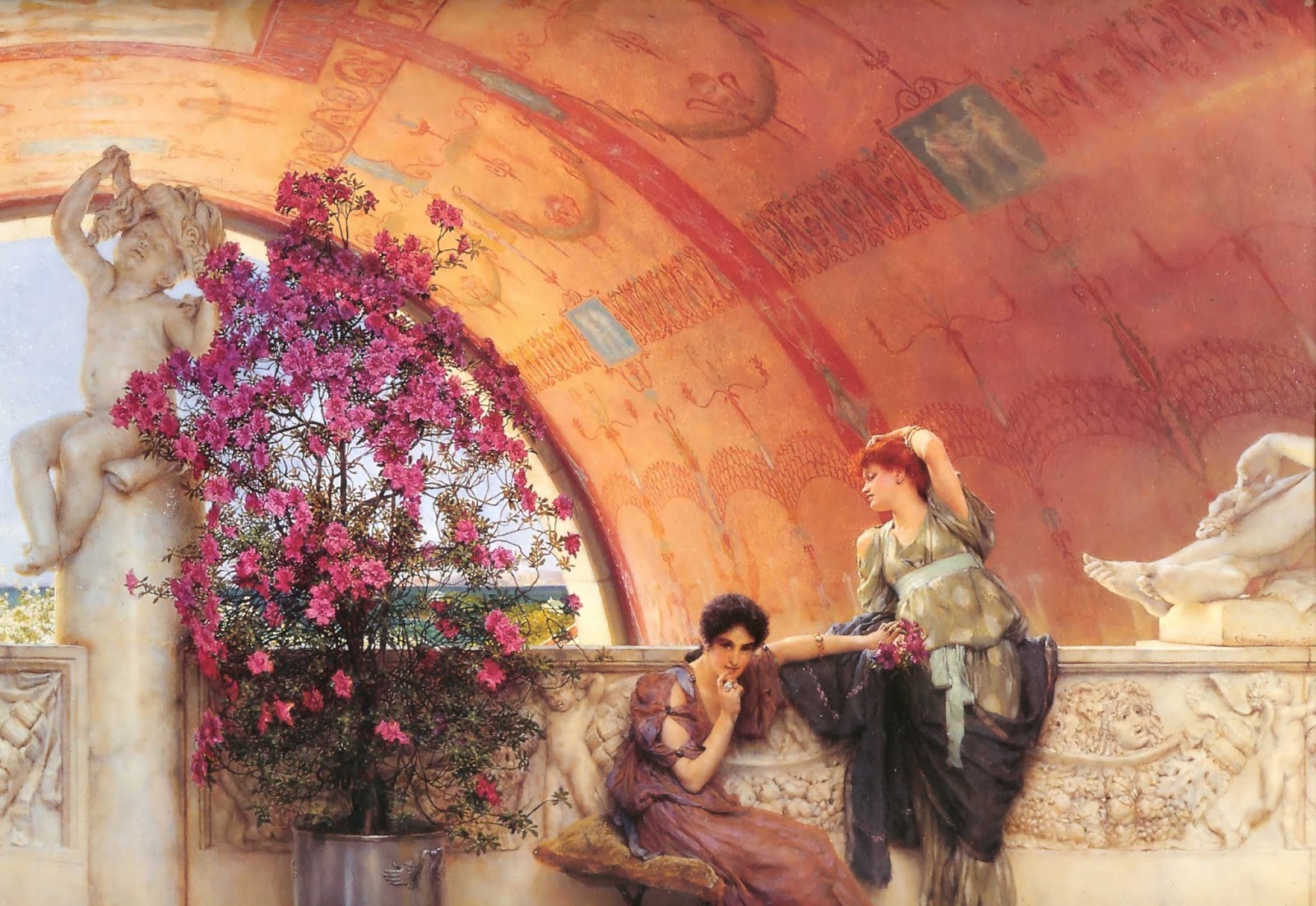
Last November, when AA and I were in Amsterdam, we took a day trip to Leeuwarden to see the new exhibition Alma-Tadema, klassieke verleiding (Alma-Tadema: At Home in Antiquity). My review of the exhibition has just been published in Nineteenth-Century Art Worldwide, which you can read here for free. One painting in the exhibition, that you see above, is Unconscious Rivals, 1893, from the collection of the Bristol Museum & Art Gallery. My own first exposure to Alma-Tadema was through  a reproduction poster of this painting in the mid-1990s, when my mother fell in love with it and we worked together at a framer getting it matted and framed. It thereafter hung in my parents' bedroom for about fifteen years. I was always fascinated by the incredible details in the picture: the glean of the marble benches; the vibrancy of the azaleas; the details in the barrel-vault ceiling. Even more intriguing, however, was the psychological relationship between the two women depicted. I remember my mother and I talking about this when we first saw it, and I think this was the added bonus, in addition to the exquisite details, that sold us on purchasing the poster and framing it.

Regardless of whether or not one likes Alma-Tadema's work, most agree that his attention to detail and ability to paint furniture, drapery, jewelry, architectural settings, etc., are noteworthy. As I write in my review of the exhibition, I was eager to see this particular painting in the show, more so because of my own personal connection to it through that poster. On first seeing Unconscious Rivals in person, however, I admit I was a little disappointed because it is smaller than I had anticipated. This is not an uncommon experience after first engagements through reproductions. But the more closely I examined the painting, the more I could see that it was a jewel of a picture with intricate details like the azaleas, which are almost too hyperrealistic in their depiction.

The scene shows two young women who respond differently to an unseen man with whom each of them, unbeknownst to the other, is in love. (The man, presumably a soldier, is represented by the legs and sword of an ancient statue of a seated gladiator.) This narrative in the picture was part of the tradition of nineteenth-century genre painting, which audiences of the day appreciated and understood well. However, while traditional genre painting offered a moral message, here aesthetics take precedence and the depiction of the two women is more a statement about beauty rather than morality. The viewer (then and now) can identify with them, sympathizing with the shy temperament of the brunette who gazes toward the picture plane with a sheepish smile, or responding sensually to the vivacious red-head (a Pre-Raphaelite trope of the femme fatale) flirting with the lover below the balcony. The painting is a reinterpretation of the allegorical sacred and profane that stretches backward to Titian and forward to Freud. Alma-Tadema’s Unconscious Rivals relies on this form of empathy that transcends time and nationalism to make its point. It appeals to audiences to identify with these women emotionally, regardless if the women or the viewer are ancient Roman, British Victorian, or twenty-first century Dutch or American. It is, indeed, a beautiful painting. You can see more of his paintings, and some gallery views from the exhibition, in my review.

Saturday, April 7, 2012

MWA II: Vatican Shepherd

Following up on last month's Tulips in a Vase by Paul Cézanne, I've decided to select as the second MWA (Monthly Work of Art) the statue you see here, The Good Shepherd, from the collections at the Vatican Museums. The statue is 39 1/8 in. in height, carved from marble, and dates from the late 3rd century. Scholars refer to this period as Late Antiquity to distinguish it from the heyday of classical sculpture, such as 5th-century B.C. Athens or early 1st-century Imperialist Rome. The implication is that the quality of this work is less impressive than these early masterworks, and it borders on the beginning of the medieval period (no one says "Dark Ages" anymore). This is the time when Christianity had spread far and wide through the Roman Empire. Emperor Constantine converted to Christianity in 312, then issued the Edict of Milan the following year, effectively ending the persecution of Christians. Hence, art from this period reflects a growing interest in Christian subjects, but it has similarities to ancient Greco-Roman precedents. For instance, this shepherd bears some resemblance to figures of the sun god Apollo, with his youthful facial features and curls of hair. Iconographically, however, the statue traditionally has been interpreted by Christians as representing Christ and his parable of the Good Shepherd, who abandons seeks out the one sheep who is lost and return him to the flock (Matthew 18:12-14; Luke 15:3-7; John 10:11-16). Of course, shepherds were a relatively common appearance in Greco-Roman art, so the figure was simply adapted as a Christian icon.

It may seem as if I've chosen this work as April's MWA because tomorrow is Easter. In fact, this statue has had great meaning for me most of my life. Art historians often reflect about the work that first inspired them to pursue the study of art. For me, it was this statue, and it makes me realize how I've come full circle in many ways, specializing in sculpture as I am. In 1983 this statue and numerous other works traveled to The Metropolitan Museum of Art here in NYC for a special exhibition entitled The Vatican Collections: The Papacy and Art. The Pater and the Mater took me to see this show. It was my very first trip to an art museum, and I am almost positive that we went because it was my 13th birthday. I don't know why I would have known about the show, but I suspect the nuns in my school probably encouraged us to see it. I remember being completely overwhelmed by the beauty of the Met building, and I remember waiting on a long line to see the show. But in going through the rooms of Vatican art from ancient through modern periods, it was this statue that left its mark on me. One would think it might have been the Apollo Belvedere or some other magnificent ancient statue on display, but I suspect I may have been bashful about that work's provocative nudity. Instead, The Good Shepherd resonated with me as an adolescent, interested at that time in my Catholic faith, and from birth always instinctively interested in caring for animals. I simply loved how he carried over his shoulders his lamb as a pet with such genuine concern. He was a savior for both humans and animals.

Curiously, I've been to the Vatican Museums twice, and I cannot recall ever seeing this statue there. In looking up more information about it, I was surprised to discover that most of it is 18th-century restoration work, although his torso and upper body and head, and most of the lamb, are 3rd century. I didn't realize that it may have been part of a column or a segment from a high-relief sculpture either. And looking at the work now in reproduction, I cannot say that it is an exquisite work of art, certainly nowhere near as idealistically beautiful as the Apollo Belvedere. This just may be one of those moments where you can never return home again. But maybe that's okay. My memory of the statue and first encountering it led me on a path that has taken me to where I am today. It is my statue, fragmented and restored, misinterpreted and misunderstood. In short, it is human in its most natural, imperfect way.

Thursday, August 20, 2009

Vespasian's Villa

Ever since Heinrich Schliemann claimed to have excavated the historic Troy of Homer's Iliad in the early 1870s, there has been a neverending determination to prove that archaeological sites are connected with famous people. Some of course have been incredibly significant. Howard Carter's discovery of the tomb of Tutankhamen in 1922, or the discovery of the terracotta army of China's first emperor Qin Shihuangdi in the 1970s, would both count as important finds with historical veracity. But then there have been the bogus claims. A few years ago, archaeologists were debating over the veracity of the so-called sarcophagus of a brother of Jesus of Nazareth; the sarcophagus turned out to be a hoax. Watching the Discovery Channel heightens these expectations when they show eye-catching documentaries with historic recreations and computer reconstructions, and they announce revelations such as that the Egyptian pyramids weren't built by slaves or aliens, but in fact were built by slaves AND aliens working together in a proto-utopian desert paradise! The rush to claim authenticity continues. About two weeks ago, news broke on NPR and other news agencies that archaeologists claimed to have discovered Vespasian's country villa northeast of Rome. Vespasian, seen here in a cast of a naturalistic portrait bust from the Pushkin Museum after an original marble at the Louvre (image courtesy of Wikipedia), was an emperor of ancient Rome who established the short-lived Flavian Dynasty. He came to power in the year 69 and was responsible for cleaning up the mess left by crazy Nero. Vespasian ordered the construction of the Colosseum, but he died in 79 before it was completed. The uncovered summer villa in the countryside was large: 161,459 square feet in size. Archaeologists have excavated evidence of highly decorative mosaic floors, baths, and marble halls. Certainly it demonstrated a show of wealth. But as Filippo Coarelli, the archaeologist of the University of Perugia who has led the excavation, told Discovery News, "We found no inscription that says it belonged to the emperor, but the location, dating, size and quality of the building leave little doubt about its owner." And that apparently is the problem. Mary Beard, Professor of Classics at Cambridge University, has been vocal in denying the attribution to Vespasian. In a recent blog post ("Vespasian's villa? Don't you believe it"), she wrote quite adamantly, "It's just a large Roman house of roughly the right date in roughly the right place." In short, it's a coincidence. She also laments the ongoing desire for some archaeologists to glamorize their finds: "As usual a combination of fantasy and wishful thinking has driven this non-story. ... After all the 'advances' in archaeology, and what it can tell us about the ancient world, are we still looking for a 'Vespasian lived here' spot?" I think she has a point, but let's face it, no one outside of academia cares much about the discovery of some unnamed villa. Throw something like Vespasian into the mix and the exoticism of his name alone opens the ears--and wallets--of people outside the academic ivory tower. (Beard has written numerous books on ancient Rome; she is the co-author with John Henderson of Classical Art: From Greece to Rome, a fantastic book about Greco-Roman art and its legacy through the late 19th century.) I've always been fascinated by archaeology and I would love to participate in a dig. Maybe then one day I'll be able to say, "I've found the ancient brothel where Caligula first lost his virginity!"