Saturday, October 30, 2010

BQH Conference Recap

The image you see here is a portion of a surviving manuscript from 1516 in which one Christopher Hewitson of Over Poppleton, England (near York) was accused of the “detestable sodomitical sin against human nature” with a number of men over a 14-year period. The manuscript is held by the Borthwick Institute for Archives at the University of York. You can read more here about Hewitson, the people called to testify against him with regard to the sexual acts performed, and his penance, walking in procession around church during services wearing a sheet over his head. Hewitson’s case was discussed in detail and analyzed in the context of social history and sexual practices at the time by Derek Neal (Nipissing University) at the recent British Queer History Conference I attended at McGill University the weekend of October 14th. Aside from my ambivalence about Montreal itself, the conference did have some interesting presentations, the Hewitson case being one of the most informative.

The conference began with keynote speaker Jeffrey Weeks’s presentation “Queer(y)ing the ‘Modern Homosexual,’” which was a historiography of the evolution of gay and lesbian history and queer theory, with a particular emphasis on what he has labeled Queer 1 (pre-Stonewall), Queer 2 (queer theory), and Queer 3 (present-day conflated sexual identities). Weeks is a pioneer in the field of gay and lesbian history, and his book Coming Out: Homosexual Politics in Britain from the Nineteenth Century to the Present (1977) was an excellent introduction when I read it more than a decade ago. What startled me, however, was that there were nearly 300 people in the room to hear his talk, and it made me realize how relevant and important this area of study still is for people.

Derek Neal’s talk I’ve already noted, but what was interesting to me was how a panel session on medieval Britain could turn out to be one of the most interesting. Nancy Partner (McGill) discussed the reception of John Boswell’s groundbreaking book Christianity, Social Tolerance, and Homosexuality: Gay People in Western Europe from the Beginning of the Christian Era to the Fourteenth Century (1980), noting how the development of queer theory as a form of literary analysis actually relates to Boswell’s work, despite the criticism by social constructionists of his work as essentialist, because of his focus on textual analysis, and how this revised understanding of his work can help medieval scholars work on queer topics today. The third (provocative and hilarious) paper by Karma Lochrie (Indiana) dealt with pilgrimage badges from ca.1400 that showed sexual genitalia in anthropomorphic form, such as penises carrying a vaginal figure on a dais. She considered them as objects with both spiritual and satirical elements, comparing them to religious icons and rituals from this time.

Matt Cook (Birkbeck) spoke about the late Victorian Aesthetic couple Charles Shannon and Charles Ricketts, and Morris B. Kaplan (SUNY Purchase) discussed Sir Edmund Trelawny Backhouse’s queer adventures in the Far East. Amy Tooth Murphy (Glasgow) gave a fascinating presentation on her work conducting oral histories of lesbians after World War II, playing some of the recordings of the women’s experiences during her talk. Will Fisher (Lehman) talked about the popularity of what he calls “thigh-sex” in 17th-century English literature. Katie Hindmarch-Watson (Johns Hopkins) spoke about the homosexual prostitution underworld of London telegraph boys in the 1870s. Finally, David Minto (Yale) discussed the global impact of the Wolfenden Report, which led to the nationwide decriminalization of homosexuality in the UK in 1967. There were plenty of other talks; you can see the whole program here.

As for the panel session I had organized, Carolyn Conroy unfortunately could not make the conference, so I read her paper for her on Simeon Solomon’s 1873 arrest for attempted sodomy. My own paper on John Gibson, the Duke of Devonshire, and queer art patronage seemed to be received well, although it seemed to be an area (art) in which many of those present were less familiar. Jongwoo Kim’s (Louisville) paper on Henry Scott Tuke and social realism, however, was very well received, I believe because of the modern implications of his work and the interest of the historians and sociologists in the room. All in all the conference was interesting and I am glad I went, but being there made me realize more than ever before that, while I have an interest in gay cultural history, I am nowhere near as committed to the debates surrounding the social construction of queer identities as these people are. They can argue those issues all they want. I prefer to focus on art.

Thursday, October 28, 2010

50 UK Days: Week 2.5

I took an opportunity this past Monday to stroll through the Leeds Art Gallery. I had been wanting to do this for quite some time, because they have a few important Victorian paintings by artists like Holman Hunt, Waterhouse, and Leighton. Alas, work by the first two was not on display, but Leighton’s painting Persephone, 1891, was, which I was glad to see. However, the picture that struck me most was the one you see above: Retribution by Edward Armitage, 1858 (image: romanticism-in-art). The painting is larger than life in size. On first examination, even in digital form, one might find it somewhat bizarre. A fierce she-man is about to slay a tiger, while a woman and child lie dead in the foreground near an open Bible, and another woman looks on from behind waiting to be rescued. In the background are palm trees and, behind the main figure, a domed building that resembles the Taj Mahal. The juxtaposition of Western classicism with Eastern exoticism tells you this is a painting about Western colonialism. Indeed, anyone who is familiar with Edward Said’s book Orientalism or Linda Nochlin’s essay “The Imaginary Orient” would be quick to point out that this picture shows the oppression of the East. The date and title of the picture, however, tell you much about its historical origins. In 1857 the Sepoy Rebellion in India led to a massacre of numerous British women and children affiliated with the British East India Company. Their bodies were violated, dismembered, and tossed into wells. This shocking news of barbarism led to the immediate governmental order to suppress the rebels and overtake the country. It was then that India officially was annexed by the British Empire, and subsequently led to Queen Victoria being named Empress of India in 1876. This painting then admittedly can be seen by us today as Orientalist oppression, but in its day it was a symbol of patriotism. The she-male is Britannia, the allegorical representation of the British Empire, and the tiger, fear now evident in its eye, is India, aware of its impending demise against the British. The picture was intended for a British public angry about the treatment of its people by an inferior, savage race, and were determined to exact retribution. A picture like this easily could be dismissed by viewers today as melodrama or kitsch, but in fact the story behind it demonstrates how powerfully political a painting could be then, and how its message can still resonate today.

In an inversion of the West-East divide, I went to a talk on Wednesday evening given by artist Marie Redmond, whose work has been influenced by Japanese Ukiyo-e prints. Redmond is a graduate of the School of Art in Glasgow (as a native Scot, her accent was so strong I had to listen very closely for the first few minutes until I became accustomed to it!). Redmond has a few pieces in the current exhibition Undone at the Henry Moore Institute. Now, as bklynbiblio readers know, I’m not typically a fan of contemporary art. I’ve been known, in fact, to call it on more than one occasion Self-Indulgent Crap. I freely admit, however, it’s because I don’t “get” it, and I do believe many of these artists are purposely ridiculing us Philistines for attempting to appreciate the idea behind their art-capital-A (call me cynical). However, I have a much greater appreciation for—and can even say I like—contemporary artists whose work connects with the art historical past or relates to the presence of the body (e.g. see my laudatory reviews on Yinka Shonibare and Marina Abramovic). Redmond explained how “The Floating World,” Japanese Ukiyo-e and Shunga (erotic) prints, influenced the making of her art. She discussed how issues of viewing (peeping/spying), interiors/exteriors, gender, and bodily forms (e.g. kimonos as sculptured objects) inspired her in the creation of specific sculptures. Her art is comprised of both found everyday objects, from corrugated metal to bamboo, and crafted objects, such as tie-dyed fabrics. What struck me as she spoke was that even though the physical body as one perceives it in Japanese prints does not appear directly in her sculptures, the suggestion of bodily presence is seen through the arrangement of the objects, and narrativity become apparent through her titles and use of specific materials. One reviewer of her work (Sarah Lowndes) described it as “stories masquerading as objects,” which I think is apt, especially when you see how she installs it in a gallery space. The pathway that is created through and among each of the objects makes you realize that they are like chapters in a story unfolding spatially around you. It many ways it is not unlike Japanese prints or Chinese scroll paintings, which are unfolded or unrolled, giving you bits of a story, and inviting you to continue to the next stage. Redmond is represented by The Modern Institute, but you can see a few images of her work when she won the 2009 Paul Hamlyn Foundation Award. Considering the picture we began with, I couldn’t help but close with one of the more titillating Shunga prints Redmond showed us, an amusing erotic scene entitled Woman Holding Umbrella Throwing a Snowball from Outside at Lovers in an Interior by Suzuki Harunobu, from about 1765-70 (image: British Museum). And, yes, they are doing what you think they’re doing.

Sunday, October 24, 2010

50 UK Days: Week 2

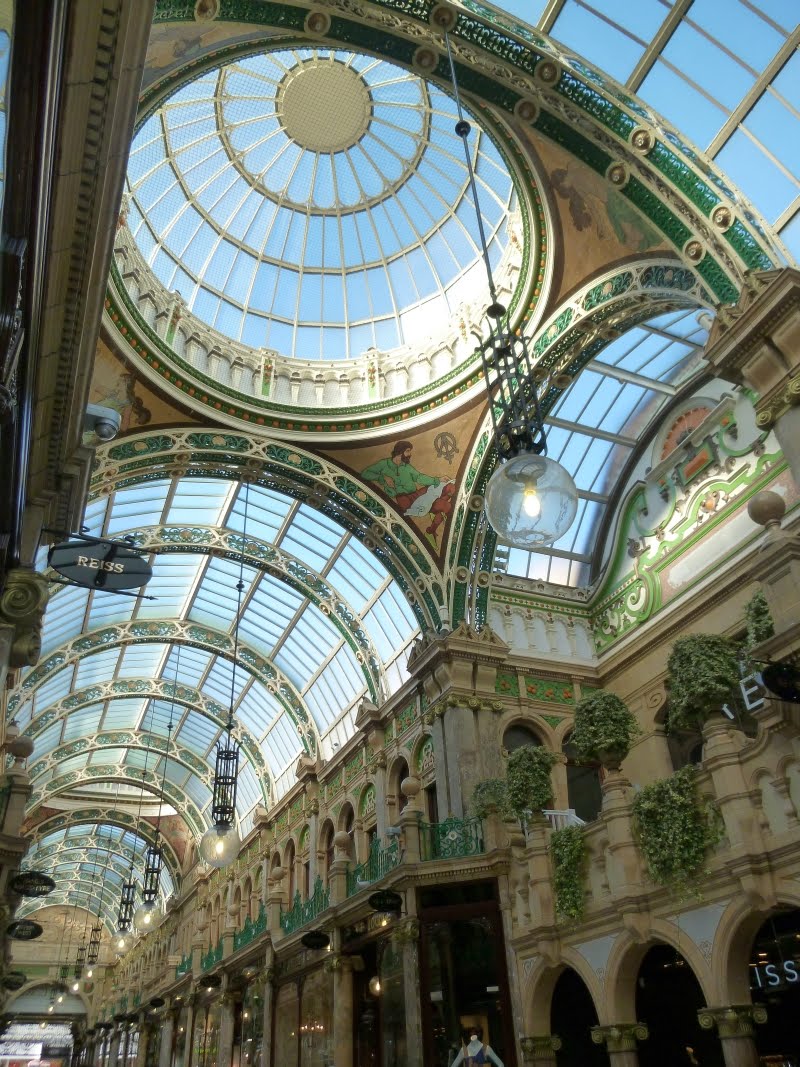
It’s natural to assume that northern England would be grey and overcast this time of year, so imagine my surprise today when the sun was shining so brightly that I needed to wear sunglasses. It was hardly cold, about 7 degrees Celsius (I’m working on my conversions; that’s mid-40s Fahrenheit). It was a perfect day to stroll through Leeds and take pictures. Here is a link to my photostream of architectural facades and other views in Leeds. The picture you see here is just one example of the exquisite Victorian architecture that still flourishes here. It is the glass-and-iron ceiling of County Arcade in Victoria Quarter, an enclosed shopping district designed by Frank Matcham in 1900. It houses today some rather posh shops. In some ways, the city center of Leeds seems like a giant shopping mall. There are numerous department stores and boutiques everywhere, and more than 1 million square feet of new retail space is under construction. But if you’re looking for “ye olde shoppes” that conjure visions of the medieval past, you need to go to a tourist-like town such as York. Here things are more working- and middle-class capitalism. I only wish it was more culturally diverse (too many white people!). There’s certainly more to explore and discover in Leeds though, including areas by the University and near Clarence Dock, so I’m sure I’ll have more to say in the weeks to come.

Despite my fascination with this city so far (and England in general), I’ve had more than one reminder this week that not everyone is as regal as Queen Elizabeth II. Perhaps the most noticeable thing is the number of people who drink at the pub. Now, don’t misunderstand me, I have nothing against having a pint at the pub. I’ve already done it myself more than once since I’ve been here (including having had a few during a burlesque show for a charity event, but I digress). I can understand why people drink here. It’s so cold, damp, and grey for most of the year, drinking probably helps warm (if not numb) the body. My cousin SG in Milano used to live in London and, as much as she loved it, she once told me she couldn’t understand why the English were always drunk (because Italians, as you know, never get drunk). Public drunkenness does seem to happen a lot here and, worse, seems to be tolerated in a way I don’t think I’ve ever seen in New York. I’m sure my English friends who read this will object to what I’m writing (some in fact may point out the recent deathly hangover I suffered while I was with them in New York last month, but again I digress). Consider, however, a few things that have happened to me in the past week alone related to this. I have witnessed someone vomiting in the street, I have had someone slam into a window and scream at me while I was eating dinner at GBK (Gourmet Burger Kitchen…amazing burgers & fries, by the way), and I have watched a crew of people stumble through the train and fall into one another, this last occurrence taking place last night as I traveled back from York. The highlight of that train ride, however, was when a young women sitting 2 rows behind me kept wailing at her boyfriend in tears wanting to know why he treated her so badly, especially with (and I quote) “me carryin’ ya baby in me belly!”, to which he kept telling her to fuck off and leave him alone, that he “weren’t cheatin’ on her!” Between their harsh working-class accent and their slurred drunkenness, it was worse than an episode of Jerry Springer. Yes, the American South isn’t the only place where there is white trash. I finally got up and moved to another part of the train. Interestingly, 4 other people followed me, as if they were waiting for someone to make the first move. Leave it to the New Yorker to lead the pack!

Saturday, October 23, 2010

Cooper & Gaga in London

I couldn't resist posting the above picture. Ultra hottie Anderson Cooper tweeted this a few hours ago, showing him and Lady Gaga in a pub in London. He's doing a series of interviews with her for 60 Minutes...no word yet when it will air though. Now...you think they'll make it up to Leeds for a pint???

Thursday, October 21, 2010

50 UK Days: Week 1

For the past 2 days, the big news in the United Kingdom has been the Tory government’s announcement that they were making cuts of over £80 billion from the national budget, a decision that will affect every aspect of life from education to welfare. (Note that the image you see here is a gilded coach owned by the royal family. I talk more about it below, but I realize now it seems sardonic to juxtapose it against a story about draconian budget cuts.) More startling though is that almost 500,000 national public sector jobs have to be cut by 2014. According to World Bank, the UK’s population is about 61.5 million, so this cut amounts to just under 1% of the population. That may not seem like a lot, but when you add it to the number of individuals currently unemployed here that will raise the national unemployment rate to 8.5%. The current United States unemployment rate is just under 10%, and the US population is 310.5 million, therefore 31 million people are unemployed in the US. That would suggest that unemployment is worse in the US, but if you compare the population ratio between our countries—-i.e. the UK is 5 times ‘smaller’ than the US—-it stands to reason that unemployment here should be only about 2%. (DISCLAIMER: I am not an economist, and as an art person I basically suck at numbers, so if anyone thinks I’m wrong with this, please feel free to comment.) In any case, the point to all this is that people are not happy with the financial cuts that will be happening here. Unlike the US where individual states handle budgets, the smaller size of the UK shows how national decisions like this will quickly affect every aspect of the nation itself.

It’s not like me to start off a post with economics, but I figured it was a good beginning for a post on my extended visit to the UK. I arrived on Monday at nearly noon, considering my flight left JFK 3 hours late. My luggage almost went to Tel Aviv, but fortunately I managed to figure out their mistake before it was too late. (I would have been devastated to have lost some of the new sweaters I had just bought!) I checked into the flat here in Leeds that afternoon and got myself settled into the area by walking around and going food shopping at Tesco. Leeds is actually a lovely small city. The juxtaposition of Victorian architecture with modern and contemporary trends blends well here. I’ll take pictures and post a few soon.

Tuesday morning I took a train down to London where I met up with my friend, the always fashionable RL. We checked into the Landmark, a former Victorian railway hotel near Marylebone Station that has been fabulously reconditioned and renovated. Thanks to the perks he’s acquired from all his traveling, we were upgraded to a junior suite, drank mimosas, and spent time relaxing in the indoor swimming pool and jacuzzi (after getting drenched in pouring rain during the afternoon hours).

We went to Buckingham Palace in the afternoon to visit the Royal Mews, the stable and coach area for the royal family, which was interesting. The picture you see at the top is the historical Gold Coach carved in 1762 by Joseph Wilton which has been used as the coronation coach, and the picture you see here is one of the beautiful Windsor Grey horses bred for the royal family’s use. We also went to the Queen’s Gallery to see the exhibition Victoria & Albert: Art & Love, a show with an array of about 300 objects on view ranging from portraits of their family by Winterhalter and Landseer to works they purchased and commissioned by contemporary painters and sculptors, as well as displays of jewels and personal items. Their love of photography was self-evident in the display of carte-de-visite photograph albums with numerous images for which they posed. The photograph you see here is by Roger Fenton and taken of them in May 1854. The theme of the exhibition is the role that Queen Victoria and Prince Albert played in the history of British art collecting and patronage practice from ca. 1840 to his death in 1861. Their love for one another and the conscious representation of their family as just another rising bourgeois family underlies the idea of the show as well, drawing in part on the rejuvenated popular interest in the couple following on the heels of the movie The Young Victoria, which bklynbiblio readers will remember me having reviewed and loved.

Last night at the Henry Moore Institute, I attended a lecture given by Glenn Adamson, a curator for modern design at the Victoria & Albert Museum. His talk was entited “Affective Objects: The Re-Invention of Craft,” and focused on both how some artists (known and unknown) have managed to instil emotion or feeling through production, whether it is referencing the anonymity and detritus of abandoned ceramic production in sculptural installation work by Claire Twomey, or through subject, as in Felix Gonzalex-Torres asking viewers to take away pieces of candy from an installation that represented his lover wasting away as he died from AIDS. Adamson also spoke about how “craft” was only invented as a concept in the 1700s, and reinvented in the 1800s by people like John Ruskin and William Morris, when the industrial revolution threatened handmade production by replacing it with machine-made goods. He also noted how craft workers today use new technologies to reinvent craft for a new age. It was an interesting talk and there was engaging discussion afterwards about sculpture as craft and the anonymity of the craft worker as compared to the ‘artist.’

That’s been my first week so far, and it’s only Thursday!

Monday, October 18, 2010

Ugh Canada!

"You’ll love Montreal!" I heard it from at least half a dozen people in the weeks before I left for my trip. I only wish it had been true. From my last post before I was on my way, I had mentioned that I had not done any research into what would be happening while I was there. It turned out that I needn’t have worried. I was so busy with the British Queer History Conference that I barely had any energy to do anything else. (I’ll write more about the conference in another post.) Certainly the weather had something to do it, since it rained most of the time, although on the day I arrived it was actually quite pleasant.

That first afternoon I made my way to the Montreal Museum of Fine Arts to see the permanent collection. That, admittedly, was worth it. Their 19th-century collection has a few interesting works, including James Tissot’s October, 1877, appropriately Aesthetic Movement as a vertical portrait of a flirtatious young woman in black surrounded by a profusion of orange and yellow autumn leaves (image courtesy of Artcyclopedia.com). In the same room was John William Waterhouse’s Saint Cecilia, 1895, which I had seen before at the Royal Academy retrospective exhibition of the artist’s work, but it’s always a refreshing surprise to see such a lovely work again. (Oddly enough, neither of these works appear on the museum’s website. Could there be an embarrassment about Victorian painting?) The museum also has one room dedicated to the arts of Napoleon, which was interesting. Some of the works were from the private collection of Ben Weider, a “Nap”-ophile who amassed not just art but also personal artifacts like his hat, boots, and a lock of his hair. The Thorvaldsen Apotheosis of Napoleon memorial bust may seem a bit over the top, but it is a brilliant Neoclassical example of how Napoleon was immortalized after his death. There was also a special exhibition of works by the German Weimar painter Otto Dix, which had been in New York not too long ago. Sadly, I have missed both versions of the show, because I had no time to see it here either.

This opening may make you think that I actually did enjoy the city. OK, so the museum was fine. But then that was it. The rest of my experience with the city wasn’t all that thrilling. The architecture is disappointing. I think I had in my mind something akin to Quebec City, but this wasn’t the case. There is Beaux-Arts style architecture for sure, but it has been swallowed and blocked by gulag-like modernist monstrosities that make you think they wanted to be Paris then New York and never made it in either direction. In contrast, Vancouver’s modernist architecture is quite beautiful (note: been there twice; love it!). I managed to get down to Old Montreal on Sunday morning, but even that disappointed me. There is construction everywhere, and the few “old”-style buildings are bizarrely juxtaposed near Chinatown, so you look in one direction and see a classical dome and turn around and see pagodas. Only when I took a taxi back from a lovely visit to see a fantastic private collection of Neoclassical books and a wonderful brunch (merci, LG!) did I finally see the Latin Quarter, and that area was delightful with its shops, restaurants, bars, etc., all of which reminded me New Orleans.

So I’m being overly harsh. I did have a wonderful dinner with JJK and CR at a Belgian restaurant one night. I also did see some go-go boys at Campus [nsfw!]...certainly always a fun experience doing that, especially considering Canadian bars allow their boys to dance sans sous-vêtements. I am glad the hotel had an indoor swimming pool, because I took advantage of that as well. One of the more interesting features of a city like Montreal is the complete comfort with which everyone interacts bilingually (French/English). If nothing else, seeing everything written in both languages helped improve my French a bit. So, who knows, maybe I’ll give Montreal another go in the future...but it will have to be in nicer weather. Perhaps with some sunshine and flowers in bloom, it may turn out to be a more pleasant city to visit.

[I wrote the above blog post while I was at JFK airport waiting for my plane to take off...3 hours late. I am posting it from Leeds, England, where I am now. More anon!]

Wednesday, October 13, 2010

Oh Canada!

It seems like ages ago when I was blogging that I would be giving a paper at the British Queer History conference at McGill University in Montreal, Canada, and that I would be going to England for my dissertation fellowship at the Henry Moore Institute. Believe it or not, the time has arrived: I leave in the morning. I'm usually fully prepared to visit museums or do specific things when I go to a new city, but this time around I haven't had time to do any research on Montreal. The picture you see here is the facade of their Musée des Beaux-Arts (Museum of Fine Arts; image: Bruce Aleksander & Dennis Milam on Flickr), but I haven't even looked at the museum website yet to know what's on at the moment. I've never been to Montreal before. I've been to Vancouver twice, and loved it, but this French city should be a wonderful experience, assuming the weather holds up. But what is there to do in Montreal? If anyone out there has been and wants to make recommendations, please let me know! In the meantime I need to brush up on my "s'il vous plait" and "merci." Time also to practice my favorite safety-net phrase: "Je suis desole, mais je ne parl pas francais." A little bit of humility in Paris helped me tremendously in Paris. I wonder if Montreal will be the same?

Friday, October 8, 2010

Auction Results: Attics and Dags

You'll recall not too long ago I had blogged about Chatsworth: The Attic Sale, a Sotheby's auction of architectural features and household goods owned by the Duke of Devonshire's family for the past few centuries. That 3-day auction ended today. The total amount earned at the sale (including buyers' premiums) was £6,486,782, which converts to $10,319,821.48. The most expensive item sold for £565,250, more than double its estimated value. It was a white marble chimneypiece from ca. 1735. Located in what was the Grand Entrance Hall of Devonshire House, it measures nearly 6' x 8' and would have been quite impressive in the entryway. The image you see here is a detail of it, showing the exquisite carving.

Following up on my last post about the daguerreotypes up for auction at Christie's, the 3 particular works I cited all sold today as well. Girault de Prangey's building with palm trees in Egypt sold for $62,500, and his gardens of the Villa Medici sold for $68,500. As for the anonymous dag of the two women, it sold under its estimated value for $1,000. That's actually a reasonable price, and it only makes it even more discouraging that I didn't bid on it.

As an aside, I learned from RL after my last post that while it was true that dags showed a mirror image of the sitter, thus altering the truth of their left/right sensibilities, that only lasted for a few years. An advancement in the development of cameras was the inclusion of an internal mirror, which corrected the image so that it would show on the dag plate exactly as an individual truly appeared. The inclusion of this mirror is still a part of all film cameras today.

Tuesday, October 5, 2010

Dags at Christie's

This morning, I accompanied RL to Christie’s auction house at Rockefeller Center to see the exhibition of photographs going up for sale tomorrow and Thursday. There are nearly 300 items in the one sale, with work by everyone from Carleton Watkins (1829-1916) to Richard Avedon (1923-2004). We were most interested in the daguerreotypes though. Dags (as I will hereafter call them) are copper plates that have been sensitized to light with a combination of mercury, silver, and iodine. (RL, pardon my oversimplified explanation!) They were first announced to the public in Paris in January 1839 as the invention of Louis Daguerre (1787-1851) based on his experiments with Joseph Nicéphore Niépce (1765-1833), and thus are considered by most today as the first stable form of photography. The incredible details that dags captured had critics declaring they were mirrors with permanent reflections. Their one deficiency was that it was a one-off. William Henry Fox Talbot (1800-1877) in England announced that the same year the invention of the calotype, a paper-based negative from which he could print positive prints. This easier reproducibility of images eventually led to Talbot’s process becoming the model for photography thereafter. But dags were still extremely popular because of the incredible clarity and detail seen in the shiny plates. Dag portraits were popular up to about 1860 because of the "photorealistic" quality seen in the portrayal of the sitter. Curiously though, because a dag is the negative of an figure or object, when you look at a dag you are actually seeing a mirror reflection of the subject as it truly appeared. In other words, a flower held in a woman’s left hand will appear in her right hand in the dag.

The image above is the cover of the catalog for the auction on October 7th of 73 dags by the French aristocrat Joseph-Philibert Girault de Prangey (1804-1892). An artist interested in architectural details and landscapes, he used dags on his trips to Italy, Turkey, Greece, and the Middle East to capture beautiful images with his own custom sized plates. He then would create drawings and watercolors and use them to make lithographs. Most remarkably, all of his dags were put in storage by him and only rediscovered in 1920, complete and intact. About a decade ago the owners began to auction some of this material off, and it’s only since then that photographic historians have been able to examine his dags and acknowledge Girault de Prangey’s place in the history of early French photography. (I owe a debt of thanks to RL for his photographic genius and for teaching me all about Girault de Prangey today!) Among the dags I particularly liked were this 1842 image capturing a large house and palm trees in Egypt, and this vista of the Villa Medici in Rome from the same year. What are their estimated selling prices? $30,000-$70,000.

My personal taste in art leans more toward figurative work, so the inclusion of a few portrait dags in the $2000-$3000 price range for the October 6th sale were of interest to me. Admittedly, they may not be perceived as great works of art, but they fascinate me as products of visual culture and social history. One in particular that interested me was the work you see here from ca. 1855 by an unknown photographer. It shows two young women holding a dag in their hands. Because the women wear the same dress, seemingly homemade in its design, it stands to reason they are working class or lower middle class. They are probably Americans and sisters. The dag they hold is surely that of a relative, perhaps their mother, whose absence is recreated in their lives using the "photorealistic" dag held firmly in their hands. Undoubtedly their dag shows someone who is deceased. It was not uncommon in the 19th century to capture the dead in photographic form so as to remember them as they appeared. Such was the power of photography once it was made widely available. But remembrance here is not just about the dag-within-the-dag. It is also present in the image of the two women themselves. This is layered memory in action, a photorecording of two sisters who are preserving their own existence, just as their relative before them had attempted to do the same at an earlier date. And yet, ironically—and sadly—, we know nothing about who these women were. They are nameless. This dag as we see it today thus becomes false memory, unsubstantiated remembrance. It presents to us simply what we see: two women from the mid-1800s trying to hold on to a glimpse of their past and preserve it for their future. It makes me wonder: should we dwell so much on recording the facts of our own past, or is it simply enough to leave behind a visual recording of our existence? I don’t know the answer, but I’m suddenly tempted to bid on the dag just for thinking about it this much.

If you want to know more about dags and the power of memory, read Geoffrey Batchen’s brilliant exhibition catalog Forget Me Not: Photography and Remembrance (2004).

Sunday, October 3, 2010

World Habitat Day 2010

Monday, October 4th, is World Habitat Day, whose "purpose is to call attention to the current global state of the human habitat and push toward adequate housing for all. We hope that by raising awareness and advocating for universal decent housing we can dismantle and alter the systems that reinforce and entrench poverty housing. In doing so, we can make an affordable, decent place to live a reality for all." The United Nations has declared the first Monday of October to be World Habitat Day. According to Jonathan Reckford, the CEO of Habitat for Humanity International, this day is "an opportunity for us to raise our voices together and speak out against the lack of decent, affordable shelter that challenges so many families here in our country and around the world." Habitat for Humanity is one of the charities I support. After the devastations of Hurricane Katrina in New Orleans and the earthquakes in Haiti, groups like Habitat for Humanity stepped in to assist in establishing basic housing needs for everyone. In their last fiscal year, they helped an estimated 63,000 families worldwide. What I especially like is that they utilize not just volunteers, but also team with local businesses, governments, and individuals so that they too are involved in the rebuilding of their own communities. I believe this instills a sense of pride in individuals to know they had a hand in helping construct their own housing. At some point in the near future, I intend to volunteer and help participate in a housing project somewhere in the world. (Care to join me? Let me know!) For now, though, a donation will do, especially since Habitat for Humanity has secured an anonymous donor who will match any donation made through the end of the day tomorrow.

Sunday, September 26, 2010

Rebecca Solomon (1832-1886)

Having posted the other day about the relaunch of the Simeon Solomon Research Archive, I realized that today, September 26, 2010, is the 178th birthday of his sister Rebecca Solomon. She was an artist in her own right, and a highly successful one at that, considering the restrictions placed upon women at the time. CC and I have created a section devoted to her on the SSRA, where you can find a list of secondary sources about her work, her lifetime exhibition history, and a selected list of her paintings. The picture you see here is her 1866 watercolor The Wounded Dove (University of Wales, Aberystwyth), which was owned by the Welsh squire George Powell, a friend of both her brother and the poet Algernon Charles Swinburne. The picture isn't perfect in capturing with anatomical correctness the young woman seated in the chair, but the way she holds the dove with closed eyes certainly alludes to Dante Gabriel Rossetti's paean to his recently deceased wife in Beata Beatrix, a version of which he was painting at this time. Rebecca's picture shows her awareness of the Japonisme craze circulating among these artists at this time, as evidenced in the imported china and fans in the background on the mantle. Below if the biographical essay I've written about Rebecca Solomon for the SSRA. It updates and is adapted from an essay I published about her in The Review of the Pre-Raphaelite Society in 2004.


Like many women artists, Rebecca Solomon has been overshadowed in art history by the male artists who surrounded her. In her case, what is more tragic is that no photograph exists that could show us what she even looked like. Despite living in the shadows of her artist brothers Abraham and Simeon, her relationship with each, especially Simeon, was strong. She shared studios with them at different points in her career, and she socialized in their circles of artist friends. She exhibited almost annually at the Royal Academy for 17 years, and participated in other exhibitions such as the British Institution and the Dudley Gallery. She was so well known among her contemporary female artists that she joined 37 of them, including Barbara Leigh Bodichon and Henrietta Ward, in a petition to have the Royal Academy open classes to women. Despite what amounted to a potentially lucrative artistic career, however, Rebecca has been largely forgotten and has had little written about her and her work, even though at the time her pictures were often reviewed favorably. Behind the Curtain (1858, Private Collection) was cited by a critic in Bentley’s Miscellany as “a first rate work.” On Peg Woffington’s Visit to Triplet (1860, Private Collection), considered her greatest success, the Art Journal wrote, “This is really a picture of great power … gratifying, encouraging, and full of hope…. [Solomon] adds another name to the many who receive honour as great women of the age."

Rebecca Solomon was born on 26 September 1832, the youngest of the three daughters born into the artistically-inclined middle-class Jewish family. Her mother Catherine Levy Solomon was an amateur artist of miniatures, and her brother Abraham was a painter who became famous for social commentary genre scenes such as Second Class—The Parting (1855) and Waiting for the Verdict (1857). Rebecca studied under her brother Abraham and attended Spitalfields School of Design. She shared his studios at 50 Upper Charlotte Street, from at least 1851 to 1856 and at 18 Gower Street from 1857 to 1862, the year of his death. Among her early works were copies after old masters and modern painters such as William Powell Frith, but she established herself in the contemporary world assisting artists such as the Pre-Raphaelite painter John Everett Millais. The best known example of her work is a version of Millais's Christ in the House of his Parents, which sold at auction in 2008 for more than £600,000 and is now in a private collection.

Contrary to what one would expect from a traditional middle-class Jewish family at the time, Rebecca did socialize with her brothers’ non-Jewish friends. Through at least the mid-1860s, George du Maurier and his wife were regular guests at the Solomons’ conversaziones and Rebecca in turn attended the Mauriers’ dinner parties. Rebecca also was friends with Agnes “Aggie” MacDonald (later Mrs. Edward Poynter, future President of the Royal Academy). On at least one occasion Aggie stayed with “Beckie” and her family at 18 John Street, Bedford Row, and on the visit of Aggie's sister Alice Kipling (mother of the novelist Rudyard Kipling), Beckie threw one of her "wildly incongruous" parties.

As Simeon’s immediate elder sibling, Rebecca may have had a hand in influencing his interest in Hebrew and Jewish subject matter, such as his first two Royal Academy offerings “Isaac Offered” (1858) and Moses (1860). Following the death of Abraham, these two siblings developed a closer relationship both personally and professionally. Rebecca shared Simeon’s studio at 106 Gower Street from about 1865 to 1867, and then at 12 Fitzroy Street from 1868 into at least the mid 1870s. The opening of the Dudley Gallery in 1865 with Simeon on the Administrative Committee provided Rebecca with another major venue to exhibit her watercolors. She also assisted him during his travels to Italy by acting as his agent with important patrons such as the Liverpool shipping magnate Frederick Leyland. Early on, however, Rebecca discovered the importance of exhibiting and marketing her own work, and she apparently did this with zeal. She participated in exhibitions throughout Britain, including in Birmingham, Glasgow, Liverpool, and Manchester. As an illustrator, her work appeared in The Churchman’s Family Magazine and London Society, and her paintings also were reproduced in papers such as the Art Journal and the Illustrated London News.

The greatest difficulty the art historian has in analyzing Rebecca’s work is finding many of her pictures. Very few are in public collections, and rarely do they come up for auction. As a genre painter, she painted works that often reflected gender and social class differences. Among these are The Governess (1854, Private Collection), where the sad governess looks longingly at the well-to-do happily married parents of the child she instructs, and A Young Teacher (1861, Private Collection), where a child playfully instructs her mixed-race nanny. She also painted historical and literary themes, probably because she had aspirations to be recognized as a painter of serious subjects. The Fugitive Royalists (1862, location unknown), for instance, depicts a scene during the English Civil War where an aristocrat and her son are offered asylum by a Puritan mother and her sick daughter, and The Arrest of the Deserter (1861, Israel Museum) is based on a scene in the 1844 comedy Dominique the Deserter by William H. Murray, where the main character in seventeenth-century clothing is led away in handcuffs by two soldiers while a woman pleads for his innocence. Simeon’s interactions with the Pre-Raphaelites also proved influential on Rebecca by the mid-1860s. Her painting Woman on a Balcony (ca. 1865, Private Collection) follows the pattern of the Venetian portrait-style works of Rossetti, Burne-Jones, and others of the same period, with a beautiful woman leaning out on a balcony gazing into the distance. The Wounded Dove (1866, University of Wales, Aberystwyth) reflects the Japonisme craze of the day, with a young woman, her hair down, caring for an injured dove, surrounded by Chinese ceramics and Japanese fans.

Little of Rebecca’s life after the mid-1860s is known. It has been said that she may have had a brief liaison with the poet Algernon Charles Swinburne, but this is highly unlikely. She visited Italy at least twice during the late 1860s. She continued to exhibit along with her brother, and was included in the 1874 Society of Lady Artists Exhibition. Her career declined about the same time her brother’s did after he was arrested and charged with attempted sodomy. However, more recent evidence has surfaced that shows she was painting portraits into the late 1870s, including a posthumous picture of Anthony Rothschild for the Jews’ Free School, and the 1881 census shows her still listed as “artist painter” with a studio at 182 Great Titchfield Street in Marylebone, London. Supposedly she became an alcoholic like her brother, but this too is unsubstantiated. She was injured on the 20 November 1886 by a hansom cab that ran her over in the street, and later died of her wounds in hospital.

Teenage Dream

I spent most of Saturday in a funk for various reasons. I tried some shopping therapy, which sort of helped, but not completely. I went out with JM and AR at night, hoping that would help too, but even then I was feeling out of it and distant, emotionally bruised at times as well. Oddly, what has been making me feel better is listening repeatedly on my iPod to Katy Perry's song "Teenage Dream." I'm still trying to figure out why. Certainly it could simply be the beat of the song. It encourages easy dancing and has an uplifting pulse running through it. It could also be the timbre. I'm often affected by songs that has the singer reach a particular pitch, but usually they're ballads, not pop songs. Maybe it's the lyrics, although in general they're nothing special here. Still, I do find some sections surprisingly meaningful, like "Let’s go all the way tonight / No regrets, just love / We can dance until we die / You and I / We’ll be young forever." Or in another part: "So take a chance / And don’t ever look back / Don’t ever look back." Admittedly I'm finding meaning because of my emotional funk. I'm seeking answers to understand why I feel like I do, and the lyrics, beat, and timbre all combine to encourage me to want to do something more, to invigorate myself with greater opportunities of discovery, to fight the negativity and darkness that creeps in sometimes. This is my life. I need to live it. Okay, sure, the song is all about a girl meeting the perfect guy, and I admit there's an element of desire in me that pines for that same feeling of innocence, that sensation of sheer bliss that comes with passion and desire, connecting completely with someone who makes you feel whole, giving yourself completely to them because you trust them. I do desire that, partly because I missed out on that during my own teenage years, partly because I've been burned so many times, partly because I find my youth passing me by and the potential for those opportunities are becoming less and less likely to happen. The song is sugar pop fantasy, and yet it has this strange subtle power to drive me to want more for myself. "Don't ever look back"...for sure. I would post the video directly here, but EMI has prohibited embedding, so here's the link to it on YouTube.

Thursday, September 23, 2010

Relaunch of the SSRA

My colleague and friend Carolyn Conroy in England and I have relaunched the Simeon Solomon Research Archive that I started 10 years ago. I must give Carolyn full credit for the current look of the site, which looks spectacular. bklynbiblio readers may remember some of my Solomon posts, including one on the passing of art historian Lionel Lambourne earlier this year, and a celebration of Solomon's birthday. The image you see here is one of his more beautiful works, a watercolor entitled Portrait of an Italian Youth from 1869, when he was in Rome on his third trip (image courtesy of the University of Wales, Aberystwyth). Below is the official release we issued to colleagues and collectors around the world.


RELAUNCH OF THE SIMEON SOLOMON RESEARCH ARCHIVE

Ten years ago this week, I announced the first version of the Simeon Solomon Research Archive which I published on the Internet. From the feedback I have received through the years, it has been a significant resource for scholars and students interested in the life and work of Simeon Solomon (1840-1905), the gay, Anglo-Jewish, Pre-Raphaelite/Aesthetic artist. A debt of gratitude goes out to Julia Kerr of ArtMagick.com, who has assisted me with the hosting of the SSRA over the past few years.

Today, I am pleased to announce with my Solomon colleague Dr. Carolyn Conroy (PhD, University of York, 2010) the relaunching of the Simeon Solomon Research Archive with a new URL (http://www.simeonsolomon.com/), a new look, and more features than ever before. As you will see from the "About Us" page on the site, Conroy recently completed her dissertation on Solomon's life and career after his 1873 arrest for attempted sodomy. Her dissertation rewrites the past false assumption that Solomon essentially disappeared after his arrest, reconstructing his life based on heretofore unpublished information and demonstrating his surprisingly active level of artistic production for the next 32 years until his death. I have been actively engaged in research and publications on both Simeon and his sister Rebecca Solomon since the 1990s. Although my PhD dissertation is on a topic other than the Solomons, I am continuing to work on their extant correspondence and other Solomon-related projects.

Highlights of this latest version of the SSRA include:
** a complete redesign of the site by Conroy, including a site-search to assist in the finding of information
** a fully updated bibliography of about 300 secondary sources about Solomon from 1858 to 2010, with many of the early sources available in full text
** an image database of selected works of art by Solomon
** an exhibition history of works by Solomon
** a section devoted to the life and work of his artist sister Rebecca Solomon (1832-1886), including a biography, lifetime exhibition history, list of secondary sources, and beginning of an image database
** a planned section devoted to the life and work of his artist brother Abraham Solomon (1824-1862), including a biography, lifetime exhibition history, list of secondary sources, and beginning of an image database
** planned future enhancements including a page on Solomon's contributions to the Dalziels' Bible Gallery (1881)

Update your bookmarks to point to the new Simeon Solomon Research Archive at http://www.simeonsolomon.com/, and continue to check back for updates to the site as we continue to enhance it even more. Comments and suggestions are welcome, as are contributions from scholars who may have discovered a source of which we may not be aware.

Monday, September 20, 2010

World Alzheimer's Day 2010

September 21st is World Alzheimer's Day. According to their official website, this is "a day when the Alzheimer's Association joins with organizations and people around the globe to raise awareness about Alzheimer's and its impact on our families, communities and nations. Today, 35 million people worldwide are affected by Alzheimer's and related dementias, and this number is growing rapidly. World Alzheimer's Day is an opportunity to raise awareness about Alzheimer's disease and the need for more education, support and research." bklynbiblio readers will recall last year's post about this and previously when I organized a team for the NYC Alzheimer's Memory Walk (we raised almost $1,200!). This year, Celebrity Champions like Jean Smart (pictured right) are helping to spread the word and to drum up financial support to help find a cure and provide much-needed assistance to those suffering from the disease and their caregivers. This year, the Borman Family Foundation will match dollar-for-dollar every donation made by midnight on September 21st. I just made a $25 donation, and their match will make it $50! Any donation amount will make a difference, so help combat this devastating disease today.

Tuesday, September 14, 2010

Paintings within Paintings

I was invited to attend a workshop today at the Yale Center for British Art in association with the exhibition Seeing Double: Portraits, Copies, and Exhibitions in 1820s London, which opened in June and is closing this coming weekend (link to the exhibition guide). The one-room show is a small but focused exhibition about paintings within paintings, frequently shown as if on exhibition in the painting itself. The exhibition centers around the 1829 painting you see above, Interior of the British Institution Gallery by John Scarlett Davis. The scene depicts a gallery during an exhibition of modern British paintings, but as co-curator Catherine Roach pointed out during her gallery talk the picture in fact is artificially crafted. The two leading pictures that frame the left and right sides of the main archway are by Thomas Gainsborough and Joshua Reynolds, two of the most important 18th-century British artists, and while we know both were in the 1829 exhibition, neither were hung in this location. This, plus the conscious rearrangement of other paintings on display, make us wonder why Davis would redesign such a space? Was it for pedagogical reasons for other artists? Was it to demonstrate his own skills as an artist? Was it meant to create a canon of masterworks of British paintings? And why the inclusion of the self-portrait by Reynolds, the 1st PRA (President of the Royal Academy), being displayed by Benjamin West, the 2nd PRA, to a viewer? Pictures such as this urge the viewer to look more closely at the inclusion of works of art in these pictures, and to reconsider their placement and value as such and for what purpose. The exhibition relates to Roach's forthcoming book on this topic, based on her recently completed dissertation.

Pictures such as these were not new in the 1820s. Paintings and prints had existed since the Renaissance of interiors of manor homes and palaces with art collections on the walls. Aristocrats traveling to Italy on the Grand Tour in the mid- to late 1700s would commission paintings of themselves standing amidst ancient works of art by artists such as Pompeo Batoni. Other artists, like Johann Zoffany, would paint galleries in museums to showcase the great works of art on display there as well. Co-curator Cassandra Albinson continued the gallery talk by drawing our attention to a small drawing by a woman artist of Thomas Lawrence's studio, in which one can make out many of his portrait paintings arranged in the studio as a showcase of his commissions at this time. What makes this drawing unique is that it is one of the only surviving examples of Lawrence's studio, which is unusual since he too was a PRA and a very important artist in his day.

We were given lunch and then listened to 3 short presentations by others working on topics related to this. Emerson Bowyer gave a very interesting talk about a bronze medal commemorating the renaming of the Louvre as the Musée Napoleon in 1802, designed by Dominique Vivant, Baron de Denon. The medal included on the back a display of the ancient sculptures appropriated from Rome and Florence as war booty and displayed in Paris. Bowyer considered the work as both a sculptural object and a form of commercial commodity, reducing the idea of ancient works of art to their financial value during Napoleon's imperial reign. Gustav Percivall spoke about J.M.W. Turner's painting Rome, from the Vatican. Raffaelle, Accompanied by La Fornarina, Preparing his Pictures for the Decoration of the Loggia, from about 1820. This painting includes in the foreground a number of works by the Italian Renaissance master Raphael, as well as a recreation of his decorative work in the loggia, and other unidentified pictures, all of which Percivall argued created organized chaos in the arrangement and significance of their presence on the canvas. (I wasn't always completely sure what he was talking about, and his ideas were challenged by a few people in the room.) Lastly, Bridge Alsdorf spoke about a small print from the 1890s by the Swiss-born artist Félix Vallotton. Shifting the focus away from pictures within pictures, Alsdorf drew attention to the idea of the spectator, as a caricature-like crowd of men gather before the window of a Parisian printseller gawking at his latest works for sale, which we, the audience, now cannot see. Following their presentations, there was a general discussion on various topics, including general issues about copies and reproduction, and the association of these paintings within paintings to printmaking and the commercial dissemination of art. All in all, the workshop made for an interesting afternoon of networking and intellectual repartee.

Thursday, September 9, 2010

Autumn in New York 2010

It was a pleasure to wake up this morning and discover that the weather for the next week in New York City will be in the mid-70s, with lows dropping near 60 at night. All I could think about was, first, that I could wear one of my sports coats without sweating to death today and, second, that autumn was here. I did (black-and-white pinstripe blazer), but it isn't (gotta wait until Sep. 23). You can tell I get rather excited about autumn in New York. After this brutally hot and humid summer, I am looking forward to the weather cooling off, the leaves changing color, and my silk cashmere sweaters returning to the forefront of my wardrobe. In the art world, autumn is always a big kick-off season for exhibitions. Last week New York magazine published its annual fall preview issue, highlighting some of the big events opening up from September through November, including their top 20 art exhibitions. The challenge for me is that I'll be heading overseas in October, so I'm actually going to miss almost half of autumn in New York this year. I guess that means I have less time to see all these exhibitions, but fortunately many of them will still be on when I return. Here are a few that I'm eager to see:

  • The Metropolitan Museum of Art of course has a few blockbusters lined up for the fall, including "The World of Khubilai Khan: Chinese Art in the Yuan Dynasty" (Sep. 28-Jan. 2), an exhibition focusing on the Mongols in China during the 13th and 14th centuries, and "Stieglitz, Steichen, Strand" (Nov. 10-Apr. 10), which highlights the work of three of the great late 19th-/early 20th-century photographers. Of the three, I love Edward Steichen's work best. He managed to capture an incredible sense of atmosphere using photomechanical processes that he kept secret and few have ever been able to uncover. The image at the top of this post is one of Steichen's most popular and beautiful works, The Flatiron (1904), from the Met's collection.
  • Franz Xaver Messerschmidt will be at the Neue Galerie (Sep. 16-Jan. 10). While I have heard of this 18th-century sculptor, I know little about him, but the move from the neoclassical to the naturalistic in his busts should make this a fascinating exhibition.
  • Edward Hopper will be at the Whitney (Oct. 28-Apr. 10). I'm not a huge fan of Hopper, but there is something agonizingly urban about his work...the feeling of emptiness and solitude one can feel even in some of the most congested of places. (Think of Nighthawks [1942] and you'll see what I mean.)
  • Neo-Pop artist Jeff Koons will have a show at the Luxembourg & Dayan Gallery (Oct. 6-Jan. 21). People who love Koons these days think primarily of his large-scale puppy balloon sculptures, not the transgressive sex-filled cornucopias that first made him famous. Says New York magazine: "The uptown gallery partially restages one of the most howled-about exhibitions in New York art history: 'Made in Heaven,' Koons's 1991 depiction of himself in various states of coitus with his porn-star then-wife. Still outrageous, still prescient."
  • And finally there will be a fascinating counterbalance in the study of 20th-century art between classicism on the Upper East Side and abstraction in Midtown when the Guggenheim hosts "Chaos and Classicism: Art in France, Italy, and Germany, 1918–1936" (Oct. 1-Jan. 9) and the Museum of Modern Art hosts "Abstract Expressionist New York" (Oct. 3-Apr. 25). It will be interesting to see which show turns out to be more popular with visitors these days.