Showing posts with label architecture. Show all posts

Saturday, July 23, 2016

Portal 11

Portal 11: Carinthia, Austria/Philadelphia (16 July 2016)
(For other works in my Portals series, click here.)

This door [made of walnut with various wood inlays, with iron lock and hinges] is from the central, ceremonial entranceway to the Stiegerhof room ..., a reception chamber from the second floor of a Renaissance manor house. The top panel of the door bears the name and coat of arms of Wolfgang Paul, the owner who had the house renovated, and the date 1589 (presumably the year the decoration of the room was completed). The bottom panel bears the name and coat of arms of Urban Holzwurm, the master woodworker and builder who was probably responsible for the renovation of the house as well as the creation of this door. The side of the door seen here was the most elaborately decorated one in the room and would have been visible only to people who were inside the room when the door was closed.

-- from wall label text (1929-56-1), Philadelphia Museum of Art

Sunday, February 28, 2016

Westward I Go


For New Yorkers, whether born and raised or appropriated, after a certain amount of time Manhattan becomes the center of the universe. Die-hard Manhattanites resist going to Brooklyn, and will never go to Queens, the Bronx, or Staten Island. So can you imagine going to New Jersey? Well, my dear readers, this post serves as an announcement that I have once again changed residencies. I have embarked on that journey far across the Hudson River to the land known as Jersey City. Westward Ho indeed! Now, to just about anyone else in the entire world, this move may seem like nothing--the JC waterfront literally looks out on the World Trade Center and lower Manhattan--but the NYC-centric mindset is a powerful force for those of us who live(d) here. I had become very accustomed, living on the Upper West Side, to doing things like heading to Riverside Park to read a book, eating a cinnamon raisin bagel with cream cheese at Tal Bagel on Saturday mornings, and shopping in a local grocery market called Broadway Farm. I had a 12-minute subway ride to work, and on beautiful days I could walk home in 30 minutes. Readers may even recall my discovery of the building I was living in having been designed by my great-grandmother's brother, the architect George Bagge! Alas, circumstances regarding my residency (i.e. the owners decided to sell) forced me into finding a new home. I confess I would never have considered Jersey City on my own, even if it is currently less expensive by NYC standards. When I was growing up, JC was one of the worst cities in the tri-state area. Not anymore, I can tell you. The restaurants, galleries, and boutiques popping up everywhere have ensured Jersey City's status as the new hipster zone. Some are even calling it the "new Brooklyn," and even The New York Times picked up on the story! (Who knew I would ever be so hip?!)

So...my daily commute is going to be much longer, but I am anticipating catching up on more reading. And I am lamenting the loss of all the NYC conveniences I have grown to love, but it will be nice to spend less on groceries. There is, though, a most wonderful turn of events about this relocation: AA and I are now living together. We are residing in a beautiful unit in the CANCO Lofts. The picture above shows you the south facade of the building, which was one of five that in the early part of the 20th century were factory warehouses for the American Can Company. The building was converted into condominiums just a few years ago. You can read more about this building as one of the new great places to live in that same NYT article linked above. And, in case you're wondering, bklynbiblio is not going to change its name. As I mentioned a few years ago when I moved to the UWS, this blog was born and christened in Brooklyn, so no matter where I go, its heart will always be in Brooklyn.

Sunday, October 4, 2015

Portals 8, 9, and 10

Portal 8: Philadelphia (4 April 2015)


Portal 9: Munich (24 September 2014)


Portal 10: San Gimignano (26 April 2015)

(For other works in my Portals series, click here.)

Doorways are so material a feature in every edifice, so much may the majesty and importance of public buildings and the beauty and convenience of private dwellings be improved or deteriorated by the judicious or inelegant arrangement of the door, that it is to be hoped, these will be considered sufficient reasons for the attention, which it is proposed to bestow upon the subject. If from the mouth the human countenance derives beauty and expression, so does a faรงade become appropriate and graceful from the proper allocation of the door, the primary object to which every other is subordinate.


-- from Thomas Leverton Donaldson, A Collection of the Most Approved Examples of Doorways, from Ancient Buildings in Greece and Italy, Expressly Measured and Delineated for This Work (London: Bossange, Barthes and Lowell, 1833), p. v

Monday, April 6, 2015

Portal 7

Portal 7: Quebec City (24 May 2014)
(For other works in my Portals series, click here.)

A door just opened on a street--
    I, lost, was passing by--
An instant's width of warmth disclosed,
    And wealth, and company.

The door as sudden shut, and I,
     I, lost, was passing by,--
Lost doubly, but by contrast most,
     Enlightening misery.

-- Emily Dickinson, Life series, Poem CXI

Saturday, December 20, 2014

Neville & Bagge and The Netherlands Apartments


I moved into my current studio apartment on the Upper West Side in Summer 2013. It is a condo building at present, and I rent my apartment from the owner. The picture you see here is a shot of the outside of the building, called The Netherlands. It is a lovely building with 12 floors and roof access, a beautiful marble foyer for a  rather grand entrance, and doormen, porters, and a superintendent who are all really great guys. I truly have enjoyed living here for the past year and a half. Interestingly, though, about 6 months ago, I discovered that my living in this building was, perhaps, kismet. I was having a conversation in the basement laundry room with my neighbor PC, whom I was actually just meeting at that time. He has been a resident here for a few decades, and knew much about the building's changes over time. At some point in the conversation, he mentioned that it was designed by Neville & Bagge. "Wait," I interrupted him, "did you just say Neville & Bagge?" He confirmed he had. I was dumbfounded. I knew Neville & Bagge had designed rowhouses in NYC around the turn of the 20th century, but I did not know they had designed apartment buildings. PC asked why this interested me so much, and I replied, "Because Bagge of Neville & Bagge was my great-uncle!"

Indeed, this is quite true. My great-uncle was George Arthur Bagge, the older brother of my great-grandmother Jessie Bagge Ambrose (whose daughter Martha was my grandmother, and whose daughter Kathleen was my mother!). I have actually blogged about my great-grandmother in a post about census records, but having now heard this news about the building in which I was living, I got very excited to learn more, knowing one day soon I would write a blog post about all this. That day has finally arrived. (This post may have a sequel, as PC has been waiting anxiously for me to write this, and I suspect he may have more information to share about our building!)

I began my research by consulting architectural historian Christopher Gray's incredibly helpful website for his Office for Metropolitan History Building Permits Database, 1900-1986. I confirmed that Neville & Bagge did indeed design this building. They applied for a new building permit from the City in 1908. The owner was Harry Schiff, who lived at 320 W. 113th St., while Neville & Bagge's office address was given as 217 W. 125th St. To give some sense of meaning to the location of their architectural office, they were in Harlem just down the street from where the famous Apollo Theater would be built. (The theater itself did not open until 1914 and it was originally a burlesque theater, not becoming the Apollo until the 1930s, when it then gave rise to famed musicians of the Harlem Renaissance; read more here.) Construction of The Netherlands began that year and was completed in 1909. One of the earliest advertisements I could find for the building was published in The New York Times on August 29, 1909. The building at that time had 36 apartments, 3 to each floor, and it was described in the advertisement as follows:
This new 12 story fireproof, sound-proof building, has one of the finest locations in Manhattan. Every apartment commands a sweeping view of the Drive [i.e. Riverside Drive], the Hudson and the Palisades on the opposite shore. . . . The apartments are desirably planned and the rooms are unusually large. Perfect light and ventilation prevail throughout. Cabinet hard woods have been used exclusively in the finish. Halls five feet wide, parquet floors; telephones, shower baths, combination wall safes, cedar lined closets, call bells and annunciators, electric wall switches, mail chute, filtering plant and vacuum cleaning apparatus, in addition to the many other improvements.
Rents started at $2,000. I pay almost that much per month for my studio now, which is not unheard of for NYC apartments today, but in 1909 that price got you an 8- or 9-room apartment. We are so accustomed to thinking about rents per month that I actually thought at first $2,000 was the monthly rental in 1909, but one of my neighbors did an historical cost analysis, and we have since determined that was the rent amount per year for an 8- or 9-room apartment. That means the monthly rate would have been on average $167! Times definitely have changed.

PC gave me the image you see here, which shows the 1909 plan for a typical floor of 3 different apartment layouts at The Netherlands. Each apartment had either 3 or 4 bedrooms--and a maid's room! My studio today has been created from one of the bedroom/bathroom/maid's quarters that once was part of the apartment next door. My studio looks out onto what was then called the "court." I confess that natural lighting in my apartment is abysmal, in part because I am on a lower floor and facing only the light shaft. But considering the quality of lighting, it is fascinating to look back at the description above and notice how they comment on the "sweeping view" and "perfect light and ventilation" that were marketing features for the property at the time (not to mention the modern amenities). Many of the larger apartments do still have windows on the outside walls, but it is worth noting that they cited views of Riverside Drive as part of the benefit of living in this building. That feature clearly was short-lived, because just a few years later, a new building went up next door, and it completely blocked views of Riverside Drive and the Hudson River from the west. (And if you want to know more about that building, just read this listing for the William Randolph Hearst penthouse...just a mere $31m.)

The continuing history of The Netherlands has other interesting tidbits that I have discovered. Owner Schiff went on to develop a number of other buildings in the area (e.g. the Cleburne Building on West End and 105th St., originally the site of the mansion owned by Mr. and Mrs. Isidor Straus, who perished on the Titanic). Schiff ultimately sold his interest in The Netherlands. According to a July 16, 1920 article in the Times, the building was sold to The Netherlands Holding Co., a co-operative comprised of the tenants who lived there, headed by Russell R. Kittell. But the co-op clearly didn't last and presumably reverted back to private ownership. On January 1, 1943, an article in the Times reported that the building had been sold by then-owner Frederick Brown to an undisclosed buyer, and they note that the building had 68 apartments and "was altered some time ago by the Metropolitan Life Insurance Company into small suites," probably producing many of the layouts as they still exist today (such as my studio). I have not yet traced many individuals from the past who have lived here, but I am still searching. I did find through newspaper searcher that the German-born artist Anton Schutz (1894-1977) lived here around 1930. Also, in August 1921, Mrs. Mae Jordan, ex-wife of a physician named Dr. William Rosenbaum, was found dead of an apparent suicide in her apartment on the 7th floor of the building. Sadly, she appears to have been broke following her divorce, while her husband lived comfortably up the street in the still-ritzy Belnord Apartment.

Few people know much about the architects who designed The Netherlands, Neville & Bagge, in part because the majority of records and designs from their firm, sadly, no longer seem to exist. Nevertheless, we know that they designed numerous buildings in NYC, including about 15 in my neighborhood alone, as well as many others in the Morningside Heights (near Columbia University) neighborhood. Columbia architectural historian and Professor of Historic Preservation Andrew S. Dolkart has written about Neville & Bagge's work in these parts of the City, citing for instance a number of five-story rowhouses they designed along Riverside Drive, all in the neo-Renaissance style fashionable among the upper middle classes when they were built in the 1890s. In his book Morningside Heights: A History of Its Architecture and Development, he writes: "Although Neville & Bagge was one of the most prolific firms active in New York at the turn of the century, almost nothing is known about either Thomas P. Neville or his partner George A. Bagge." Dolkart goes on to note that architects such as they were often criticized in professional journals at the time for their lack of education and training, but he points out that they were "proficient in producing well-planned and well-appointed dwellings at the reasonable costs expected by developers" (279), which explains their success at the time. It pleases me to know, then, that I can fill in some of the gaps and provide information, possibly for the first time, about Neville & Bagge.

The architect George Arthur Bagge was born in Manchester, England, on October 16, 1867, and died in the Bronx, New York on January 20, 1958. He was one of 8 children born to George Bagge (1836-ca.1910) and Mary Smith (1842-ca.1910). His father was a joiner and bricklayer from Norfolk who gradually made his way north for work and ended up in Lancashire where he married and had his family. (In a strange twist, however, my great-grandmother Jessie was the only one of their children to be born in Chiswick, near London, during a brief residential stay there.) The family all appear in the 1881 census living in Levenshulme, Lancashire, but later that year and into 1882 they made their way in groups across the Atlantic to settle in the United States. Surprisingly, George Arthur Bagge traveled alone at the age of 11 on the Arizona, arriving in NYC on the June 5, 1882. His father and sister Jessie already were established there, and his mother and siblings would arrive later that year. By 1883 the Bagge family was living at 228 E. 110th St. and father George was working as a carpenter. On October 28, 1892, father George was naturalized with his family, but his son George Arthur contended in a later passport application that he had been naturalized on October 17, 1890.


The image you see here is a detail from the 1900 census showing Bagge's family. On November 16, 1887, George Arthur Bagge married Mary E. C. Willoughby (1869-1954), the daughter of Jeremiah and Margaret Wood Willoughby, and they had three children: Frank (1889-?), George Arthur (1892-1976), and Edward Jared (1894-1977). It is uncertain where or when Bagge received his architectural training, but it is likely that he moved into this profession through his family connections (note: his brother-in-law, my great-grandfather Thomas Ambrose, was a mason). I have found evidence of a few Atlantic crossings for Bagge, in the mid-1890s, 1900, and 1920, and we know he did visit various European countries where, presumably, he advanced his study from direct observation of Beaux-Arts architectural designs. Dolkart claims that Neville & Bagge was established in 1892, and this is supported by the fact that this is the earliest this name appears in the New York City Directory, with their office listed as being on W. 125th St. From 1892 until at least through the 1900 census, Bagge and his family lived on what was then 2187 Seventh Ave., now known as Adam Clayton Powell Blvd., the extension of Seventh Ave. north of Central Park. This address was just a few blocks away from his architectural firm. (As an aside, Bagge's nephew John Edwin Eaton, the son of his oldest sister who remained in England, emigrated in 1905 to the United States to work in the firm as well, clearly a sign of Neville & Bagge's growing success. You can read more about J. E. Eaton in a this earlier blog post.)

Bagge's partner, Thomas P. Neville, was born in 1874 in New York, the son of Irish immigrants Thomas and Ann Neville. The 1900 census shows Neville living with his parents and his occupation is listed as an architect. Hence, this clearly is the man who was Bagge's partner. However, considering that Neville would have been only 18 years old when Neville & Bagge began, it seems very strange that the younger partner would be the primary feature in the firm's name. Upon closer examination of the 1900 census, however, one discovers that Thomas Neville, Sr. listed his occupation as a builder. Hence, the partnership between Bagge and Neville was, then, based not just on architectural design but construction as well. Thomas P. Neville and George Arthur Bagge may have been the architects, but Thomas Neville Sr. presumably built their rowhouses and apartment buildings.

According to Gray's online database for new permits issued after 1900, Neville & Bagge requested permits for 401 house and building projects between the years 1900 and 1917 (note: that doesn't necessarily mean that they built that many, but received permits to do so). After 1917, there are no more permits under that company name, and little is known about what became of the Nevilles. One does find after 1921, however, 29 building permits issued in Manhattan to "Geo. A. Bagge & Sons," and indeed his sons joined their father as architects too. Bagge and his family had moved to the Bronx by 1905, and by 1920 he and his wife were living in Mt. Vernon, NY. After that, we know when and where Bagge and his wife died, but I have yet to trace where they were buried. I also have not had success tracing his descendants. It is hoped that one day perhaps someone will read this post and know who and where those descendants might be. Perhaps then we will discover an archive of architectural drawings and records for Neville & Bagge, including much more information about The Netherlands apartment building, which opened 105 years ago.

Works Cited:
Andrew S. Dolkart, Morningside Heights: A History of Its Architecture and Development (New York: Columbia UP, 1998).
Christopher Gray, Office for Metropolitan History, "Manhattan NB Database 1900-1986," accessed May 11, 2014, http://www.MetroHistory.com.
Census data from the National Archives, provided by Ancestry.com.
Articles cited from issues of The New York Times.

Tuesday, November 4, 2014

Portal 6

Portal 6: New Haven (20 November 2011)
(For other works in my Portals series, click here.)

A doorway is more than merely a hole in a wall through which we get from outside to inside or from one room into the next. A doorway is more than a practical necessity brought about by our predilection for dividing up the space of the world by building walls. A doorway is an instrument for the management and nuancing of space; it is also a punctuation in our experience of the world, and has psychological effects on how we see the world and how we behave. . . . A doorway is a locus of opposites and contradiction. It links spaces on either side of a barrier but it also divides those spaces. It creates a sense of otherness in places and between the occupants of those places. A doorway discriminates between those who may pass through and those whom are excluded. Often they are guarded and kept under surveillance. Usually they can be locked shut. A doorway hides more than it reveals, and controls what may be seen. Passing through a doorway may be a challenge but it is also often a reassurance, the attainment of a place of safety and privacy. . . . As in-between places, doorways are where we can be in a state of being neither here nor there, in limbo, a transitional state of becoming rather than being.

-- from Simon Unwin, Doorway (London: Routledge, 2007), p. 205

Sunday, September 14, 2014

Munich-bound


Tomorrow I depart for Munich on a work-related trip associated with the afore-blogged story about Florine Stettheimer, for the exhibition at the Lenbachhaus. This summer got away from me and I never had a chance to blog about my trip with AA to Chicago, or even my recent get-away weekend to Maine. But hopefully I will have a chance to write about Munich. I am actually intrigued to be going here. The sculptor John Gibson visited Munich rather frequently from the 1840s on, and always seemed to enjoy it. Much of the city was destroyed during World War II, so I have been told that the architecture today has a tendency to look as if "something isn't right," to quote my former dissertation adviser PM (who kindly loaned me a little travel guide on the city). This will be a week filled with work-related tasks, but I am hopeful I will get to see many of the important art museums and collections there, most notably the Glyptothek (seen above), which houses some of the more important sculptures from ancient Greece and Rome. It's also Oktoberfest, so I suspect it will be important to drink some beer...to fit in with the locals, of course...

Wednesday, November 13, 2013

Random Musings 15


Big news in the art world last night! More major auction records were broken at the Christie's New York post-war and contemporary art sale. The sale itself brought in a record-high amount of $691.58 million, and there were record high sales for major artists, including one that put Jeff Koons at the top for most-paid-at-auction-for-a-living-artist. The really big news of the night, however, was when Francis Bacon's triptych Three Studies of Lucian Freud, 1969, stole the show, selling for the hammer price of $142.4 million, becoming the most money ever paid for a work of art at auction. (The actual sale price was $127m; the rest was the buyer's premium that goes to the auction house.) The previous record happened last year with a version of Munch's Scream selling for $119. (Here is more on my past musings about these records and art sales.) You can see the trio of framed works by Bacon in the image above (source: Chang W. Lee/The New York Times), hovering over the crowd as the frenzy of the auction took place. I'm wondering if some wise ass will claim that as a triptych each piece should only count for 1/3 of the hammer price and thus be much lower. For the record, Bacon worked in triptychs over and over, and even though the three pieces are framed separately, that doesn't mean they're separate works. Unlike the Scream, which was quite a big deal but not life-altering to me, I must confess that this sale excites me because I'm a fan of Bacon's work. Long-time readers may recall my post about Bacon's rise in fame back in 2008, just prior to the big retrospective exhibition that was being planned for London, New York, and Madrid. I find Bacon's work visceral; it hurts to look at it. If you think you can hear the scream in Munch's painting, you will feel in your gut the heart-wrenching agony bellowing from Bacon's paintings. Despite the pain and angst, though, there's something also energizing about his pictures. They are both figurative and abstract in a way that makes you question what you think figurative and abstract actually mean. And in my chats with painters, I've discovered they love him as a painter. His brushstroke and use of colors dazzle them and demonstrate amazing skill and handling that make him a rival to Picasso and Matisse as the leading painters of the 20th century. And now that he carries the highest record ever paid at auction for a single work of art, few can doubt hereafter his awesome presence in modern art. For more about the auction, see the news report by Carol Vogel in the NYT. Some of CultureGrrl's observations about the sale and Christie's bizarre disclaimer on buyer and seller buy-ins shows that the old days of equality in auction sales are long gone.

Among some other musings I've been storing up... About two weekends ago, AA and I took a short getaway trip to New Orleans for some R&R. We got to see the RL-DGs and their new baby NGL, plus play with the ever-adorable dog Penny. But RL--officially and professionally Russell Lord, photography curator--also had some incredible exhibitions on that we went to see. Edward Burtynsky: Water at the Contemporary Arts Center New Orleans was just beautiful. His photographs shot around the world highlight the importance of water in our lives and the ways in which we control it. The images are dazzling and breath-taking. He creates such complex compositions in colors so vibrant you would swear you were looking at abstract paintings. The image below is one of a number of these beautiful pictures (image: Dryland Farming #2: Monegros County Aragon Spain, 2010; copyright Edward Burtynsky). To top that show off, Russell also curated the thought-provoking exhibition Gordon Parks: The Making of an Argument at the New Orleans Museum of Art. Here, Russell explored how Parks's 1948 photographic essay, published in Life magazine about a Harlem gangster named Leonard "Red" Jackson, actually revealed a cropped, edited form of sensationalist journalism that belied the truth behind what Parks really saw in this so-called gang leader struggling to live an everyday life as a black youth in Harlem. Both of these shows are just fascinating, so everyone should go see them if you're in New Orleans. And while you're there, you can check out his third exhibition, a "best of" in the photography collection at NOMA.


For photography and architecture buffs who love New York City, there is a new fun website that appeals to all those people who love seeing pictures of cities and landmarks "then and now." Called NYC Grid, it allows you to use a yellow dividing-line bar over photographs to see how landmarks like the Brooklyn Bridge and surrounding areas changed from the past to now. It's quite an amazing tool and demonstrates how fun Internet technology can be at times. There are currently only 32 works you can do this too, but the site has fun photography of different neighborhoods worth perusing as well.

Have you ever wondered how music sounded in ancient Greece and Rome? Mathematically and chromatically, scholars had determined in the past how it was constructed. Now with some clever tinkering of musical instruments, a scholar at Oxford University has demonstrated how Greek music sounded. You can read more about this interesting study here from the BBC, and click here to listen to a few of the recordings of vocal and instrumental music (in association with Archaeology magazine).

Finally...(drum roll, please!)...imagine my devilish delight when I discovered that my all-time favorite Disney villain, Maleficent from Sleeping Beauty, was being given her own biopic in non-animated form! I haven't seen a Disney movie like this in eons, so I'm looking forward to this. Maleficent really was wicked...and could turn into a dragon too. How cool is that? Angelina Jolie plays her in the film...creepy! OK, it's also a bit bizarre, I know, but still...it's Maleficent! Here's the trailer for the film...

Friday, July 26, 2013

Portal 2

Portal 2: Richmond upon Thames (8 October 2011). This is the second in my portal series of photographic/literary works.

   There were doors all around the hall, but they were all locked; and when Alice had been all the way down one side and up the other, trying every door, she walked sadly down the middle, wondering how she was ever to get out again.
   Suddenly she came upon a little three-legged table, all made of solid glass: there was nothing on it but a tiny golden key, and Alice’s first idea was that this might belong to one of the doors of the hall; but, alas! either the locks were too large, or the key was too small, but at any rate it would not open any of them. However, on the second time round, she came upon a low curtain she had not noticed before, and behind it was a little door about fifteen inches high: she tried the little golden key in the lock, and to her great delight it fitted!
   Alice opened the door and found that it led into a small passage, not much larger than a rat-hold: she knelt down and looked along the passage into the loveliest garden you ever saw.

-- Lewis Carroll, Alice’s Adventures in Wonderland, 1865

Sunday, June 30, 2013

Avery Library


The Avery Architectural & Fine Arts Library at Columbia University recently released the official announcement about my appointment as Curator of Art Properties. You can read the announcement by clicking here. After having completed 3 weeks of work, I can say for sure that I truly am thrilled by this new position. There's an unbelievable amount of work involved in this job, but I'm up for the challenge. In the last few weeks alone, I've been involved in potential donor opportunities, a sculpture conservation project, the photographic reproduction of an 1890s portrait painting, meeting a few administrators for the loan program, rethinking some policies and procedures, and looking into some exhibition ideas for areas of the collection. My staff members have been great to work with; I'm learning a lot from their years of experience. All in all, it's been an incredibly busy but rewarding 3 weeks.

I also feel rather privileged to be back in a library community, and one of the most prestigious art and architecture libraries in the world at that. Avery Library has world-class general and special collections, including the recent acquisition of the Frank Lloyd Wright archive. Avery Library was established in 1890 when architect Henry Ogden Avery (1852-1890) died unexpectedly and his parents established his book collection as the foundation of what became Avery Library. In 1912 the library was the first to be established in its own Renaissance palazzo-style building on the campus of Columbia in a building designed by McKim, Mead, and White. You can read more about the history of Avery Library by clicking here.

Saturday, December 22, 2012

Random Musings 13


It's been a while since I posted one of these "Random Musings," briefly bringing in a hodge-podge of stories. This week there were a few things worth noting. The first has to do with the destruction...excuse me, "renovation"...of the New York Public Library's main research building. bklynbiblio followers may recall that I (and others!) have had a few things to say about this plan here and here. This week the NYPL released the official reconstruction plans, with swanky drawings (image above) and an eye-catching video on their website, to demonstrate how incredible the renovation will be to the public at large. The biggest attraction is that everyone will have wonderful views of Bryant Park. The worst part about the release of these plans is that it's going to have exactly the effect they want: suddenly now even I'm finding myself instinctively rethinking my criticism. That doesn't mean I support the changes; rather, it means the advertising about the changes is designed to make you think it's for the greater good and to make you forget all the negative things about the historic building and its collections. This is Mad Men in action, 2012 style. Even though this week noted preservationist Ada Louise Huxtable published an excellent article in the Wall Street Journal about the destruction of this building, this is one of those moments where it's obvious now that it's irrelevant what people think. The NYPL is moving forward with their plans.

Elsewhere in NYC depressing news, the MTA has announced that starting in March they're raising prices again for the subways and buses. My 30-day unlimited pass is going up to $112 and a regular one-way pass will now be $2.50. This is the 4th increase in 5 years. Word has it that FEMA is supposedly going to pay for the hundreds of millions of dollars of repairs and operational costs the MTA suffered as a result of Hurricane Sandy, so apparently this increase was just a regularly scheduled one. I have to admit that following the hurricane I was among those who were impressed by how quickly the MTA got mass transit back up and running, so I can't completely knock them these days. The fact that the MTA chairman Joseph J. Lhota is suddenly so popular for that must be the reason why he's resigning...and apparently running for Mayor next year.

On a more positive side of things, New York magazine has published their 8th annual "Reasons to Love NY," which is always a delightful reminder of why NYC is so great. Among the highlights this year: our governor (Andrew Cuomo) isn't afraid to talk about global warming; our mayor (Michael Bloomberg) isn't afraid to talk gun control; Donald Trump finally became the joke we always knew he was; you can get anything in a bodega; and we screw in public (my favorite of them all!). You can read all these and more here.


In the art world, the Blanton Museum of Art at the University of Texas, Austin, made news recently after conservation work on a 17th-century French painting suddenly revealed that the nude woman you see on the left was actually a mythological subject, with images of the god Zeus/Jupiter and a putto/Cupid. The over-painting probably had been done in the 19th century. It's always amazing to me how art can surprise us still sometimes. Here's an article about it from The Art Newspaper.

And last but not least, Archaeology magazine has issued their annual "Top 10 Discoveries" for 2012. They had previously discounted the whole Mayan-end-of-the-world story, so that wasn't on the list. Two of the more interesting that did make the list, however, are the discovery of the remains of "Frankenstein"-like creatures made of body parts from different people all laid to rest in a ritualistic grave in Scotland, and a 2000-year-old bag filled with coins and jewelry in Israel that was probably hidden by a woman during an uprising with the Romans. The best, however, has to be the image you see here. It's a 37,000-year-old stone engraving found in France depicting, of all things, a vulva. There's not much one can say after that, is there?

Monday, December 26, 2011

Keighley and Perry

Although I talk about libraries and museums on this blog, I haven't said much about my job at The Metropolitan Museum of Art. I work part time as an Associate Museum Librarian in the Image Library, which for over a century has been the repository and archive for the collection and dissemination of visual images in all media for educational and commercial uses. The collection holdings include stereoscopes, negatives, and 35mm slides, although not surprisingly we work almost exclusively with digital images now. I do a variety of tasks, including reference, instruction, and cataloging, but I'm also project manager for a few digitization projects. For instance, I'm currently working on selecting and cataloging historic views of the Met's galleries from the 1900s through the 1950s, which will be scanned from our lantern slide collection. This is a project being done in partnership with NYU's Institute of Fine Arts Visual Resources Center. But another project on which I was working for more than 5 years (with IFA and ARTstor, in particular a large number of individuals deserving lots of credit for all their hard work over the years) has been the digitization of selected images from the William Keighley Collection, a set of about 35,000 slides donated to the Met from 1958 through the 1970s by Keighley, a well-known film director. He had a second career as an amateur art and architectural historian and with his directorial eye took beautiful images of exterior and interior spaces throughout Europe, including private estates closed to the public at the time. We've been working to make about 10% of these images available for educational uses in digital format, including the image you see here showing the library of Saint Florian Abbey in northern Austria, which ARTstor is using to promote the collection. In order to see and download the images, you must belong to a university/museum that subscribes to ARTstor, but you can read more about the project here and see the official release here.

In related news, bklynbiblio readers may recall my very positive blog review of the Grayson Perry exhibition currently on at the British Museum. I subsequently revised and expanded this review in its entirety and I am pleased to announce that it has just been published in the Winter 2012 newsletter of the Historians of British Art. (I do hope the teddy bear god Alan Measles is pleased by the news.)

Tuesday, December 13, 2011

28 New Haven Days: Part 4

If you've been following my posts about New Haven, you know that I've been lamenting about the crime here. Shermania commented on my last post about how he's in New Orleans right now and that their crime is much higher, and the RL-DGs have told me as well that since they moved to New Orleans, they have been warned about the crime and it has prevented them from exploring their neighborhood like they normally would. In a bizarre coincidence, The New York Times happened to publish an article last week about crime in New Orleans. This year they have had 175 murders, which is a ratio of 51 per 100,000 citizens. Compared to NYC, where it's 7 per 100,000, that is a shocking difference. The current population of New Haven is about 130,000, however, which means this city has a ratio of about 28 murders for the same number. Clearly it's not as bad as New Orleans, but it's certainly much higher than NYC. In thinking more about this, I've come to the conclusion that 2 issues here are at stake: (1) people (myself included) envision this area as a "New England college town" when in fact it is a city, even if it is small; and (2) NYC has become so safe it has given us a false sense of security about how other cities really are.  On Sunday, the PR-AMs came from NYC to visit, and even they were a bit surprised that we were asked for money by people out in the street about six times. Our favorite incident happened during dinner when a guy asked us for $3 and when we said no he went back to the bar where he was drinking a beer. Not surprisingly, he ducked out without paying.

After all is said and done, however, I cannot emphasize enough how fantastic my time here has been. The staff of the YCBA has been simply incredible. This really has been an amazing opportunity and it has helped me tremendously in my dissertation research. The picture above is a shot of the Reference Library where I spent most of my time in one of those study carrels on the mezzanine level, upper right. I'm going to regret leaving in a couple of days! And in spite of the issues with crime, I have ventured out and eaten a number of delicious meals here: vegetarian restaurant Claire's just across the street from the Taft (great soup), Big Bear Saloon (awesome burgers), Zinc Artisan (tasty personal pizzas), Istanbul Cafe (yummy Turkish), Zaroka (inexpensive Indian buffet), Woodland Cafe (tea & bagel sandwiches), Caseus Cheese food truck (delectable grilled cheese), and of course the old standby Atticus Cafe & Bookshop on the ground floor of the YCBA. There are many good restaurants here too, but I haven't had time to eat everywhere.

As far as my work goes, last Friday I gave a presentation to the YCBA staff. About 25 people showed up, which was great, and they provided boxed lunches for everyone. Although I gave an overview of my dissertation itself using PowerPoint, I focused more on things I've discovered since I've been here. What started out to be an almost 25-minute presentation turned into nearly 75 minutes of round-table discussion with excellent feedback, which I needed and greatly appreciated. One of the challenges of working on an artist from the past (in particular one who hasn't had a book published on him since an edition of his memoirs came out in 1911) is that there is a tremendous amount of information to cover, and so I must be very selective in what I work on, or postpone for a future project. For instance, in the process of working on John Gibson, I've found myself now also interested in his brother Benjamin (1811-1851), who also was a sculptor. This portrait bust of John is by Benjamin, made about the year 1838 (image: YCBA). Benjamin was 20 years John's junior and was never the success his brother was, but he did work in John's Roman studio, taught himself Latin and Greek, and published a few articles on archaeological discoveries in Rome. He was frequently ill, however, and sadly he died near the baths of Lucca when he tripped and suffered a concussion. He is buried in Lucca, but John also set up a memorial in his honor in Rome at the Protestant Cemetery where he himself was buried in 1866. My interest in him is probably not too much a coincidence; he was about my age when he died.

Tuesday, December 6, 2011

28 New Haven Days: Part 3

After my last New Haven post, I was starting to think that I may have overdone it in my descriptions about the urban environment here. Okay, so it's a city and it has crime and sharp contrasts in socio-economic classes. But the university area is of course delightful, as you can imagine from the picture I took here of a rather adorable Justice figure decorating the exterior of the neo-Gothic Yale School of Law. But then my friend JM was here for 2 nights (his mother had to have emergency surgery, so I was able to provide him with a place to crash; she's recovering!), and he agreed with me that he saw exactly what I was talking about. Having grown up in CT, he knows many other areas in the state are like this as well. Still, I thought, I must be exaggerating. After all, when last week citizens gathered in the park to light the big Christmas tree, they had a carousel, snacks, petting zoo, and so on. I had no idea there were so many children in this city! It couldn't be that bad. And then, I heard it again: this morning on the local news they announced that yet another murder had taken place during the night. This is New Haven's 32nd murder this year. So now I know for sure I'm not cracking up. Surprisingly though the community seems to getting upset as well. This evening I was coming out of the Beinecke Library and I heard/saw what must have been a crowd of over 200 people protesting and marching in the streets. At first I thought it was an Occupy New Haven event, but their chants corrected me: "What do we want?" - "SAFE STREETS!" - "When do want it?" - "NOW!" I rest my case.

Sticking within the enclave that is the museum and university environment, I joined the YCBA staff for their annual holiday party, which was delightful. I also went to a lunch-lecture last Thursday sponsored by the Material Culture Study Group. Becky Conekin, Senior Research Fellow in the History Department, gave a fun talk about '60s model Twiggy and mopeds. She based the talk on a series of photos taken of Twiggy in the late 1960s and proceeded to explore more about how the moped in the shots related to new ideas about youth, women, sexuality, and London as a new counterculture city. I also went today to an "Art in Context" talk at the YCBA, which is free and open to the public, although many people in the university art community come as well. Set in conjunction with the current exhibition Adapting the Eye: An Archive of the British in India, 1770-1830, the talk was about this near life-sized painting you see here, Dancing Girl, 1772, by a little-known English painter named Tilly Kelly, who had a productive career in India. The talk was given by Gillian Forrester, Sylvia Houghteling, and Holly Shaffer, each of whom addressed different aspects about the painting, from the subject to details like the sari the woman wears. One of the more intriguing things about this picture was that conservation work and x-rays have shown that the subject originally was part of a much larger painting in which the woman was performing or paired with another figure, probably a man who was reclining looking up at her. The background was also completely different and repainted by Kelly, perhaps to suit a patron who decided he wanted just an exotic Indian woman. More research needs to be done to consider other aspects about this picture, but it just goes to show how art shouldn't be taken at face value. There is often much more going on behind the layers of paint, and its social history makes it a much more living thing.

Saturday, May 28, 2011

Art Websites of Interest

I've been visiting a few brand new art-related websites that I thought I would share. For instance, I was thrilled to hear that the Yale Center for British Art has relaunched their website and included, for the first time, a database with digital images for all public domain paintings, sculptures, drawings, prints, etc. in their collection. The image you see here of Leighton's charming portrait of Mrs. James Guthrie (1864-5) comes from the new database. Almost every museum is now working toward this goal (e.g. see the collection databases for the Met and the V&A), as it can only increase exposure to a museum's collection. In the case of specialized museums like the YCBA, an online collection database is even more important because it allows people to discover works that people might not have ever known they had. The database launch coincides with an in-house special exhibition highlighting works from their collection. I'll be able to see that show and (finally!) the Thomas Lawrence exhibition when I'm there next weekend. Yale also recently released the incredible news that they are the first university to make available digital images from their museum, archival, and library collections free of charge for all purposes, including publication. From Yale's press release: "In a departure from established convention, no license will be required for the transmission of the images and no limitations will be imposed on their use. The result is that scholars, artists, students, and citizens the world over will be able to use these collections for study, publication, teaching and inspiration." Works still protected by copyright will require permissions from the copyright holder of course, but this is an incredible advancement in the sharing of intellectual property, and it sets a challenging precedence for other universities to follow.

The newly launched website Mapping the Practice and Profession of Sculpture in Britain and Ireland 1851-1951 is a database that highlights the lives and working practices of British sculptors from the period of the Great Exhibition of 1851 to the Festival of Britain in 1951. Information on artists such as Hamo Thornycroft (1850-1925) includes things like exhibition history, chief works, associated studio assistants and pupils, etc., helping to create an integrated understanding of how sculptors were not individuals working in isolation but part of a large production of individuals who interacted with in one capacity or another.

My friend and fellow Solomon colleague CC is once again tapping into her creative juices, this time returning to her former career as a practicing artist. She has launched a site where she is selling prints and collages of her work. She has some beautiful work there, so check it out.

And my friend and fellow PhD Candidate PR has joined the world of bloggers (something I've been telling him to do for years now!) with his new blog Architecture/Cosmopolis. Specializing in Beaux-Arts and classical architecture in America and Europe, he has already written some great posts on things like the recent cleaning of the facade of the New York Public Library and Art Nouveau architecture in Brussels (which bklynbiblio readers will recall is very recently near and dear to my own heart).

Sunday, November 14, 2010

50 UK Days: Week 5

During my last week in Leeds, I had the opportunity to go to the Yorkshire countryside to visit 2 estates where I was given personal tours, an incredible privilege that I will not forget. I first was at Lotherton Hall. Curator Adam White guided me around and told me about the history of the house, which has changed much in appearance since it was first built in the 1700s and now has a more Edwardian feel to it. The last owners were the Gascoigne family, and one can tell from what remains of their personal art collection that they were traditionalists whose taste did not reflect contemporary trends in art. Col. Gascoigne was an imperialist and named each of his guest rooms after far-flung regions of the British Empire, like the Rhodesia and Cape of Good Hope bedrooms. Later that same afternoon, curator James Lomax guided me around Temple Newsam, a huge manor home with so many rooms that at one point I was unable to even figure out what floor we were on. A house has stood at this location for over a millennium, but the current building dates from the Tudor period, with changes made to the exterior and interior over time. In the medieval period, it was a meeting place for the Knights Templar. The picture you see here is of the Oak Staircase, with paintings dating back to the 1500s and Richard James Wyatt’s Nymph Removing a Thorn from a Greyhound’s Foot (1850) at the base of the stairs. Although the staircase is Jacobean in design, it actually is a historic recreation from the 1890s when the Hon. Mrs. Meynell Ingram decided the house needed to live up to its rich historic past. She even altered the bedroom where Lord Darnley was born to give visitors a better sense of what his childhood room might have looked like in 1545. Darnley was the second husband of Mary, Queen of Scots, and the reputed father of King James VI (who subsequently became James I of England and Scotland in 1603), so for a brief period Temple Newsam was a royal palace. Darnley himself was assassinated at the age of 21 because he sought to increase his power on the Scottish throne, after having already killed his wife’s private secretary because he was jealous of the time she spent with him.

I was a bit sad to leave Leeds, more than anything because the research fellowship at the Henry Moore Institute was so productive for me. I couldn’t have accomplished as much as I did if it weren’t for the superb staff there. I won’t name them all because I may forget someone (and some of them are now reading bklynbiblio!), but all of them truly made my time there a great one.

As the train rolled into Liverpool today, I wasn’t sure what to expect. I had been here once before with my cousin HA for a day visit, but not along the waterfront. Within an hour of my arrival, I was amazed to discover how much I like it. It probably helped that music by the Beatles was being piped through speakers as I stepped out of the taxi in front of my hotel at Albert Dock on the Mersey River. The dock area was established in the 1840s by Prince Albert as an important center for the shipping industry, and in the late 1980s underwent a complete overhaul and commercial gentrification that is quite stunning to behold as I walked around this afternoon. The hotel is actually one section of an enormous U-shaped Victorian warehouse that includes other hotels, restaurants, shops, and residences. It even has 3 museums in it, including a branch of the Tate, which I visited today, first to have a spot of afternoon tea and a scone with cream and preserves, then to go look at some art. I was thrilled by the sculpture exhibition I saw, and was dazzled by one particular bronze statue that reaffirmed for me, as I circled it over and over, the importance of seeing art in person. Sometimes a reproduction will just never do.

But I will save all that for my next post. I had a delicious dinner at ha ha bar & grill (sure, laugh at the name, but it was yummy: a glass of Sauvignon Blanc, chicken with Serrano ham and mozzarella cheese with a cherry tomato glaze baked in a brick oven until crisp, accompanied by new potatoes and green beans, followed by “eton mess” for dessert, berries with meringue and cream). While I ate, I read an interesting article by Anne Helmreich entitled “The Death of the Victorian Art Periodical,” and I attempted every once and a while to flirt with the cute waiter. For now though, I think I’ll settle down for the night with a nice cuppa tea.

Thursday, November 11, 2010

50 UK Days: Week 4.5

Last Friday, on Guy Fawkes Day, CC and I took a trip to Lincoln, which is about 2 hours southeast of Leeds in the area of England known as the Midlands. My main interest in going related to my research. Here I am posing beside one of John Gibson’s best sculptures, The Hunter and His Dog. He modelled this work in 1839, but the marble version you see here, from ca. 1846, was commissioned by Lord Yarborough. The Art-Union in March 1847 wrote that it “commands admiration by the symmetry of the bending figure of the hunter, and the characteristic expression of the animal.” In short, the work merges the idealization of ancient Greek classicism with a close observation of nature. The subject was in fact inspired by Gibson watching a Roman holding his dog back from chasing another dog. Considering how much the Victorians loved their dogs, it’s no surprise that this work was tremendously popular and touted after Gibson's death as one of the best pieces he had ever made. This and 2 other statues by him were donated in 1930 to the city of Lincoln by the 4th Earl, and they are now in the Usher Gallery.

The Gallery also showed an exhibition of finalists from the BP National Portrait Award 2010, an annual competition organized by the National Portrait Gallery. The number of expressionistic portraits of children were less cute and more creepy to both CC and me. Of the works, I found Daphne Todd’s Last Portrait of Mother to be the most visceral of those on display. With her mother’s permission, Todd painted her for 3 days following her death while her body decomposed on her bed. The painting is a no-holds-barred presentation of rigor mortis, her mother’s face frozen with the cackling grin of death. The work follows the historic tradition of death masks and 19th-century deathbed photography, and thus becomes a metaphor for the spectre of Death. But the lush colors of the work create original tonalities that show the fluids and fluidity of life and death layered one over the other. Painted on two conjoined wood panels, the work becomes a diptych, a devotional piece, that honors the memory of her mother who had just celebrated her 100th birthday. In Googling for an image of the painting, I discovered that Todd actually one first prize for this painting, which on reflection does not surprise me. It is truly a moving subject. This photograph of her holding the award as she stands before the painting presents an even more uncanny take on how her emblem of death has become a high point of her life.

Whilst we were in Lincoln, we made a point of stopping at 2 tea shops for our required tea and cakes. The city center looks a lot like a stereotypically lovely English village. The earliest city walls date from the Norman period, but one shop owner allowed us to see parts of the ancient Roman road that date back almost 2000 years visible behind the walls of his shop. Parts of the city are built on the side of a hill, so pedestrians are forced to hold on to the railings as they climb up or down the brick-paved roads. Of course we visited Lincoln Cathedral. I took the picture above showing the nave from the entrance. The present church was first constructed in the 11th century and dedicated to the Virgin Mary (this is pre-Protestant days), but the building as it appears now with all of its Gothic tracery was largely in place by the mid-1400s. Pop culture fans will be surprised to discover that this was the church where they filmed scenes from The Da Vinci Code. The church is beautiful. The Gothic elements of pointed arches, stained glass windows, and lit candles were enhanced by the gloomy afternoon and minimal number of tourists. Our feet echoed on the stone floor as we walked around as if on a pilgrimage.

One highlight of the cathedral was the Russell Chantry, a chapel for a Renaissance bishop that has painted murals from the 1950s by the Bloomsbury artist Duncan Grant. I was frustrated at first because I couldn’t figure out how to turn the lights on, but CC in all her brilliance found the light switch outside the chapel and around the corner on a large column. I took a few pictures of the chapel, and show you one detail here. I leave the reader to determine whether it seems overtly homoerotic or not. Grant was a homosexual after all. I’ve added more pictures of Lincoln, as well as additional shots from Leeds (Royal Armouries Museum and waterfront), to my photostream, which you can access by clicking here.

Sunday, October 24, 2010

50 UK Days: Week 2

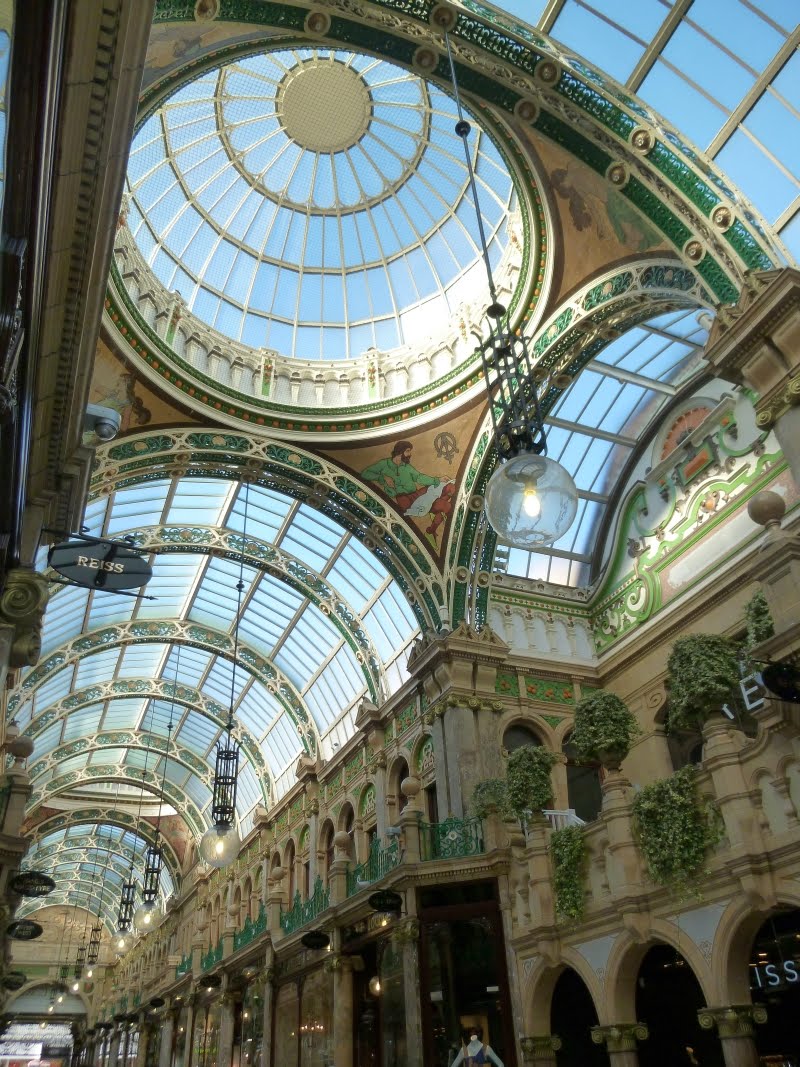
It’s natural to assume that northern England would be grey and overcast this time of year, so imagine my surprise today when the sun was shining so brightly that I needed to wear sunglasses. It was hardly cold, about 7 degrees Celsius (I’m working on my conversions; that’s mid-40s Fahrenheit). It was a perfect day to stroll through Leeds and take pictures. Here is a link to my photostream of architectural facades and other views in Leeds. The picture you see here is just one example of the exquisite Victorian architecture that still flourishes here. It is the glass-and-iron ceiling of County Arcade in Victoria Quarter, an enclosed shopping district designed by Frank Matcham in 1900. It houses today some rather posh shops. In some ways, the city center of Leeds seems like a giant shopping mall. There are numerous department stores and boutiques everywhere, and more than 1 million square feet of new retail space is under construction. But if you’re looking for “ye olde shoppes” that conjure visions of the medieval past, you need to go to a tourist-like town such as York. Here things are more working- and middle-class capitalism. I only wish it was more culturally diverse (too many white people!). There’s certainly more to explore and discover in Leeds though, including areas by the University and near Clarence Dock, so I’m sure I’ll have more to say in the weeks to come.

Despite my fascination with this city so far (and England in general), I’ve had more than one reminder this week that not everyone is as regal as Queen Elizabeth II. Perhaps the most noticeable thing is the number of people who drink at the pub. Now, don’t misunderstand me, I have nothing against having a pint at the pub. I’ve already done it myself more than once since I’ve been here (including having had a few during a burlesque show for a charity event, but I digress). I can understand why people drink here. It’s so cold, damp, and grey for most of the year, drinking probably helps warm (if not numb) the body. My cousin SG in Milano used to live in London and, as much as she loved it, she once told me she couldn’t understand why the English were always drunk (because Italians, as you know, never get drunk). Public drunkenness does seem to happen a lot here and, worse, seems to be tolerated in a way I don’t think I’ve ever seen in New York. I’m sure my English friends who read this will object to what I’m writing (some in fact may point out the recent deathly hangover I suffered while I was with them in New York last month, but again I digress). Consider, however, a few things that have happened to me in the past week alone related to this. I have witnessed someone vomiting in the street, I have had someone slam into a window and scream at me while I was eating dinner at GBK (Gourmet Burger Kitchen…amazing burgers & fries, by the way), and I have watched a crew of people stumble through the train and fall into one another, this last occurrence taking place last night as I traveled back from York. The highlight of that train ride, however, was when a young women sitting 2 rows behind me kept wailing at her boyfriend in tears wanting to know why he treated her so badly, especially with (and I quote) “me carryin’ ya baby in me belly!”, to which he kept telling her to fuck off and leave him alone, that he “weren’t cheatin’ on her!” Between their harsh working-class accent and their slurred drunkenness, it was worse than an episode of Jerry Springer. Yes, the American South isn’t the only place where there is white trash. I finally got up and moved to another part of the train. Interestingly, 4 other people followed me, as if they were waiting for someone to make the first move. Leave it to the New Yorker to lead the pack!

Friday, October 8, 2010

Auction Results: Attics and Dags

You'll recall not too long ago I had blogged about Chatsworth: The Attic Sale, a Sotheby's auction of architectural features and household goods owned by the Duke of Devonshire's family for the past few centuries. That 3-day auction ended today. The total amount earned at the sale (including buyers' premiums) was £6,486,782, which converts to $10,319,821.48. The most expensive item sold for £565,250, more than double its estimated value. It was a white marble chimneypiece from ca. 1735. Located in what was the Grand Entrance Hall of Devonshire House, it measures nearly 6' x 8' and would have been quite impressive in the entryway. The image you see here is a detail of it, showing the exquisite carving.

Following up on my last post about the daguerreotypes up for auction at Christie's, the 3 particular works I cited all sold today as well. Girault de Prangey's building with palm trees in Egypt sold for $62,500, and his gardens of the Villa Medici sold for $68,500. As for the anonymous dag of the two women, it sold under its estimated value for $1,000. That's actually a reasonable price, and it only makes it even more discouraging that I didn't bid on it.

As an aside, I learned from RL after my last post that while it was true that dags showed a mirror image of the sitter, thus altering the truth of their left/right sensibilities, that only lasted for a few years. An advancement in the development of cameras was the inclusion of an internal mirror, which corrected the image so that it would show on the dag plate exactly as an individual truly appeared. The inclusion of this mirror is still a part of all film cameras today.

Tuesday, September 7, 2010

Miami Beach and Delray Beach

I returned today from another trip to Florida, spending the first 4 nights in South Florida visiting my old stomping grounds. I spent 2 nights in Miami Beach rooming with my friend NV. I shot the photo you see here from his balcony on the 15th floor. Standing out there, if you look to the left, you get a glimpse of the Atlantic Ocean between other buildings, but this incredible view of Indian Creek and Biscayne Bay from his balcony is simply spectacular. We sauntered up and down Lincoln Road, and while parts of it are striving for cosmopolitan sophistication, by and large Miami Beach has become glamor-less bling. Even the gay scene that once dominated the area has been reduced to a few insignificant bars. NV and I did meet up with my friend CF for lunch on my 2nd day, visiting Coral Gables which, oddly, I don’t think I had ever visited before. Later that night NV and I got together with CB, and the 3 of us headed to Wilton Manors, near Fort Lauderdale, where we used to hang out almost every week some 6 to 7 years ago. We ate at our old standby, the Thai restaurant Galanga, which still has good food, and had drinks at Georgie’s Alibi. Wilton Manors has easily taken over from Miami Beach as the new South Florida gay mecca. There's even a fantastic new place called The Manor Complex, which houses a martini bar, a lounge, a restaurant, a cafe, a Latino dance room, and a 2-story nightclub. We had lots of fun that night.

On the Sunday, I made my way north to Palm Beach County, where I stayed with the AKs. Half of the AKs is Library Director for the Delray Beach Public Library, a beautiful 47,000-square-foot building built 5 years ago in a Key West style with levered shuttered windows and pastel colors. The inside has an impressive loft ceiling on the second floor, a public meeting hall and a cafรฉ, lifelong learning classes in a computer room, and an adorable children’s section with hand-painted scenes of Floridian nature scenes on the walls. It looks like a great library in which to work. I also went back with the other half of the AKs to visit the main library at Florida Atlantic University, where I previously worked for more than 7 years. After I left, they broke ground on an extension to the main building, and one of the best parts of this project has been the expansion of The Arthur & Mata Jaffe Center for Book Arts. Now incorporating space for lectures and workshops, this area has helped generate an incredible amount of interest in the Jaffe Collection of thousands of artists’ books and related works, many of which are 3D sculptures unto themselves. Jaffe curator John Cutrone and I co-wrote an article about the collection that was published in Art Documentation in 2004. It’s exciting to see how the collection has increased, not to mention the popularity of the numerous public programs and events held there. The rest of my visit to the library itself was fine. It was good to see so many people I had once worked for and with (and those who once worked for me!). But if ever I needed affirmation that I had made the right decision to move on, it was confirmed for me that day, simply because I realized how I personally had evolved into a different phase of my life and that my time there was now officially my past. We came together for a time, but even they have moved into their own future.

The rest of my trip was spent in Pinellas County visiting family, but mostly celebrating the Padre's 79th birthday and helping take care of him with some of his health issues. I did get to see a few old friends (and I made one new friend…you know who you are!). I’ll be back there again in a couple of months, probably for a longer period of time, but for now I’m back home in Brooklyn and looking forward to my next adventure.