Showing posts with label 15th-century art. Show all posts

Sunday, February 5, 2017

Art Details: 11-15


Image Credits: All images taken by bklynbiblio/Roberto C. Ferrari. Top to bottom:
  1. Adriaen van Utrecht, Still Life, ca. 1644, oil on canvas, Rijksmuseum, Amsterdam.
  2. Johan Christian Dahl, Dresden Seen from Pieschen, March Haze, 1844, oil on canvas, Ny Carlsberg Glyptotek, Copenhagen.
  3. Monument of Tizoc, Aztec/Mexica, 1480s, basalt, National Museum of Anthropology, Mexico City.
  4. James Thornhill after Raphael, Peter and John Healing a Lame Man, ca. 1730, oil on canvas, Columbia University, New York.
  5. Luigi Lucioni, Portrait of Rose Hobart, 1934, oil on canvas, Pennsylvania Academy of Fine Arts, Philadelphia.

Tuesday, December 29, 2015

Art Details: 1 to 5

About a year and a half ago, I started taking detail shots using my iPhone (now 6, then 4S) of paintings and sculptures in museums that I found particularly fascinating. Although I am an advocate of always seeing art in person to fully appreciate it, admittedly it is not always possible to do that. Thus, images can help supplement the live experience of art to some extent. Art details in particular arguably give us an opportunity to hone in on a work of art, to examine aspects of it so as to attempt to see deeper into the artist's intent or vision. Admittedly, these details also give the photographer (in this case me) an opportunity to be creative in interpreting these masterful works of art. After all, in seeing these, you are experiencing my detail, my interpretation, of these paintings and sculptures. Beauty, indeed, is in the eye of the beholder. I typically post these on my Instagram account, which you can see by clicking here. (Warning: fun, personal images are there too.) Below these 5 images, I've provided some metadata about each. Enjoy!


Image Credits: All photographs taken by bklynbiblio/Roberto C. Ferrari. Top to bottom:

  1. Albrecht Durer, The Paumgartner Altarpiece: The Birth of Christ, 1498-1504, oil on panel, Alte Pinakothek, Munich.
  2. Auguste Rodin, The Three Shades, originally designed for The Gates of Hell before 1886, 20th-century cast, bronze, Rodin Museum, Philadelphia.
  3. Dante Gabriel Rossetti, La Ghirlandata, 1873, oil on canvas, Guildhall Art Gallery, London.
  4. Paul-Albert Bartholomé, Congiunti al di là, 1891-99, marble, Galleria Nazionale dell'Arte Moderna, Rome.
  5. Sarah Miriam Peale, Still Life with Watermelon, 1822, oil on canvas, Harvard Art Museums, Boston.

Thursday, December 24, 2015

MWA XXXVI: Botticelli's Nativity

Here in New York City, we are having record-high temperatures for Christmas. It is supposed to reach 74 degrees (23 Celsius)! I thought I was staying in NYC, not going to Florida, for Christmas! Today AA and I happily will spend our first official Christmas together on the actual Eve & Day (rather than before or after the holiday) in Jersey City. Tomorrow we are scheduled to meet up with the nephew and nieces to ice skate in Bryant Park...in 64-degree weather...assuming the ice doesn't melt beforehand.

With another Christmas upon us, it seems only appropriate to share another beautiful and important Monthly Work of Art suited to this time of year. The picture you see here is by the Renaissance painter Sandro Botticelli and this painting, from about 1500, is called the Mystic Nativity. While the central portion of it celebrates the birth of Christ in a traditional manner--albeit with Botticelli's usual sinuous forms, as best exemplified by the Virgin Mary--and with humans and angels paying homage to the newborn, above them a group of angels celebrate his birth in a rondo dance, and below angels embrace humans as an extension of God's love. These two parts of the painting elevate it to the esoteric.

This painting was likely a private devotional work commissioned by a wealthy merchant in Florence. Today it is in the collection of the National Gallery in London. On their website, here is what the curators say about it: "Botticelli's picture has long been called the Mystic Nativity because of its mysterious symbolism. It combines Christ's birth as told in the New Testament with a vision of his Second Coming as promised in the Book of Revelation. The Second Coming--Christ's return to earth--would herald the end of the world and the reconciliation of devout Christians with God. The picture was painted a millennium and a half after the birth of Christ, when religious and political upheavals prompted prophetic warnings about the end of the world."

Merry Christmas to you all!

Tuesday, July 29, 2014

MWA XXVI: Leonardo's Supper


Despite everything that has been happening in my life these days, I didn't want to forgo the Monthly Work of Art, in part because it seemed rather appropriate to share as this month's subject an Italian Renaissance masterpiece that was arguably my father's favorite work of art: Leonardo da Vinci's Last Supper (Il Cenacolo). Because Leonardo experimented with different media in the fresh plaster when he painted this work from about 1494 to 1498, it has suffered and degraded over time. Continuous restorations have attempted to preserve it as much as possible, so it hasn't always been available for public viewing. I saw it once with my father and Zia Marisa, and I remember more the experience of how the spotlight shines briefly then dims, so as not to expose the work to light for too long. It is beautiful in a subdued, peaceful way. It is a testament to Renaissance geometric and spatial practices in art, to create a more humanistic approach to the human form and to fool the eye into thinking a flat wall is a three-dimensional space. (So much has been written about this painting, I won't even bother commenting further. Readers are invited to post comments about their favorite texts that discuss this work though.)

When I think about why my father loved this work of art, I suspect it had less to do with all of that, however, and more to do with the fact that it is located in Milan, his hometown, at Santa Maria delle Grazie. With so many famous Renaissance and Baroque masterworks found in cities like Florence, Venice, and Rome, the placement of one of the greatest of these in Milan is rather unique. For my father I'm sure his love of this work of art was about civic pride, a constant reminder of the beauty of life, particularly during the dark days of World War II when his family struggled to find food and avoid bombings throughout the city. I choose Leonardo's Last Supper for this MWA, as a tribute to my father and to his Milanese cultural heritage.

Tuesday, March 18, 2014

MWA XXII: Botticelli's Spring


This Winter has been incredibly cold, with record amounts of snow and below-normal temperatures, even this late in March. Needless to say, I am ready for Spring! So what better way to celebrate the start of the new season this week than to share as this Monthly Work of Art the Primavera (Spring), ca.1482, by the early Italian Renaissance painter Sandro Botticelli (images: Web Gallery of Art). This painting hangs at the Uffizi in Firenze. The first time I ever saw it in person (1991?) I was in awe. In fact, I was so much in awe, that my father took the photograph you see below, which admittedly is quite embarrassing because of my mullet, but you get the impression from my stunned look how awestruck I was to see this painting in person.

The fact is, Primavera is my favorite painting in the world. It's often not easy to narrow down one's ideas of what is a favorite anything, but I can say for sure that this painting seems to have always been, and remains, my favorite. The question is...why? The painting itself is an enigma. We know that it is intended to be an allegory of spring. We can identify the central figure as the goddess of love, Venus, here seen as a glorified wife and mother goddess, Venus Victrix, not a sexualized goddess. She gazes at the viewer and her raised hand offers a sign of welcome to her bower as if it were a mudra of peace. Behind her, among the trees, the branches form an arched niche, and the sky becomes like a halo around her head. She is Venus and Virgin Mary in one. Above her is her son Cupid, blind as is love, shooting an arrow. As for the other figures, they should be read right-to-left. The god of the wind Zephyrus chases after the nymph Chloris, ravishing her, symbolically transforming her into Flora, the goddess of flowers, who throws petals from her dress into the grass. Sexuality has been allegorized as fertility. On Venus's proper right are the 3 Graces (image here), who perform a dance of celebration, their hands gently touching one another, their diaphonous clothes floating around their nude bodies, commingled, dancing to music only they can hear. And beside them is the god Mercury, the messenger god who carries the souls of the dead to the underworld. Is this the finality to love and life for all humankind?

The painting is done in tempera (egg yolk with pigment), a favored medium in Florence at this time. Tempera paint helps reinforce linear structure, as the colors rarely blend, but Botticelli devises a way in his brush strokes to make the paint create motion, not only in each figure's positions and bodily forms, but in the way the clothes on each figure move, most notably the aforementioned dresses on the 3 Graces. These mythological figures all appear like a painted relief, presented to the viewer with no obvious subject, but at least with recognizable iconographic forms. It is said that the painting was commissioned from Botticelli for a cousin of the Medici family as a wedding present for the bride and groom, and that it hung in a main room in the couple's villa, just beside Botticelli's other masterpiece from this time, The Birth of Venus, a symbol of Venus as a idealized beauty and sexualized love.

I've actually written about this painting before on this blog, emphasizing Mercury in particular, albeit with some humor in that post. But it is true that this painting is my favorite. It has always struck me for its frozen beauty. It is timeless. It is the perfect Eden, populated by beauty and sound and nature, but represented only as a flat painting. It is Spring, a perpetual sense of new life and new love, and it offers viewers the hope of a future, one that leaves them peaceful and happy, in their own personal Arcadian bower. I have not seen this painting in person in almost a decade now, but the next time I return to Firenze, I will revisit my personal Spring once again.


Tuesday, November 13, 2012

Doppelgänger?


This past week a story went viral online about a young man who found his doppelgänger in a portrait by an unknown 16th-century Italian artist at the Philadelphia Museum of Art. A doppelgänger (from the German meaning "double goer") is a ghostly double--not a spirit, but an actual person. The resemblance between him and the portrait is rather uncanny. Notice how people in the article speculate that he might have to lose the tie-dye shirt and wear a bigger codpiece though? But, like others, the story made me wonder if anyone else had ever seen their doppelgänger in art.


When I was younger, I thought I bore a striking resemblance to the messenger god Mercury in Botticelli's Primavera (Spring), ca. 1478, from the Uffizi Gallery in Florence. You see a detail of Mercury here, but click here for the full picture. It's perhaps not a coincidence that this painting also just happens to be my all-time favorite in the history of art. Of course, the resemblance was perhaps much more true some twenty years ago when I was younger and had a mane of curly hair. Back then, people also used to think I looked like actor Kirk Cameron or singer/songwriter Richard Marx. But the weirdest thing lately is having heard a few people say I look like Derek Jeter! Doppelgänger to a baseball player? Hm...I think I'd rather look like someone in a Renaissance painting.

Sunday, June 3, 2012

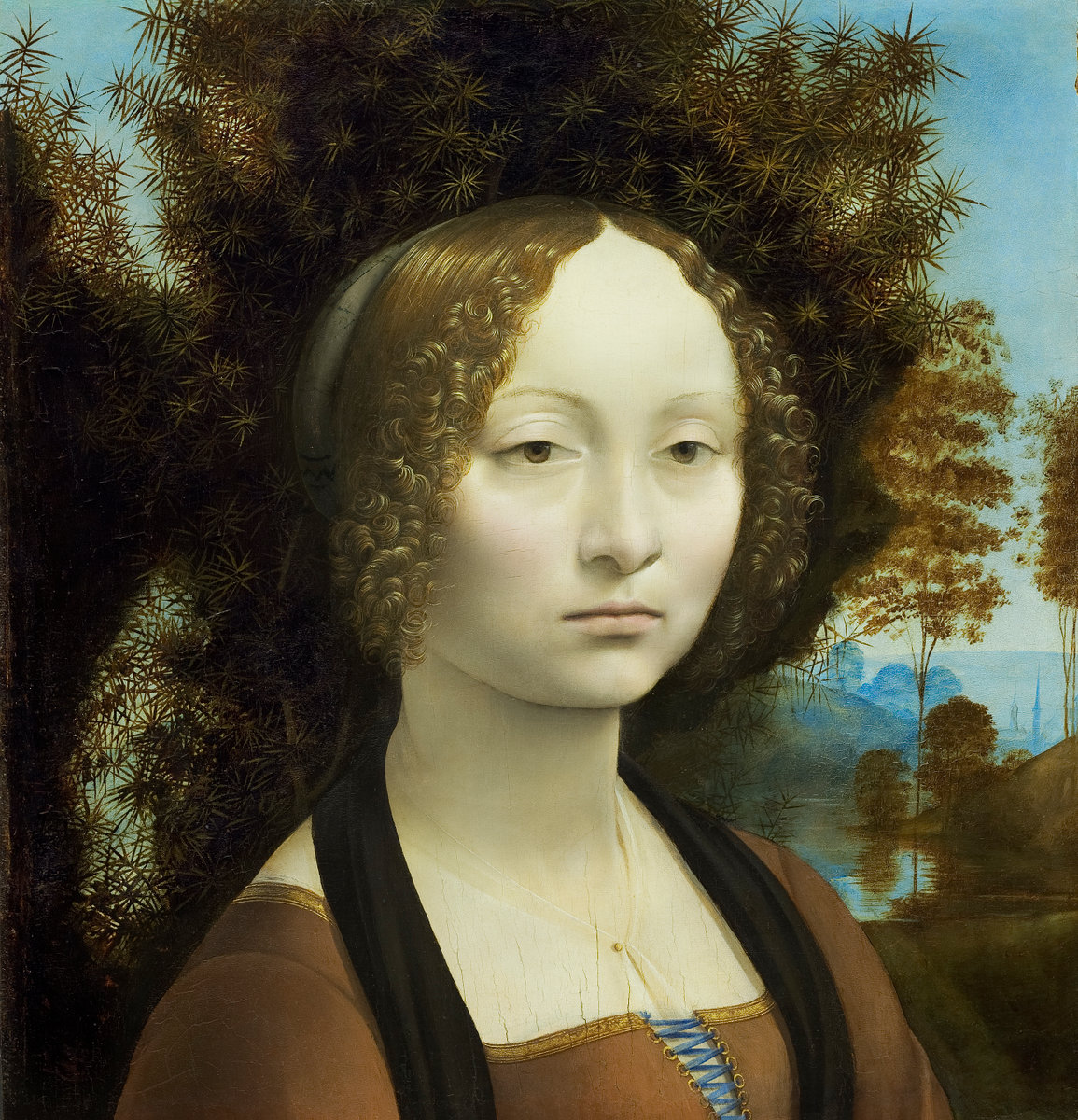
MWA IV: Leonardo's Ginevra

Back in March, the National Gallery of Art in Washington, D.C. announced they were releasing high-resolution digital images of more than 20,000 objects from their collection in an ongoing attempt to make these public domain works more widely available for both commercial and non-commercial purposes using the highest quality museum-produced photography. This is a tremendous coup for educators and the public alike, as the removal of specific fees for publishing and other uses inevitably will draw more people's attentions to the NGA's collection in support of their open access policy. You can read more about their open access policy here. bklynbiblio readers will recall that the Yale Center for British Art previously had done something very similar last year. Other museums will follow, for sure. In celebration of the NGA's move forward, I've selected Leonardo da Vinci's Ginevra de' Benci, ca. 1474-78, as June's Monthly Work of Art. Rather than give my own thoughts on the beautiful portrait, here's just a small piece of what the curators at the NGA have to say about it: "She was the daughter of a wealthy Florentine banker, and her portrait—the only painting by Leonardo da Vinci in the Americas—was probably commissioned about the time of her marriage at age 16. Leonardo himself was only about six years older. The portrait is among his earliest experiments with the new medium of oil paint; some wrinkling of the surface shows he was still learning to control it. Still, the careful observation of nature and subtle three–dimensionality of Ginevra's face point unmistakably to the new naturalism with which Leonardo would transform Renaissance painting. Ginevra is modeled with gradually deepening veils of smoky shadow—not by line, not by abrupt transitions of color or light." You can read more about the painting by clicking here. To search and download NGA images for your own use, click here.

Saturday, December 17, 2011

Random Musings 10

I'm heading to Florida for a dysfunctional family Christmas. If you're wondering if this is a picture of my relatives, it's not, but I swear if my lesbian cousins (the DG-JBs) were to ever really let loose, I'm convinced they would be just like Edina and Patsy (more on them below). I've been saving up a bunch of links and posts to blog about, so enjoy this Random Musing.

The Guardian has an interesting interactive guide that allows you to zoom in and find out more about drawings by Leonardo da Vinci, in conjunction with the National Gallery's current exhibition about his years at the court of Milan.

When I was at the YCBA, my co-visiting scholar was Georgina Cole, who received her PhD from Sydney University in Australia. She was there working on a project relating to the senses in 18th-century British painting. She's also started a new blog/website, Early Modern Art Network, which focuses on news relating to art from the 17th and 18th centuries. She's transcribed a funny 18th-century letter to the editor from an enraged parent about how having his children trained to be artists had made his life miserable: "When I the other Day found that Remonstrance was in vain, and rage exerted without Effect, and clasped my Hands and sighed with pure Vexation, my Daughter told me I looked like the Soldier in Belisarius; my eldest Son said I was more like West’s weeping Grenadier, and my youngest, a little Imp about ten Years of Age, got into a Corner of the Room with his Chalks and blue Paper to copy my Face, his own Father’s Face, Sir, for a Head of Despair."

I've blogged about the World of the Year in the past, but unfortunately we now have conflicts depending on the source as to what the actual word of 2011 is. Dictionary.com had declared "tergiversate" to be the annual word (huh?), but now Merriam-Webster claims the word of the year is "pragmatic," based on the number of people who searched for that word. Complicating matters is the Oxford English Dictionary, which apparently declared "squeezed middle" the word of the year, never mind that's a phrase, not a word.


Thanks to my dear friend SVH, my latest sci-fi obsession is Farscape. Yes, I'm a little late to this, as it's been off the air for a while, but it's fun. A pregnant bio-ship with a sexy lost human and escaped alien prisoners, none of whom know or trust one another? What a fun concept!

New York magazine has declared 2011 to be the year in which male bodies were exploited in the movies, such as Chris Evans here in Captain America. There is a rather lovely slideshow of images worth seeing on the site, although I do find it odd that they all look alike (never mind why  Evans insists on shaving his chest hair). Unfortunately, my fantasy boyfriend Ewan McGregor wasn't on the list, although I guess he didn't actually take his shirt off in any films this year (a first for him!). His film Beginners, with Christopher Plummer as his aging father who comes out of the closet late in life, was absolutely one of the best movies of the year. The Anglophenia blog put up a post earlier this year with video clips of all things Ewan, so check it out.

And unless you've been living under a rock I'm sure you've heard the news that--20 years after the first episodes premiered--Absolutely Fabulous is coming back with some new episodes with Edina and Patsy partying hard and Saffie scolding them the whole time. I can't wait! Here's a hilarious clip from the newest episode in which they trash-talk the Kardashians (who I still to this day do not understand why people think they are important!!). Enjoy, sweetie dahling!

Sunday, April 17, 2011

Brussels, Ghent, and Bruges

If you're in London and you want to travel to the Continent, take a Eurostar train. With all the aggravation these days of airline security, traveling by train to Paris or Brussels is a piece of cake. The trip is much easier and it only costs about $100 round trip. You check in about an hour before departure, scan your e-ticket at the entrance, put your bags on the security scanner then pick them up, clear customs/immigration, drink a cup of coffee until they announce your platform, and then you board, put your bags in the rack, and relax in your seat. In less than 2 hours, you're in Paris or Brussels. It really is amazing and well worth doing.

Unfortunately, when SVH and I arrived in Brussels, we were a little disappointed. DE had said to us beforehand "It's not Paris," and now I understood what he meant. Not only is it smaller, but it's lacking the pristine beauty that lies at the heart of Paris. We checked into our hotel and wandered around town. It was noisy, full of screaming youths and gals drinking lots of the ubiquitous Stella Artois beer. Tourists poured into the Grand Place, the main square surrounded by historic buildings decorated in gilt that, upon reflection, still is nothing compared to the Louvre in Paris or even the Piazza di Signoria in Firenze. The more we walked around, we couldn't understand why there was trash everywhere and why there were no flowers. London's parks are already bursting with flowers. There was nothing here. We quickly made the decision to take a guided coach tour the following day to Ghent and Bruges. It turned out to be a fantastic day.


Ghent is about 45 minutes outside of Brussels, with Bruges another hour heading northwest, just near the border of The Netherlands. Both cities are absolutely charming and reflect exactly the atmosphere we thought we'd find in Brussels. Ghent is an old university town from the medieval period, and the architecture is simply delightful. Normally I wouldn't advocate taking guided tours, but this one was relaxing and gave us plenty of free time to wander, which helped. The major highlight for me in Ghent was going to St. Bavo's Cathedral and seeing the large triptych of The Adoration of the Mystic Lamb, 1432, by Hubert and Jan van Eyck (image: Web Gallery of Art). It's historically important and simply beautiful. The center panel with the representation of God the Father has been a source of inspiration for numerous artists over the centuries. Both Ghent and Bruges have man-made canal systems dating back to the 1400s, and although once used for shipping and commerce, they now serve mostly for tourism. Terraced roofs on facades is classic Flemish-style architecture, so it was lovely to see so many of these beautiful houses of the old guilds lined up one after the other on the canal (see picture at top). Bruges, unlike Ghent, is more of a tourist city. It's obvious that if Brussels is a business center, then Bruges is where people come to relax. Another artistic highlight there was Michelangelo's sculpture of the Madonna of Bruges, which had been brought by its patron to the city in the 1500s.

We were back in Brussels on my birthday, and the more we wandered the more we realized that the beauty of the city is outside the Grand Place area. We found gardens, public sculpture, and exquisite Art Nouveau-style townhouses. We went to the Musée Magritte to see the work of René Magritte, the native Belgian Surrealist. We also took the long walk to Rue Americaine to visit the Musée Horta, one of the earliest Art Nouveau-style homes designed by the architect Victor Horta for himself ca. 1900. Art Nouveau has a tendency to seem outdated when one looks at it in reproductions, but seeing it as an architectural space makes you realize how incredibly modern it was with its exposed ironwork and open floor plan. The Musée Royaux des Beaux-Arts had large portions closed for renovations, so I decided I needed to come back and visit that museum on a future visit.

As for food, we definitely indulged. We ate Belgian chocolates from numerous high-end chocolatiers such as Pierre Marcolini (all simply delectable), we had dessert crepes as a birthday indulgence in Brussels, and we had a Belgian waffle with raspberry coulis in Bruges. We ate lunch in a restaurant overlooking the city from the top floor of the Museum of Musical Instruments, a fabulous ca. 1900 Art Nouveau building. We had dinner one night at Falstaff's brasserie, an historic restaurant where I drank Belgian beer and ate moules (mussels) cooked in white wine, with a side order of pommes-frites (fries). I was amazed at how delicious my meal was, as you can see from my picture below. Our trip to Belgium was relaxing and enjoyable. We're glad our initial impression of Brussels changed over the weekend, which goes to show that meandering to nowhere when on holiday sometimes can turn out to bring you some of the most delightful surprises you could ever imagine.

Friday, December 24, 2010

Christmas 2010

The picture you see here is The Adoration of the Shepherds by the northern Italian artist Andrea Mantegna, showing the scene from Luke 2:16, "So [the shepherds] hurried off and found Mary and Joseph, and the baby, who was lying in the manger." This Renaissance picture dates from just after 1450 and is part of the exquisite paintings collection at The Metropolitan Museum of Art. Christmas this year is a bit different for me. For the first time, I decided to stay in NYC and not visit family. With all the traveling I've been doing, and just getting back into my NYC groove, I decided to spend this holiday season doing...well...nothing. Since last night I've been reading, watching movies, and gorging on Entenmann's marshmallow iced devil's food cake (it's taking all my will power not to inhale the whole thing in one sitting). In short, I'm relaxing. And enjoying every minute of it. While it would have been wonderful to see everyone and participate in all the food and presents and blissful dysfunctional chaos that has defined every Christmas in my life, I have to admit there's something spectacular about having no pressure to do anything more challenging than deciding whether I should change from my pajamas into a pair of sweat pants. A blessed holiday indeed. Merry Christmas, dear readers!

Monday, December 1, 2008

Donatello's David

Continuing my trend of Italian-themed posts, a few days ago the Bargello Museum in Firenze showed off their freshly cleaned bronze statue of David by Donatello. About 60 years before there was Michelangelo's David, there was Donatello's David. You can read about how they cleaned the statue using laser technology and see images of the restored sculpture in this news byte from the Associated Press. The image I'm showing you here (courtesy of the Web Gallery of Art) is pre-cleaning and doesn't do the sculpture justice. It really is an amazing piece of craftsmanship in conveying the human condition. It consciously invites you to move around it and look at it from all perspectives. The work is one of the great early Renaissance masterpieces that celebrated the classical ideal of mankind. Scholars still aren't sure when it was made, although best estimates are between 1430 and 1450. It may have been a wedding present among the famous de' Medici family members, but no one knows for sure. Certainly by the time the de' Medicis were exiled from Firenze in the 1490s, the bronze statue was confiscated by the Florentine government. The sculpture was displayed outside the Palazzo Vecchio with another work by Donatello, Judith and Holofernes. If there seems like a theme, there was. Both subjects recounted how so-called weaker Biblical figures overcame adversity with God's help and vanquished their enemies. Judith was a Hebrew maiden who seduced General Holofernes, got him drunk, then cut his head off. David was a shepherd boy who used a slingshot to knock out the giant Goliath, then cut his head off (David later became King of Israel). Both statues became symbols for the city-state of Firenze, for despite its small size the city had defeated larger enemies, including the country of France. Donatello's David is a shepherd boy wearing a pastoral hat on a head with long locks of hair. His nudity emphasizes his youthful, weaker body, but he stands triumphantly with one foot on the decapitated head of Goliath. Scholars such as James M. Saslow (Pictures and Passions: A History of Homosexuality in the Visual Arts) have discussed the homoerotic quality of this figure. Renaissance Firenze was a haven for homosexuals. That's probably a slight exaggeration, but historians like Michael Rocke (Forbidden Friendships: Homosexuality and Male Culture in Renaissance Florence) have shown that there is plenty of evidence that male-male relations were common in 15th-century Italy. Saslow has pointed out that in this sexually liberated environment, an effeminate, youthful David would have appealed to the male homosexual audience as an object of desire. He points to how the feather from Goliath's helmet stands erect against David's leg, but then caresses his thigh with its sculpted feathers. If you were to see it in person, you'd see right away how true it is. Donatello's David was a hero: politically and sexually, he represented the spirit of Renaissance Firenze.

Monday, October 27, 2008

Siena near Sheffield?

Do you ever dream about what it would be like to "discover" some masterpiece of art? You know, like you happen to rummage through your grandmother's attic and discover not only that she was Picasso's secret mistress, but that he painted a Cubist portrait of her that she's kept hidden all these years because it made her look indecent? The likelihood is that it will never happen, but one can always dream. Still, surprises similar to that do happen occasionally in the art world. Take for instance the news about these "Sienese panels found in English parish church" in the latest edition of The Art Newspaper. Apparently a small church in a mining village in Yorkshire, England turned out to have two heretofore unknown panel paintings by the early Renaissance painter Sano di Pietro (1406-1481). No one is still certain how they got there, but the local aristocracy may have had something to do with it about a century ago. And if all that wasn't interesting enough, turns out there's a New York connection as well. The expert called in to examine the works was Everett Fahy from The Metropolitan Museum of Art.