Showing posts with label art exhibitions. Show all posts

Saturday, January 4, 2020

Projects of 2019

Here's my annual list of professional "projects" that I was involved in and overseeing during 2019. (You can read previous lists here and here.) As I've mentioned in the past, it's good to take stock of these accomplishments because it helps remind me how busy things have been, particularly as I have a tendency to always move on to the next project and forget what I've already done. The photo you see here is of me giving the introductory remarks at an event I coordinated in April, an "Evening at Avery: British Portraiture", to coincide with the exhibition I co-curated (more on that below; no idea whose head that is in the photo!). The event had a surprisingly good turn-out, and our two speakers were Mateusz Mayer, PhD student in art history, who co-curated the exhibition with me, and Dr. Meredith Gamer, assistant professor of art history at Columbia who gave a riveting talk about alternative concepts of 18th-century British portraiture for those who are often forgotten by history and society.

Here is the 2019 list...

  • I published two book reviews, which I mentioned about in my Books of 2019 post as well. The first was a short review on Beyond the Face: New Perspectives on Portraiture, about which I posted even more. The second was a review essay in Nineteenth-Century Art Worldwide on Anthea Callen's new book Looking at Men: Art, Anatomy and the Modern Male Body.
  • I curated at work a summer exhibition entitled Animalia: The Essence of Animals in Art, with artwork from the permanent collection dating from 3rd-century Mexican dog sculptures to contemporary Inuit sculptures. During the winter/spring, I co-curated the exhibition Hoppner, Beechey, Fisher, Lavery: Researching Columbia's Portraits with M. Mayer, and we published online a catalogue of the exhibition with essays by both of us, which you can download and read here. My staff and colleagues at work deserve lots of credit for all their help in making these exhibitions possible.
  • I acted as curatorial project manager with Dr. Frederique Baumgartner on the "MA in Art History Presents" exhibition at Columbia entitled Clodion (1738-1814) and "Clodion Mania" in Nineteenth-Century France, which has a fantastic online exhibition component you can see here.
  • Tomas Macsotay and I co-chaired a panel session entitled "Transnationalism and Sculpture in the Long Nineteenth Century (ca. 1785-1915)" at the annual conference of the College Art Association in February in NYC.
  • I served on the selection committee & jury for the 16th annual graduate student symposium co-sponsored by the Association of Historians of Nineteenth-Century Art and the Dahesh Museum of Art in March in NYC.
  • I was the guest speaker at a Columbia Alumni Association of New Mexico event, where I spoke about the collections and our educational programs to alumni. This took place in Santa Fe, New Mexico in September.
  • Columbia's Department of Art History and Archaeology had received a small grant to coordinate an international project called Parallel Heritages, with some of their students and students at The Sorbonne, Univ. Paris I, for an international research project on archaeological objects in both collections. I gave presentations at both components, in NYC in March, and in Paris at The Sorbonne in November.
  • I also gave a paper entitled "British Portraits at Columbia University: Opportunities for Object-Centered Learning" at the annual Understanding British Portraits seminar, held at the National Portrait Gallery in London in November.
  • I participated in the annual conference of the Association of Academic Museums and Galleries in June in Minneapolis, Minnesota.
  • Totally not work-related, but worth documenting... in February AA & I took a fantastic wine-tasting class that was incredibly informative (we are doing a repeat, focused version on Italian wines later this month), as well as a fun cocktail making class in December. We also went to go see the opera The Magic Flute at the Metropolitan Opera and Moulin Rouge on Broadway.
All in all, another incredibly productive and fulfilling year!

Sunday, April 14, 2019

British Portraits at Columbia Catalogue

Just over a month ago, I blogged about the new exhibition about four British portraits that we have on view at Avery Architectural & Fine Arts Library. The paintings are from Columbia's permanent collection. I'm pleased to share the news that the pamphlet-type catalogue we've published is now available for free to download from Columbia's Academic Commons network (click here). I'm incredibly pleased with this came out, which is a testament to the incredible design skills of Katherine Prater, one of my co-workers. The essays are extended versions of the didactic panels Mateusz and I wrote.

Ten days ago, on April 4th, we hosted an invitation-only Evening at Avery to celebrate the exhibition and bring more paintings out to show. Dr. Meredith Gamer was our keynote speaker, and my co-curator MM and I also gave brief talks that were well-received. My thanks to Paul Jeromack for sending me pictures he took from the evening, which I am posting here.


The Social Media Phenomenon (aka Naked Men)

24 hours ago, I was in Chelsea to see two exhibitions: Jeff Miller's show "Through the Looking-Glass: Alter Egos & Others" at the Atlantic Gallery; and "The Young and Evil" curated by Jarrett Earnest at David Zwirner. Soon afterward, I posted on my Instagram account pictures showing installation views and object shots from both shows. Whenever I post on Instagram, the norm for me is about 50-60 likes. Occasionally, it goes up to the 80+, and I've had about 4 posts that were liked by over 100 people. Let's face it: despite some personal "fans" (you are reading this right now!), I'm not a social media phenomenon, nor have I ever aspired to be. So you can probably imagine my complete shock and surprise how--only 24 hours later--I now have over 1,300 likes on my Instagram post about the exhibition at David Zwirner. I am literally stunned by this and--dare I say--even a little disturbed by it. I said to AA at least twice today "post a picture of a painting of a naked man..." Clearly that has something to do with it. But there has to be something else going on. I wonder if it is some sort of algorithm, pushing the image higher in the search for people or coming up randomly on people's Instagram posts because friends-of-friends-of-friends are liking it, and it's growing exponentially as a result. I don't think my hashtags (e.g. #queerart #stonewall50 etc.) are that special, but maybe I'm wrong. It has occurred to me that perhaps the gallery is somehow actively pushing the feed, but I don't see how they could do that. In any case, it's all completely bizarre how over 1,300 people I have never met, who live everywhere in the world, are liking these pictures. A few have commented and asked questions, so I've helped identify the works and responded to them. Some have started following me now, which is how this is supposed to work I imagine, and I in turn have chosen to follow a few back.

What is fantastic about the exhibition (which has now closed--yesterday was the last day) is that it presents a number of pictures never published before and rarely, if ever, seen by the public, all depicting works of art by a group of gay male artists (and women close to them) who were all active in the 1930s and 1940s in New York City.  The artists on view include Paul Cadmus, Jared French, George Platt Lynes, George Tooker, and so on. The style of art is largely figurative, somewhat surrealist, frequently provocative (and unapologetically so), and using older painting techniques out of favor at the time (e.g. tempera paint). Ultimately, it presents an alternative canon of American art, and it challenges the modernist tendencies that lean towards abstraction and social realism--art movements almost completely dominated by heterosexual men, culminating in the mid-century, uber-macho-modernity of Abstract Expressionism (i.e. Jackson Pollock, Mark Rothko, etc.). One of the artists who has been underappreciated and clearly comes to the foreground in the show is the Russian-born artist Pavel Tchelitchew (1898-1957). The image you see above is by him: The Lion Boy, 1936-37, gouache on paper mounted onto canvas. The stark hyperrealism of the muscular, blonde youth whose mane-like hair bursts from his body even more strongly than that from his head is without a doubt incredibly startling to see. The fact that it is uncomfortable for some to even see it now, or the fact that so many others are enamored of it because of its eroticism, reinforces how unusual such images are in our society. Would anyone have reacted the same way if it was a painting of a nude woman with blonde hair? I doubt it. Even if it were a spectacular painting, I can't imagine that it would have generated over 1,300 likes just 24 hours after I had posted the picture.

Going back to Jeff Miller's show, if you're in the NYC area, you should go see his show too before it closes next week. Like the other exhibition profiling gay male artists, Miller exhibits his own interpretation of the idealized male body. His drawings have a fascinating energy to them, and his hyperrealistic sculptures play with ideas of ego and superego in their doubling effect. So far, though, the post of his pictures on Instagram has only generated about 40 likes in 24 hours. The thing is, that is actually a great number! But when compared to the other post, it just demonstrates that there is something more going on that has to explain how the other post has literally shot through the social media roof.

Saturday, March 2, 2019

British Portraits at Columbia Exhibition

On February 11th, we officially opened a new exhibition at work that I curated with PhD art-history student Mateusz Mayer. The show is entitled Hoppner, Beechey, Fisher, Lavery: Researching Columbia's Portraits, and is on view in Avery Architectural & Fine Arts Library, Wallach Study Center for Art & Architecture, until May 10th. It is open to the public Mon-Fri, 9am-5pm. This focused exhibition showcases four rarely-seen historical British portraits from the permanent collection, and transforms them into objects of study rather than present them as traditional museum-style masterpieces by these artists. The portraits were painted between the years 1800 and 1927, and the show highlights new discoveries that we have made about them, ranging from biography to provenance to political propaganda. As examples of British portraits, the show also seeks to query the idea of "British-ness," both in its historical context and in the age of Brexit.

One of the paintings on view is the work you see here, a portrait of King George III by Sir William Beechey and his studio. The portrait depicts the king wearing a field marshal's uniform, his bicorn hat and Star of the Order of the Garter prominent ornaments to his outfit. The painting is an artist's copy of his life-sized portrait of the king that he exhibited at the 1800 Royal Academy exhibition, now in the Royal Collection. The painting became so popular (arguably a form of political propaganda) that Beechey's studio produced numerous replicas and copies, some with various backgrounds and in half-size and portrait-bust versions. In the background of this portrait is Windsor Castle, the king's primary residence, where Beechey likely painted the original version. This painting was a gift to Columbia in 1943 by Mrs. Mary Hill Hill. Her doubled surname is not an accident: her father and husband, both of whom were railroad magnates, had the same last names, but there were no family relations between them. Although originally from Minnesota, Mrs. Hill Hill lived at the time of the donation in Tarrytown, NY, and auction catalogs after her death show that she was an avid collector of 18th-century British portraits and George III silver.

A free accompanying exhibition catalog will be made available very soon, so I'll post a link to the PDF version when it's ready.

Saturday, January 12, 2019

Projects of 2018

Here is my last "highlights" list from 2018...a little late, perhaps, but not by much... (Here is the 2017 list.) I've discovered it's beneficial for me to record these events because it helps me take stock of the activities I've been involved with and what I've accomplished. I have a tendency to forget things and move on, and reflecting on these things annually makes me realize that I am doing quite a lot professionally and that I need to stop being so self-critical about what it is that I am not doing.

The picture you see here commemorates one of the more memorable events. In early October, I joined my fellow Solomaniac friend & colleague Carolyn Conroy and numerous descendants of the Solomon/Salaman family for the rededication of the Salaman family graves and a visit to the recently rededicated grave of Simeon Solomon, all at Willesden Jewish Cemetery in London. It was a special and humbling moment to be there.

In addition to all our travels (professional and vacation), here is the 2018 list of projects...

Monday, December 17, 2018

Morier and Persia Exhibition


It may seem strange to be blogging about an exhibition that has now closed, but it only occurred to me last night that I never wrote about the exhibition Looking East: James Justinian Morier & Nineteenth-Century Persia that we recently had on view in our display cases in Avery Architectural & Fine Arts Library, Columbia University. (Chalk it up to having been too busy for months to actually write about it!) The exhibition was part of the MA in Art History Presents series, the second in a new series in which the MA students curate an exhibition utilizing art from Columbia's permanent collection, under the guidance of Dr. Frederique Baumgartner (director of the MA program, Department of Art History and Archaeology, Columbia University) and me (curator of Art Properties, Avery Library, Columbia University). You may recall that earlier this year we opened the first of these shows about the 17th-century printmaker Robert Nanteuil.

This exhibition centered around the portrait you see here of the writer and diplomat James Justinian Morier (ca. 1780-1849), attributed to the painter George Henry Harlow (1787-1819) and painted in 1818. At first glance the portrait is a theatrical depiction of Morier dressed in Orientalist clothing, but in fact there is some historical accuracy to his clothing as representing what men wore in the early years of the Qajar dynasty (1794-1925) in Iran. Morier was part of the British diplomatic service that sought to establish a peace treaty between Persia and Britain during the years of the Napoleonic wars. Morier wrote and illustrated two travelogues about his time in Persia (published in 1812 and 1818), and then went on to have an illustrious career as a Romantic novelist with his most famous book being The Adventures of Hajji Baba, of Ispahan (1824). The exhibition sought to contextualize the historical period in which the painting and his illustrated texts (including the image of the "Persian Breakfast" you see at top), while considering ideas of colonialism and Orientalism in the writings of Edward Said and Linda Nochlin. I curated with one of the students a supplementary section as well, focusing on a selection of Iranian ceramics from the collection.

It was quite a successful exhibition, and we produced an excellent online companion exhibition, including a series of essays by the students introduced by Baumgartner and me. This project was inspired by research I had done previously on this painting, having given two conference papers about it in Pittsburgh in October 2015 and in Raleigh in January 2017. It's a great tale of how a painting first draws you in because of its appearance, but the more you look into it and consider all the imagery, as well as the background of the sitter and his world, it shows how art can convey new ideas and still have an incredible lifeline 200+ years after the events in which it was first painted.

Sunday, June 24, 2018

Wisdom of the East Exhibition


I'm very pleased to share the news that I've curated an exhibition now on view in the Wallach Study Center of Avery Architectural & Fine Arts Library at Columbia. The show, entitled Wisdom of the East: Buddhist Art from the J. G. Phelps Collection, brings together a group of Asian sculptures and ritual objects from Tibet, Nepal, Japan, and China, dating from the 12th to 19th centuries, in the permanent art collection at Columbia. The image you see above is one of the four cases, this one showcasing three Buddhist sculptures from Japan. The figure on the left is Manjusri, the Bodhisattva of Wisdom who rides a lion, carries religious texts, and defends the faith with his sword. The figures on the right are a Bodhisattva and Buddha associated with Mahayana Buddhist traditions of Japan. All three are gilded and lacquered wood. This exhibition brings together just a small selection of the 50+ sculptures and ritual objects that the NYC socialist politician James Graham Phelps Stokes (1872-1960) donated to Columbia the year before he died. I mentioned Stokes recently as the author of the observation on time and experience in his travel journal to Japan in 1892, an entry I discovered in doing research in anticipation of this exhibition. You can read a little more about the exhibition here. It will be up until September 14, 2018.

Monday, June 18, 2018

Skanda in Georgia

I'm writing this post from Athens, Georgia, where today we de-installed a few works of art that we loaned from the Columbia University art collection. The exhibition at the Georgia Museum of Art, which closed yesterday, was "Images of Awakening: Buddhist Sculpture from Afghanistan and Pakistan." It revolved around an amazing new acquisition they have received: a 5th-century Buddhist head from Hadda (their image online currently is pre-conservation; trust me, it's gorgeous). The exhibition included loans from a few collections to narrate more fully the story of art, mostly Buddhist in nature, from the region once known as Gandhara, a crossroads for Western and Eastern cultures from the time after Alexander the Great to nearly the 7th century. Today, of course, this region is a political quagmire because of the Taliban and Isis, which is partly why a show like this in Georgia (traditionally, a more-conservative state) becomes so important. In my role as Curator of Art Properties at Columbia, I can say that we were very pleased to be able to participate in this exhibition and loan four small schist stone sculptures to this. Three of them were Buddhist in nature, but the work you see here actually has origins in Hinduism. This is somewhat surprising as Hinduism was not yet fully developed as we know it today, although its earlier origins as Vedism were culturally entrenched throughout the Indian sub-continent. A sculpture of a Hindu deity from this region, during a time when Greek-inspired art was influencing Buddhism, arguably demonstrates how globalism has always impacted art and is not a 21st-century phenomenon.

The figure represents Skanda, the god of war and son of Shiva and Parvati. It dates from the 4th to 5th century. His mythological origin is rather fascinating, and a bit provocative--curiously, it seems to bear some relationship to the Greek story of the birth of Aphrodite, goddess of love (both born from water, seed thrown into the water, etc.). Despite its fragmented state today, this work has held up well (it had some minor conservation in order to be shown, so thank you Jones Abbe Art Conservation). The sculpture shows the god not with multiple heads but rather in a warrior stance holding what once was a spear and, in his other hand, a peacock, the animal with which he is associated. That makes for another interesting analogy, as peacocks in Greek mythology are associated with Hera, queen of the heavens, and seen as a symbol of marriage. Is another love/war cultural emblem at work here? Perhaps. Peacocks are beautiful birds, particularly when they display their shimmering iridescent feathers, but they are also notoriously loud and vicious. I guess all is fair in love and war.

Saturday, February 10, 2018

Art in 17th-Century Life: Robert Nanteuil


At work we have been incredibly busy preparing for a new exhibition opening tomorrow in Avery Architectural & Fine Arts Library. The show is entitled "Art in Life: Engravings by Robert Nanteuil (c. 1623-1678) from the Frederick Paul Keppel Collection," and was curated by students in the MA program in Art History at Columbia, under the guidance of the MA director Frédérique Baumgartner and the Curator of Art Properties (yours truly). This is the first time that the MA program has partnered with Art Properties to utilize art from the permanent collection for an exhibition, thus giving the students an opportunity to curate an exhibition. It has been a lot of work to do this for all involved, including everything from selecting the prints, digitizing them, conserving one, mounting and matting them, and so on, not to mention all the work we've done environmentally, including retrofitting display cases, installing new LED lighting, and constructing faux walls. The short-term work, however, is going to benefit all in the long run, as this is the beginning of what we hope will be a recurring annual exhibition curated by a new student group each year. Below is a view of one of the cases showcasing some of the prints on display.


Nanteuil grew up in Reims, France, where he trained as an engraver. He settled in Paris in 1646-47 and soon established himself as portraitist to the court of King Louis XIV, the famous Sun King, eventually rising to the position of Designer and Engraver to the King. Over the course of his career Nanteuil made over 230 painstakingly realistic portraits, most of which were ad vivum (taken from life). Many of the prints went through multiple states and editions with altered backgrounds. Most are traditional window-style framed portraits as you see in the installation view here. However, a few show individuals in particular settings. The 1659 print of Cardinal Jules Mazarin (1602-1661) at the top of this post is taken from a portrait by Pierre Mignard, rather than life, but Nanteuil depicts him seated in his palace with his kunstkammer of scientific instruments and gallery of ancient and modern sculpture behind him. Among the prints in the exhibition this one is one of my favorites, even if it is atypical of Nanteuil's style. Rather than a straight-on portrait, the print contextualizes Mazarin as a connoisseur and collector, and arguably foreshadows depictions of over famous collectors over time, most notably Charles Willson Peale's The Artist in His Museum, 1822 (Pennsylvania Academy of Fine Arts).

These prints were owned by Frederick Paul Keppel, a former dean of Columbia College and son of the NYC print dealer Frederick Keppel. In 1947, 184 of the Nanteuil prints were donated to Avery Library by F.P. Keppel's widow, and for this exhibition the students selected 16 to showcase, arranged in 4 cases with various themes. The exhibition is open to all 9am-5pm Monday-Friday, until May 18, 2018. There is also an online exhibition: http://projects.mcah.columbia.edu/ma/2017.

Wednesday, October 25, 2017

Thinking about Rodin

This coming Friday, October 27th, at 5pm, I'm giving a talk (free & open to the public) entitled "Thinking about Rodin: A Century Later." The image here of Rodin's Thinker is a bronze commissioned by Columbia University in 1930 from the Musée Rodin and installed outside Philosophy Hall the next year. (One of my students this past Spring semester wrote a paper about this sculpture and its placement on campus, which you can read here.) I find The Thinker riveting, not just because of its execution as a figure in the round, but also because it is subject to so many different interpretations. I believe Rodin would have agreed with that assessment. It was clearly a significant work for him: another large-scale version of the statue gazes down on the grave of Rodin and his wife.

My talk will be held at the Florence Academy of Art based in Mana Contemporary, Jersey City (basically right next door to where AA and I live). I gave a talk there earlier this year about Gibson, and Rodin could be seen as a nice antithesis ... or is he? Auguste Rodin (1840-1917) is considered by most to be the proverbial "father" of modern sculpture, but when I look at his sculpture I see more of a reinterpretation of art-historical precedents. When you read some accounts of his life and work (e.g. Bernard Champigneulle and Albert Elsen), you sense from these authors an intentional insistence that Rodin broke away from the past to be original and unique. While that may be true to some extent--for just about every artist who strives to be recognized for her/his accomplishments--I don't think it's so "black or white." Successful artists absorb what they have learned and synthesize it with other life experiences to generate something that may seem new or original to viewers. But that doesn't mean their "teachers" should be forgotten or, even worse, elided from interpretations of their work in an attempt to portray them as artistic geniuses.

My talk on Friday will discuss some of this, as well as explore a few interpretations of Rodin's life and work with the numerous centenary-of-his-death exhibitions that have been taking place this year. The picture below is one gallery view I took when we visited the exhibition at the Grand Palais in Paris. It was quite comprehensive and informative, but I questioned whether the connections/influence of Rodin on other sculptures thereafter was perhaps pushing the exhibition theme itself a little too far.


Sunday, April 2, 2017

MWA XLVII: Alma-Tadema's Rivals


Lawrence Alma-Tadema (1836-1912) is considered by most to be a British artist, but in fact he was born and raised in The Netherlands and did not emigrate to London until 1870. He was then a widower with two daughters trying to make a bigger name for himself in the commercial art capital of Britain. He succeeded, becoming one of the greatest names associated with the Aesthetic Movement, his London home a salon for artists, writers, musicians, composers, and actors to socialize and exchange ideas. His second wife and daughters were all painters too. What people love about Alma-Tadema today was his uncanny ability to capture imaginatively Greco-Roman lives from over 2,000 years ago as if they were people we saw in our daily lives today (or, for his contemporaries, in Victorian times). His critics, however, have a tendency to refer to his paintings pejoratively as nothing more than "Victorians in togas."

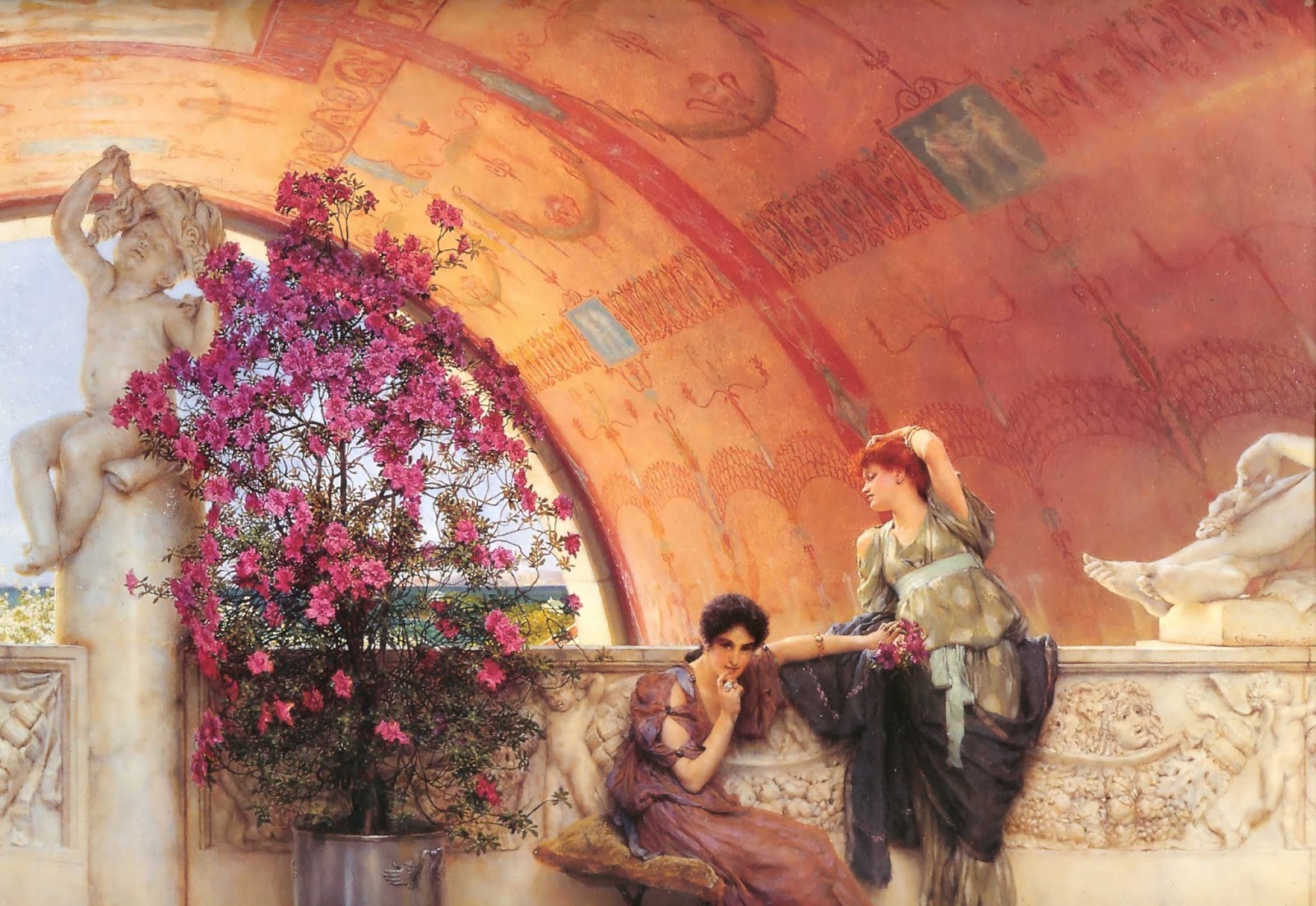
Last November, when AA and I were in Amsterdam, we took a day trip to Leeuwarden to see the new exhibition Alma-Tadema, klassieke verleiding (Alma-Tadema: At Home in Antiquity). My review of the exhibition has just been published in Nineteenth-Century Art Worldwide, which you can read here for free. One painting in the exhibition, that you see above, is Unconscious Rivals, 1893, from the collection of the Bristol Museum & Art Gallery. My own first exposure to Alma-Tadema was through  a reproduction poster of this painting in the mid-1990s, when my mother fell in love with it and we worked together at a framer getting it matted and framed. It thereafter hung in my parents' bedroom for about fifteen years. I was always fascinated by the incredible details in the picture: the glean of the marble benches; the vibrancy of the azaleas; the details in the barrel-vault ceiling. Even more intriguing, however, was the psychological relationship between the two women depicted. I remember my mother and I talking about this when we first saw it, and I think this was the added bonus, in addition to the exquisite details, that sold us on purchasing the poster and framing it.

Regardless of whether or not one likes Alma-Tadema's work, most agree that his attention to detail and ability to paint furniture, drapery, jewelry, architectural settings, etc., are noteworthy. As I write in my review of the exhibition, I was eager to see this particular painting in the show, more so because of my own personal connection to it through that poster. On first seeing Unconscious Rivals in person, however, I admit I was a little disappointed because it is smaller than I had anticipated. This is not an uncommon experience after first engagements through reproductions. But the more closely I examined the painting, the more I could see that it was a jewel of a picture with intricate details like the azaleas, which are almost too hyperrealistic in their depiction.

The scene shows two young women who respond differently to an unseen man with whom each of them, unbeknownst to the other, is in love. (The man, presumably a soldier, is represented by the legs and sword of an ancient statue of a seated gladiator.) This narrative in the picture was part of the tradition of nineteenth-century genre painting, which audiences of the day appreciated and understood well. However, while traditional genre painting offered a moral message, here aesthetics take precedence and the depiction of the two women is more a statement about beauty rather than morality. The viewer (then and now) can identify with them, sympathizing with the shy temperament of the brunette who gazes toward the picture plane with a sheepish smile, or responding sensually to the vivacious red-head (a Pre-Raphaelite trope of the femme fatale) flirting with the lover below the balcony. The painting is a reinterpretation of the allegorical sacred and profane that stretches backward to Titian and forward to Freud. Alma-Tadema’s Unconscious Rivals relies on this form of empathy that transcends time and nationalism to make its point. It appeals to audiences to identify with these women emotionally, regardless if the women or the viewer are ancient Roman, British Victorian, or twenty-first century Dutch or American. It is, indeed, a beautiful painting. You can see more of his paintings, and some gallery views from the exhibition, in my review.

Sunday, October 30, 2016

MWA XLIII: Carpeaux's Ugolino

Previous Monthly Work of Art posts around Halloween have included dark works by Goya and Caravaggio. In 19th-century sculpture it is often difficult to find what one can call a "Romantic" work, i.e. a figure who conveys more emotion in its representation, rather than an example of austere beauty or naturalism. One exception is the disturbing and arguably frightening group statue crafted by the French sculptor Jean-Baptiste Carpeaux (1827-1875) entitled Ugolino. Designed to be his 4th-year work while a student at the French Academy in Rome, the large-scale figural group took longer than anticipated. He began in 1857 and completed the large-scale plaster cast in 1861. He himself was uncertain whether the subject would be better appreciated in bronze or marble, and both were eventually made. A bronze cast is in the Musée d'Orsay, but personally I prefer the marble version made in 1865-67 and now at The Met.

The marble sculpture measures almost 2 meters (78 inches) in height and weighs almost 5,000 pounds. The subject comes from Dante's Inferno, Book XXXIII, recounting the story of Ugolino (ca. 1200-1289), the tyrant of Pisa whom Dante and Virgil meet in the Underworld:

... When I beheld
My sons, and in four faces saw my own
Despair reflected, either hand I gnawed
For anguish, which they construed hunger. Straight
Arising all they cried, "Far less shall be
Our sufferings, sir, if you resume your gift;
These miserable limbs with flesh you clothed;
Take back what once was yours."

Ugolino had been imprisoned by his enemies, along with his 2 sons and 2 grandsons, all of whom died while in prison. Ugolino reportedly ate the flesh of his sons and grandsons in order to survive. Here, though, Dante has Ugolino claim that these men pleaded with him to eat them out of filial piety. Dante is not read by most people today, so at first seeing this sculpture in person one may not understand its context. However, once the viewer discovers the subject, there is an immediate sense of horror, but also sympathy. Carpeaux convinces the viewer of Ugolino's anguish as he contemplates survival in a desperate situation, while these men and boys around him die. This work is one of the most haunting sculptures of the 19th century.

The work was inspired by the ancient sculpture of the Laocoön and owes a great deal to the influence of Michelangelo. In the recent exhibition catalogue on Carpeaux, Edouard Papet writes: "Carpeaux's Ugolino remains a work of profoundly Romantic and pictorial inspiration. ... Like all of Carpeaux's monumental works, Ugolino was the product of a complex integration of disparate sources, both literary and visual, the latter absorbed on-site or in reproductions. This synthesis was combined with a nervous curiosity and irrepressible desire for formal renewal, which, in the days of eclecticism, in no way meant starting from a tabula rasa. ... Ugolino presented all the necessary features: structural complexity, narrative, terribilità, and a variety of expressions. ... Carpeaux's composition closes in upon themselves the open forms of the antique drama of Laocoön and turns it in on itself, while retaining its fundamental elements: nudity, a central paternal figure, conspicuous muscularity, the dying adolescent on the right, and the contrast between a body in its prime and youthful anatomies."

(Translation from Dante and quote: Edouard Papet, "Ugolino," in The Passions of Jean-Baptiste Carpeaux [New York: Metropolitan Museum of Art, 2014], 66-69.)

Tuesday, September 27, 2016

Gibson Exhibition and Essays

bklynbiblio readers may recall that my doctoral dissertation was on the British sculptor John Gibson (1790-1866), about whom I have blogged a few times over the years. (The image you see here is a ca. 1850 portrait of Gibson by Edwin Landseer, from the collection of the Royal Academy of Arts in London.) My dissertation was the first in the United States--and, I believe, in the United Kingdom--on the artist. Since I finished and defended, I've been working on spin-off essays. One of these was published last December, focusing on Gibson's interest in reproductive media such as prints, statuettes, and cameos as a way to disseminate the classicism for modern audiences.

Last week another essay of mine, entitled "The Sculptor, the Duke, and Queer Art Patronage: John Gibson's Mars Restrained by Cupid and Winckelmannian Aesthetics," was released in the new book Rome, Travel and the Sculpture Capital, c.1770-1825. The book was edited by my colleague Tomas Macsotay, whom I met years ago when we were both in Leeds on different fellowships. This latest essay may seem familiar to some as I have presented different versions of the subject at conferences in Montreal and Storrs, Connecticut. This is standard practice, as it allows for opportunities to "test the waters," so to speak, and see how arguments are received by peers before publishing them. I reread my essay on the subway today and, while I think it still holds up, I confess my chronic (obsessive?) need to re-edit my own work makes me wish I had changed a few things. For instance, I think that in a revised version I would likely not be so "all"-encompassing in certain parts, and qualify matters by saying things like "selective" and "most" instead. Nevertheless, I am hopeful that the essay is a valuable contribution to the literature on the homoerotics of neoclassical sculpture, and that it will add to an increased appreciation on Gibson himself.

Later this year I have another Gibson essay coming out in the book The British School of Sculpture, c.1760-1832. This forthcoming essay relies more on biography and art-historical interpretation to consider the origins of Gibson's training and career before he moved to Rome in 1817 and set up a studio where he lived the rest of his life. That essay should be released around the time I go to a planned study day on Gibson in mid-December. This meeting (details are still under wraps) will be held in association with the new exhibition John Gibson RA: A British Sculptor in Rome, which opened a few weeks ago at the Royal Academy in London. Among the works on display is this one: The Meeting of Hero and Leander, ca. 1842, plaster (Collection: Royal Academy). This exhibition commemorates the 150th anniversary of Gibson's death, but surprisingly it is also the first monographic exhibition of Gibson's work since he died in 1866. Because he had bequeathed a substantial sum of money and numerous plaster casts and drawings to the RA, perhaps there never was a need to hold an exhibition in his memory as his bequest led to the opening of the Gibson Gallery to allow visitors and students to learn directly from his classical figures from the nineteenth century. But of course no one from his day foresaw the decline of classicism and the rise of abstraction, so that by the 1960s it is not surprising to know that the Gibson Gallery was taken down and the works scattered about and kept in storage.

This new exhibition has been curated by my colleagues Annette Wickham and Anna Frasca-Rath. There is a small publication, but to date I have not seen it, or the show, so I cannot comment on them. Anna (who completed her dissertation on Gibson in Vienna about a year or so after me) also has spear-headed the beautifully-designed online digital project The Gibson Trail, which provides images of his works with short essays, as well as a map outlining a 6-mile circle in London where one can view examples of his sculptures at places such as Westminster Abbey, the Tate, Buckingham Palace, and of course the RA. It's all quite impressive. In fact, I admit I'm a little envious of what they've accomplished. When one works so hard on a project, particularly a monographic project, one often becomes possessive over their individual. As a result it is difficult to acknowledge that one doesn't "own" that artist and that others are allowed to do work on him/her as well. In fact, they likely are doing equal (or even better!) work than oneself. So, inevitably, there can be a feeling of competition among us. (Some academics relish in this competition; these same academics also need serious therapy.) That said, one hopes that we still celebrate our collective achievements, because we are all working on the belief and spirit that this artist's masterpieces deserve reexamination and his career reevaluated and triumphed for what he accomplished at a particular moment in time. I am looking forward to seeing this exhibition and participating in the upcoming programs later this year. It will be a great opportunity for all the "Gibsonites" to come together and have a collegial meeting of the classical minds.

Tuesday, March 29, 2016

London 2016: Day 1


I'm back in the UK for a few days of research and exhibitions, so I'll see if I can maintain a daily blog highlighting what will have transpired. Not surprisingly, we departed late from Newark on Sunday evening, and arrived late into Heathrow. Not impressed by United's entertainment options, nor their food, on this trip. The trend toward using your own hand-held devices seems like a cop-out to me for the airlines to provide services, as prices keep increasing. And dinner was not appetizing at all. In any case, what did startle me was how quiet Heathrow was when we arrived, and how quickly we got through immigration. At first I couldn't imagine what was going on, but then I realized it was a bank holiday, Easter Monday, so oddly fewer people were actually working. In any case, the long day was ahead of me--making sure I stay awake!--and so I took the Heathrow Express and then a taxi to my hotel where, fortunately, my room was ready so I could rest and freshen up.

After doping up on more coffee and a sandwich at Costa (why, of why, has neither Caffe Nero or Costa made it across the pond to the U.S.? Starbucks needs more competition!), I could see that the streets were quieter than usual for the holiday. I made my way via the Northern line on the tube to Charing Cross, then walked to the National Portrait Gallery to see the exhibition "Russia and the Arts: The Age of Tolstoy and Tchaikovsky." It was a small exhibition of portraits of Russian writers, musicians/composers, and thespians, all from the collection of the State Tretyakov Gallery in Moscow, what was once the private collection of an individual art collector. I was inspired to see this because of having recently finished reading Anna Karenina, so it was useful to see a few paintings I am less familiar with contemporaneous to Tolstoy's novel (1877) and late nineteenth-century art. Not surprisingly one could see the influences of Realism and Impressionism, and a few Cubist-style works from the 1890s that predate Cubism itself by a decade. The painter Ilia Repin stood out as clearly the most talented painter of the group, which may explain why he is the one name that appears in surveys of 19th-century European art. His life-size, whole-length portrait of Baroness Varvara Iksul von Hildenbrandt, which can be seen by clicking on the link above, was the highlight work in the show. Overall the show was interesting, but I was done in 20 minutes.

After stopping for a lovely blackberry-apple tart and English breakfast tea (yes, more caffeine needed) at the National Cafe, I went to see the exhibition "Delacroix and the Rise of Modern Art." At an entry price of 15 pounds, I have to confess I was not impressed. Why oh why could they not just have an exhibition about Eugene Delacroix and his contemporaries? Why justify all the accomplishments in Delacroix's use of color and Rubenesque brush stroke by simply showing how more famous names like Renoir (yuck!) and Gauguin (more yuck!) were influenced by him?! Delacroix was an amazing artist and clearly changed the entire realm of 19th-century French art. The image above shows one example of a painting by him in the exhibition: Lion Hunt, 1860-61, from the collection of the Art Institute of Chicago. This was, in fact, the iconic image used as the headliner for the exhibition and it is arguably the best picture in the exhibition by Delacroix. It is just disappointing that half of the works in the show were by this masterful painter. I certainly would have preferred to see an actual Delacroix exhibition. I spent the rest of the afternoon (after another snack) walking through the National Gallery to see their incredible painting collection, one masterpiece after another.

Sunday, January 17, 2016

First Snowfall: 2015-2016 Winter...and Picasso at MoMA

When you consider that our first snowfall last fall/winter took place around Thanksgiving 2014, it is actually rather surprising that today, January 17, 2016, is the first snowfall of the 2015-2016 winter. And aptly timed for this blog, as I just posted about snow and winter landscapes earlier today. AA and I had brunch on the UWS with JDN, and then AA and I went to the Museum of Modern Art to see Picasso Sculpture, the exhibition about which the critics have been raving.

I hate the crowds and lines at MoMA, but we still were able to get a good look at a number of pieces. It is actually an interesting show to see how Picasso's sculptural styles and media transformed over the decades. There was an introductory wall panel for each room; however, there were no wall labels for the objects on display. At first this was disconcerting, although I quickly realized people had picked up free booklets with all the object information detailed in their hands, or they were listening to podcasts on their iPhones or hand-held devices. Rather than follow their lead, however, AA and I just wandered and gazed at various sculptures we could get close to, and we talked about them without really having complete contexts on which to base them. In many ways it was a more refreshing experience because we focused more on the materiality and design of the sculptures. At one point I even noted that if we dropped Picasso's name from the show entirely, it still was an interesting survey of modernist sculpture over the decades with some excellent works of art. For an artist known to people as a Cubist and hence abstract artist, it was fascinating to see how figurative his sculptures actually were, i.e. faces of his lovers, friends, animals, etc. Even his Cubist-style sculptures were more figurative than one might imagine. We also walked through the Joaquín Torres-García exhibition. I was only familiar with the Uruguayan artist as part of the Barcelona group of circles who moved from Art Nouveau to Surrealism. It was an interesting survey of his career. His own particular Cubist-brand of Surrealistic symbolic language in gray and white, ca. 1930, was clearly the apex of his oeuvre, but after a while the pictures all seemed to be highly repetitive and lacking individuality to my eye.

It had started snowing before we got into the museum, and it was seriously coming down when we left about 4:15pm. The picture you see above I took at the intersection of 79th St. and Broadway, and the brief 5-second video you see here I took outside MoMA on 54th St., and shows you how fast the snow was coming down. It is not sticking to the ground, so we can't call this the first snowstorm of the season, but as I mentioned in my previous post it is still wonderful to watch it fall. I stayed outside longer, walking in the snow, just to relish the cool wetness of it on my head and face.

Sunday, January 3, 2016

Art Exhibitions of 2015


The end of each calendar year brings out all the art critics to write about the best art exhibitions they experienced that year. Because we live in the NYC area, with an incredibly rich cultural scene, we are fortunate that there is so much to see. Here, for instance, is the link to Holland Cotter and Roberta Smith's article on the best in the art world in 2015, which is quite comprehensive if thematic in its arrangement. Conscious of geography and its limitations to lists, I like that Hyperallergic does separate reviews for NYC and other parts of the world in their annual rankings, to create a more level playing field, it would seem. As for me, since I don't have the luxury, liberty, or time to see every exhibition in NYC, let alone in the world, I can only base my list on what I have been fortunate to see. This year I did see a lot, including a number of new museums and collections for the first time, listed at the end of this post. Below is my annual summary of what I felt were the best shows I saw this year (here is last year's post). And, for the record, I should note that I have not yet seen Picasso Sculpture at MOMA, partly because going to see an exhibition there is a total nightmare. Fortunately, it closes in about a month from now, so I still have time.

I still am surprised that no one I have encountered, read, or spoken to, ever saw what I consider to have been one of the best shows of 2015. Entitled Body and Soul: Munich Rococo from Asam to Günther, this exhibition (installation view above) brought together over 160 sculptures in polychrome wood, terracotta, silver, and stucco, as well as drawings and paintings and prints by a number of largely unknown sculptors based in Bavaria during the 1700s (hence the eponymous Asam brothers, Cosmas Damian and Egid Quirin Asam, working early in the century, to Ignaz Günther at the end). This exhibition was installed at the Kunsthalle in Munich, a space for rotating special exhibitions. The installations of many of these works was simply stunning. The exhibition was ecclesiastic in its focus (Bavaria, unlike the rest of Germany, historically remained Catholic), so one saw mostly angels and saints in the show. Normally installed in churches, cathedrals, and chapels, these works typically are part of elaborate, intricate architectural settings and interior spaces. Removing them and putting them on exhibition in this way, however, gave the viewer the opportunity to appreciate them as individualized works of art, with an emphasis on the sculptural quality of these figures, i.e. their materiality and craftsmanship, and occasionally their hyperrealistic theatricality. At the same time, removing them from their usually-ornate environments, the viewer appreciated how their contorted, exaggerated forms make them seem proto-surreal and modern. The image you see above was just one of the many rooms in which the stunning display of larger-than-life figures impressed viewers. It is unfortunate that this exhibition did not get more attention internationally. Despite the national focus, I suspect it is because it was largely religious in nature, and religion does not usually do so well with audiences today.

Two other sculpture shows that are high on my list derive from the ancient and contemporary art worlds. In Florence I saw at the Palazzo Strozzi the exhibition Power and Pathos: Bronze Sculpture of the Hellenistic World, which showcased intricate and often naturalistic works of art crafted from the period between Alexander the Great's death in 323 BCE and the foundation of the Roman Empire in 31 BCE (image left: Victorious Athlete, 300-100 BCE, bronze and copper, Getty). Drawn from collections worldwide, many of the objects were presented with interesting didactic panels that provided a broad context from how the bronze figures were made to their socio-economic and political uses. The exhibition was co-organized with The J. Paul Getty Center, and is currently still on show at present at the National Gallery in Washington, DC until March.

In contrast to this ancient survey, the exhibition of works by Doris Salcedo at the Guggenheim here in NYC was absolutely worth visiting. I was first introduced to Salcedo a few years ago when she did the infamous "crack" Shibboleth in the floor of the Tate Modern Turbine Hall, which had some interest but seemed to rely too much on the conceptual for my taste. This year, however, the exhibition of a selection of her work clearly revealed her focus on her heritage growing up in Colombia during turbulent years in its history. Her works address violence, racism, and misogyny, but they also fool the mind with their use of unusual materials and the juxtaposition of hard and soft media that confuses the mind. The installation view seen here shows a series of historical wooden pieces of furniture that have had concrete poured into them. Making them useless as furniture, they take on a new function as archaeological monoliths that question ideas about the domestic sphere. An installation piece that changes with each space, these incredibly heavy objects challenge one's ideas about what constitutes space itself, then, and in the spirit of sculpture-as-objects the viewer is forced to engage with them in a way that blocks your entry and exit. Their monumentality and gravitas were provocative and almost tangible. The two criticisms I had about this exhibition, however, was that it was spread out through the galleries at the Guggenheim in a way that I found disconcerting and fractured. Secondly, it was absurd of the designers not to make the wall texts and panels bilingual. In this day and age in America, curators and designers have a responsibility to create Spanish texts in addition to English texts whenever they exhibit a Latino/a artist. (Brooklyn Museum successfully did this with their Francisco Oller exhibition, but alas I was not as thrilled about that show overall.)

Shirin Neshat: Facing History was on exhibition at the Hirshhorn Museum in Washington, DC, when AA and I visited there in June. Like with Salcedo, I had seen a few of Neshat's photographs and one film in the past, and was intrigued by her work, but this retrospective was amazing. I would go so far as to say it is #2 on my list of the best exhibitions I saw this year. Born in Iran in 1957, Neshat left in 1975, and her art work since then has addressed the turbulent politics of Islam and Iran's relationship with the West. She has staged historical recreations of important political events, uses multiple cameras to personify the divided worlds of men and women, and hand-manipulates exquisite black-and-white and color photographs with Persian texts, all in to draw attention to the crises we face in our ongoing political battles between Iran and the West to this day. Neshat is one of those artists whose work continues to have more relevance with each passing year as jihadists in the Near East continue to strike fear in the hearts of everyone--Christian, Muslim, Jew, Buddhist, everyone--in the world. The image you see here is a manipulated photograph from her 1993 series I Am Its Secret (Women of Allah) [Photo: Plauto © Shirin Neshat].

On my list, I would next say that #3 is Archibald Motley: Jazz Age Modernist. On display at the new Whitney Museum of American Art, this show was an absolute delight. African-American of mixed-race heritage, Motley (1891-1981) was trained academically, but was influenced by modernist trends after World War I. His portraits of blacks, whites, and mixed-race people emphasize the wide array of complexions and social standings that exist in our world. He celebrated the advancements and opportunities that jazz gave to blacks in America and Paris, and clearly loved music and dance. The painting you see here, Tongues (Holy Rollers), 1929, is an exploration of the spirituality endemic in some black communities, but you also can see in the movement of their bodies that this is a dance, a paean to life-as-spirituality, and how jazz is influencing even how one can think about religion. This exhibition taught me about an American artist whose work I had little exposure to before now, and showed me beautiful paintings that made me go through the exhibition more than once to absorb all the colors, forms, compositions, and sensations. It made me appreciate yet again how incredibly fascinating the 1920s were in American art, a statement I have been making ever since I saw the incredible show Youth and Beauty: Art of the American Twenties at Brooklyn Museum in 2011. To wrap up this section, I should add that the Whitney Museum also deservedly gets kudos for the new Renzo Piano building in the Meatpacking District. They have done an amazing job of integrating public and private space, outdoor and indoor space, in one building, and in so doing have unexpectedly also created a charming new community in a neighborhood that culturally was on the rise but now has taken off.

To wrap up this post here are a few other honorable mentions from exhibitions I saw this year:

  • I was delighted I had the opportunity to see Flaming June by Frederic, Lord Leighton, at The Frick (image right). This painting is one of those great pictures from posters and postcards that first inspired people to look anew at Victorian painting (even I had a poster of it!). Seeing this picture in person reminded me that Leighton is painterly and has a lush brushstroke, even though images make him seem to be a slick, linear classicist. Viewers love this painting for its sensual depiction of the young woman in her diaphanous draperies, and it does not disappoint in person. I also liked how the Frick installed the picture by two of their ladies by J. A. M. Whistler, cleverly demonstrating how the two were part of the Aesthetic Movement, which emphasized beauty in art without subject or moral meaning, but painted so differently.
  • At the Metropolitan Museum of Art this year, one of their big successes has been Kongo: Power and Majesty, which I saw not too long ago. It is indeed an excellent installation and does a good job of not only showcasing beautiful examples of African art in numerous media, but also engaging well with issues such as slavery and post-colonialism with the Portuguese trade of this area from the 1600s to the 1900s. 
  • Another great Met Museum exhibition was Sargent: Portraits of Artists and Friends, not because it was a wonderful installation, but because everyone just loves gazing at and revelling in John Singer Sargent's bravura of a brushstroke. 
  • In contrast, Navigating the West: George Caleb Bingham and the River was not necessarily a beautiful exhibition, but it was very interesting learning more about this 19th-century painter based in Missouri drawn from scientific analysis of his paintings and looking more closely at his contemporary sources. 

I will close this post by noting that I was fortunate to visit a few museums for the first time this year. These were, in no particular order: the Nelson-Atkins in Kansas City; the Barnes Foundation and the Pennsylvania Academy of Fine Arts in Philadelphia; the Galleria Nazionale dell'Arte Moderna in Rome (amazing unknown 19th-century art); the Guildhall Art Gallery in London (Victorian pictures galore!); and Dia:Beacon in upstate New York (whole new appreciation for Sol LeWitt's wall murals). I also had a great research trip to Boston and visited for the first time the Isabella Stewart Gardner Museum and the reconstituted Harvard Art Museums, and revisited for the first time in almost twenty years the Museum of Fine Arts, Boston. Amazing art, collections, installations, and exhibitions in these places...2015 was quite a great year.

Sunday, September 27, 2015

San Francisco 2015


I'm writing this blog post from my hotel room in San Francisco. I arrived today and will be here just for a brief couple of days. This is work-related. We have a painting at Columbia that will be on loan to the de Young Museum for its upcoming exhibition Jewel City: Art from San Francisco's Panama-Pacific International Exposition. I am here to oversee installation and make sure our painting (a gorgeous 1913 landscape by Arthur Wesley Dow), which traveled cross-country, made the trip in good condition. Our painting was in the Expo in 1915, a century ago (I will likely share that work soon, so stay tuned). The picture you see above is the Palace of Fine Arts, built for the Expo, and the work is by Edwin Deakin, showing rather Impressionistically one of the main buildings and the lagoon. I was able to visit this area, along with doing so many other things, when I was Frisco-bound two years ago on vacation here. Indeed, I must say, thanks to AA we saw so much on that trip that I think I have seen all the primary highlights here, including the de Young and the Asian Art museums, rode the cable car and a trolley, saw the Redwood forest in Muir Woods. drove across the Golden Gate Bridge, even took a ferry to Sausalito, and went to Napa and Sonoma overnight for wine-tasting trips. It was a great visit, thanks almost entirely to AA. So this afternoon as I wandered around a bit, I was quickly reminded of a few things, and how insanely crazy the hills are! It was great to have another peak at the Golden Gate Bridge in fog and see the Bay. Time to think about dinner though...

Monday, March 16, 2015

Review: Sculpture Victorious

Toward the end of December, I had included in my annual round-up of favorite art exhibitions Sculpture Victorious: Art in an Age of Invention, 1837-1901, aka the long-awaited Victorian sculpture exhibition. It was held in New Haven at the Yale Center for British Art, and currently is on show at Tate Britain. I'm actually a little frustrated because I wanted to see the exhibition again when I go to London in a few months from now, but the show is scheduled to close a week before I arrive. In any case, I'm very glad I had the opportunity to see it in its version at Yale, and I'm pleased to share that my exhibition review in the Spring 2015 issue of Nineteenth-Century Art Worldwide has just been published. This open-access, peer-reviewed journal is free to read, so you can see my review by following this link: http://www.19thc-artworldwide.org/index.php/spring15/ferrari-reviews-sculpture-victorious-art-in-an-age-of-invention.

The image you see above is one of the smaller, technical marvels in the exhibition, a hand-sized figurine of Queen Victoria made by a machine, a work that was but one of the many in the show that celebrated the union of man and technology during the Victorian age. Here is what I wrote about it: "Displayed in vitrines to the left and along the wall [in the entrance] were miniature, mass-produced representations of Victoria available to middle-class consumers, derived from official images of the monarch such as the busts [seen nearby]. One amazing feat of artistic, technical ingenuity, developed early in Victoria's lifetime, was the sculpture-reduction machine. Prototypes had been designed and utilized by James Watt and John Isaac Hawkins, but by 1828 Benjamin Cheverton had launched the most commercially viable machine. His replica of [Sir Francis] Chantrey's bust of the queen, in ivory on a stone socle, measures about 7 inches and dates from 1842. The carving arguably reveals its mechanical origins, but the delicacy in its handling and details is still extraordinary." (Image: Victoria and Albert Museum)