Showing posts with label writing. Show all posts

Saturday, January 4, 2020

Projects of 2019

Here's my annual list of professional "projects" that I was involved in and overseeing during 2019. (You can read previous lists here and here.) As I've mentioned in the past, it's good to take stock of these accomplishments because it helps remind me how busy things have been, particularly as I have a tendency to always move on to the next project and forget what I've already done. The photo you see here is of me giving the introductory remarks at an event I coordinated in April, an "Evening at Avery: British Portraiture", to coincide with the exhibition I co-curated (more on that below; no idea whose head that is in the photo!). The event had a surprisingly good turn-out, and our two speakers were Mateusz Mayer, PhD student in art history, who co-curated the exhibition with me, and Dr. Meredith Gamer, assistant professor of art history at Columbia who gave a riveting talk about alternative concepts of 18th-century British portraiture for those who are often forgotten by history and society.

Here is the 2019 list...

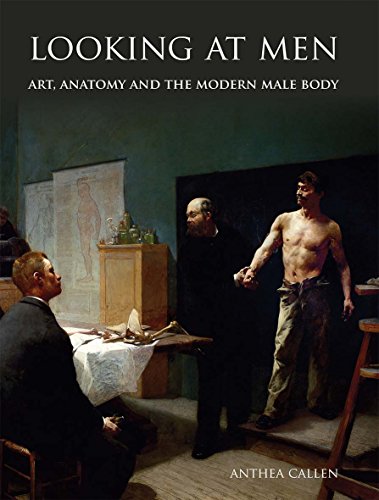
  • I published two book reviews, which I mentioned about in my Books of 2019 post as well. The first was a short review on Beyond the Face: New Perspectives on Portraiture, about which I posted even more. The second was a review essay in Nineteenth-Century Art Worldwide on Anthea Callen's new book Looking at Men: Art, Anatomy and the Modern Male Body.
  • I curated at work a summer exhibition entitled Animalia: The Essence of Animals in Art, with artwork from the permanent collection dating from 3rd-century Mexican dog sculptures to contemporary Inuit sculptures. During the winter/spring, I co-curated the exhibition Hoppner, Beechey, Fisher, Lavery: Researching Columbia's Portraits with M. Mayer, and we published online a catalogue of the exhibition with essays by both of us, which you can download and read here. My staff and colleagues at work deserve lots of credit for all their help in making these exhibitions possible.
  • I acted as curatorial project manager with Dr. Frederique Baumgartner on the "MA in Art History Presents" exhibition at Columbia entitled Clodion (1738-1814) and "Clodion Mania" in Nineteenth-Century France, which has a fantastic online exhibition component you can see here.
  • Tomas Macsotay and I co-chaired a panel session entitled "Transnationalism and Sculpture in the Long Nineteenth Century (ca. 1785-1915)" at the annual conference of the College Art Association in February in NYC.
  • I served on the selection committee & jury for the 16th annual graduate student symposium co-sponsored by the Association of Historians of Nineteenth-Century Art and the Dahesh Museum of Art in March in NYC.
  • I was the guest speaker at a Columbia Alumni Association of New Mexico event, where I spoke about the collections and our educational programs to alumni. This took place in Santa Fe, New Mexico in September.
  • Columbia's Department of Art History and Archaeology had received a small grant to coordinate an international project called Parallel Heritages, with some of their students and students at The Sorbonne, Univ. Paris I, for an international research project on archaeological objects in both collections. I gave presentations at both components, in NYC in March, and in Paris at The Sorbonne in November.
  • I also gave a paper entitled "British Portraits at Columbia University: Opportunities for Object-Centered Learning" at the annual Understanding British Portraits seminar, held at the National Portrait Gallery in London in November.
  • I participated in the annual conference of the Association of Academic Museums and Galleries in June in Minneapolis, Minnesota.
  • Totally not work-related, but worth documenting... in February AA & I took a fantastic wine-tasting class that was incredibly informative (we are doing a repeat, focused version on Italian wines later this month), as well as a fun cocktail making class in December. We also went to go see the opera The Magic Flute at the Metropolitan Opera and Moulin Rouge on Broadway.
All in all, another incredibly productive and fulfilling year!

Sunday, April 14, 2019

British Portraits at Columbia Catalogue

Just over a month ago, I blogged about the new exhibition about four British portraits that we have on view at Avery Architectural & Fine Arts Library. The paintings are from Columbia's permanent collection. I'm pleased to share the news that the pamphlet-type catalogue we've published is now available for free to download from Columbia's Academic Commons network (click here). I'm incredibly pleased with this came out, which is a testament to the incredible design skills of Katherine Prater, one of my co-workers. The essays are extended versions of the didactic panels Mateusz and I wrote.

Ten days ago, on April 4th, we hosted an invitation-only Evening at Avery to celebrate the exhibition and bring more paintings out to show. Dr. Meredith Gamer was our keynote speaker, and my co-curator MM and I also gave brief talks that were well-received. My thanks to Paul Jeromack for sending me pictures he took from the evening, which I am posting here.


Saturday, March 16, 2019

Review: Beyond the Face (and Carrie Mae Weems)

Earlier this month, ARLIS/NA Reviews published my short review on the new book Beyond the Face: New Perspectives on Portraiture, which was published in 2018 by the Smithsonian Institution, National Portrait Gallery, as part of its 50th anniversary celebration. Edited by curator emerita Wendy Wick Reaves, the book includes her introduction and sixteen essays by junior and established scholars on aspects of American portraiture. You can read my review here. The book truly does offer new insights into thinking about American portraiture, historical and modern/contemporary, with a particular emphasis on non-white artists and representations thereof. The essays on photography were among the most interesting, and I mentioned in the review that one scholar's take on a photograph by Carrie Mae Weems was brilliant. I thought I would engage with that a little more here.

Nikki A. Greene's essay, "Habla LAMADRE: Maria Magdalena Campos-Pons, Carrie Mae Weems, and Black Feminist Performance," focused on these two women artists, but more importantly engaged with the way that women of color have been excluded historically as makers of art from the great museum collections and exhibition programs. Weems's 2014 exhibition at the Guggenheim Museum was unprecedented, as she was the first African-American woman to have a show there. I remember the exhibition well; it was incredibly moving and powerful. Weems's photographs from her Museums series position the artist as a Ruckenfigur, displaying her body shrouded in black to the viewer as she stands outside the great cultural institutions and museums worldwide as an outsider. In her essay, Greene writes of the image you see here, Guggenheim Bilbao, 2006, as follows:
Weems journeyed to northern Spain ... to encounter the seduction of the sweeping, undulating, titanium walls of the Guggenheim Museum Bilbao, designed by Frank Gehry and completed in 1997. In the photograph Guggenheim Bilbao, Weems stands as a dark silhouette in her black, long-sleeved dress with her back to the viewer .... Weems stretches her arms outward to rest her hands on a white railing that heightens the chasm between her and the museum as water gently ripples below her. The framing of this photograph plays on the building's ship-like forms, with stern-like triangular peaks making Weems appear as if she is viewing the museum across a body of water from her own ship. Weems's serenity in the face of the immensity of the museum's presence grounds the viewer, encouraging a pause as the two ships purportedly confront each other. This moment of recognition of each other's position in space acknowledges their unreachability. (pp. 294-95)
What Greene also intimates with this ship-like allusion is the history of the transatlantic slave trade and the ongoing legacy of slavery as a hindrance to people of color, in this instance in an art world dominated by white privilege and the 1%. Greene's reading of this image is wonderfully intuitive.

The next book I'm scheduled to review for a publication is this: Looking at Men: Art, Anatomy and the Modern Male Body by Anthea Callen (2018). The book focuses on the nineteenth century. It should prove an interesting read, incorporating issues of science and medicine along with artistic practice, framed by the development of heterosexual, homosocial, and homosexual identities over the course of the century. Or so I hope!

Saturday, January 12, 2019

Projects of 2018

Here is my last "highlights" list from 2018...a little late, perhaps, but not by much... (Here is the 2017 list.) I've discovered it's beneficial for me to record these events because it helps me take stock of the activities I've been involved with and what I've accomplished. I have a tendency to forget things and move on, and reflecting on these things annually makes me realize that I am doing quite a lot professionally and that I need to stop being so self-critical about what it is that I am not doing.

The picture you see here commemorates one of the more memorable events. In early October, I joined my fellow Solomaniac friend & colleague Carolyn Conroy and numerous descendants of the Solomon/Salaman family for the rededication of the Salaman family graves and a visit to the recently rededicated grave of Simeon Solomon, all at Willesden Jewish Cemetery in London. It was a special and humbling moment to be there.

In addition to all our travels (professional and vacation), here is the 2018 list of projects...

Wednesday, October 17, 2018

Statue of a Countess

I am pleased to share the news that my latest article, "Between Venus and Victoria: John Gibson's Portrait Statue of the Hon. Mrs. Murray, Later Countess Beauchamp," has just been published in Nineteenth-Century Art Worldwide (along with a number of other very interesting essays by some colleagues I know that I look forward to reading). My essay discusses for the first time the portrait statue you see here that Gibson made for the 3rd Baroness Braye of her widowed daughter Catherine, who later married Earl Beauchamp (pronounced "Beecham").

The statue was commissioned in 1842 when the Baroness and members of her family were on their grand tour in Rome, and it was completed in 1846. Gibson exhibited the marble statue at the Royal Academy that year, where it received mostly positive feedback, but one critic rather surprisingly compared it to the Hottentot Venus. (You'll have to read the article to learn why!) The Baroness and her daughter were friends with Gibson for many years, and he often visited them at their London home and at Stanford Hall, where the statue is on view as part of the family's art collection to this day. What makes the story of this statue even more remarkable is that Catherine made the bold decision to have Gibson tint it while it was still in the early days of his own experiments with polychrome sculpture (i.e. Tinted Venus). As I discuss in my essay, she received sharp criticism afterward for having done this, but Gibson urged her to "fight it out" and not give in to the critics. (Wise words I need to remember myself many days!)

I am incredibly grateful to the current Baroness Braye and her family for their generosity and hospitality in giving me access to unpublished family papers and their homes, and to the staff at Stanford Hall for responding to all my inquiries along the way. Without their encouragement and support, this article never could have come to fruition.

Wednesday, June 20, 2018

Gibson and Portraiture Essay


Back in 2016 I had blogged about the new exhibition at the Royal Academy on the sculptures and drawings of John Gibson (1790-1866). Toward the end of the exhibition's run, there was a study day held at Tate Britain, and I was honored to be invited as one of the speakers for this event. We also did a local London version of the Gibson Trail and examined closely a selection of his figures and busts in the UK capital. About two months afterward, our host for that day, M. G. Sullivan, announced that some of us had been invited to submit articles associated with that study day in Tate Papers, the peer-reviewed, free online journal published by the museum. Sullivan and I decided to collaborate and co-author an article on Gibson's portraits, basing a portion of the essay on the bust of William Bewick that is in the Tate's collection. Our essay--and three others--have now been released (click here), and I must say that I am pleased to see this one in print.

Our essay is the first to focus on his portraits, and I think we managed to convey well how, despite Gibson's general distaste for portraits, he still made quite a number. We tapped into his extant account books to record prices and heretofore unknown commissions, and examined a number of these works chronologically and culturally. The image you see above is a detail from the back of the bust of an unidentified woman, dated to the 1820s, by Gibson; the work is in the collection of the Yale Center for British Art and is a rather magnificent bust, particularly in the carving of the sweeping hairdo. The title of our essay is "'Men thinking, and women tranquil': John Gibson's Portraiture Practice." I'm looking forward to reading the other essays on Gibson's studio practice by Anna Frasca-Rath and his association with the Duke of Devonshire by Alison Yarrington (a subject I've written about as well, from a queer context, but Yarrington is the world expert on Devonshire's sculpture gallery). I read the other day Susanna Avery-Quash's essay on Gibson's friendship with Sir Charles Eastlake, which was excellent. So take a look, and if you feel inclined, enjoy the reading!

Sunday, December 24, 2017

Cities and Projects of 2017


Anyone who has been following bklynbiblio for many years now of course will have noticed the general decrease in the number of posts coming from me. It's not intentional. Time (or lack thereof) has been a key factor, but I will admit that I've discovered a shift in my own attitude about life, which also has affected my blogging. That sounds a bit obnoxiously existential, but what I mean is that I find myself focusing more on living in the moment and enjoying experiences as they are happening, rather than attempting to record things afterward as a memory of an event or experience. I believe I've noted elsewhere, too, that as the world of social media has increased with various platforms, blogging is no longer my only online outlet. Facebook, Instagram, and work-related blog posts, all somehow now come together in conjunction with this blog to provide the snapshot of activities, thoughts, and events. (I still have a Twitter account, but I've largely dropped it; Pres. Tyrant has ruined it for me completely.)

I've also discovered, though, that as I'm getting older I'm having a more difficult time just remembering things the way I used to. I read a book and six months later sometimes I can't even remember the name of the protagonist. That never used to happen before, but I hear it is normal aging. (It better be!) In the spirit of commemorating good fortune over the past year, in that I have been able to see more of the world, this post is a revisit of my travels of 2017 (here is last year's post). I thought I would add this time a section of highlights of professional projects (some related to work) over the course of the year as well. I have a tendency to disregard my past professional activities, because I'm always looking toward the next one (and criticizing myself that I haven't done enough, despite what others say to me). So consider this post also an attempt on my part to slow down and recognize what I have actually done the past year, and why there have been fewer blog posts as a result. And to those of you who have been contacting me the past few months commenting how happy you are to see me blogging again, THANK YOU!

I do want to add that with all the travel either AA & I, or I alone, have done, some of the best memories have been celebrating events with family. For instance, this year AA's parents came out to celebrate Thanksgiving with us, and after that we went to Florida to celebrate Uncle Eddy's 89th birthday and then visit Epcot Center with my godchildren. Good times, indeed, were shared by all.

Here is the 2017 alphabetical list of visited cities outside of NYC...

Cambridge, England
Charlottesville, Virginia
Dieppe, France
Fairfield, Connecticut
Houston, Texas
Leicestershire/Northamptonshire, England
London, England (2 visits)
Mexico City, Mexico (well, technically, we haven't gone yet, but we will before the end of the year!)
Ogunquit, Maine
Paris/Versailles, France
Philadelphia, Pennsylvania
Portland, Maine
Raleigh/Durham/Chapel Hill, North Carolina
Rouen, France
Salem, Massachusetts
St. Petersburg/Palm Harbor/Tarpon Springs, Florida (3 visits)
Toronto, ON, Canada
Washington, D.C.

Professional Highlights of the Year (in no particular order):

  • Co-taught with Prof. Robert Harrist an undergraduate, semester-long seminar at Columbia on "Public Outdoor Sculpture at Columbia and Barnard" (including watching a bronze pouring of sculpture at the Modern Art Foundry, which was utterly fascinating and almost transcendental; see the picture at left)
  • Took a professional development course on "Basic Drawing Techniques for Art Professionals" at NYU
  • Published an essay "Before Rome: John Gibson and the British School of Art" in the book The British School of Sculpture, c.1768-1837, eds. Burnage & Edwards (Routledge, 2017; this project took seven years to see to completion, if you can believe it)
  • Published a review on the exhibition Alma-Tadema: At Home in Antiquity, at the Fries Museum, Leeuwarden, The Netherlands, in Nineteenth-Century Art Worldwide (which you can read here)
  • Took two research trips to the U.K. and did work at the National Gallery, Royal Academy of Arts, Victoria & Albert Museum and National Arts Library, University of Cambridge, and in a private collection
  • Gave a paper at the "New Scholarship in British Art History" conference at the North Carolina Museum of Art
  • Gave two separate talks on the sculptors John Gibson and Auguste Rodin at the Florence Academy of Art in Jersey City
  • Co-presented with Stephen Brown (The Jewish Museum) about artist Florine Stettheimer and her world for the EdelHaus Salon
  • Organized & led a round-table discussion called "The Power of Political Protest Art" for the exhibition ...Or Curse the Darkness at the Atlantic Gallery
  • Served on the selection committee & jury for the Graduate Student Symposium co-sponsored by the Association of Historians of Nineteenth-Century Art and the Dahesh Museum of Art
  • Participated in a study day on Pre-Raphaelite art and design at The Metropolitan Museum of Art
  • Participated in a workshop on the care and preservation of paintings, sponsored by the Conservation Center for Art & Historic Artifacts
  • Attended the College Art Association conference in NYC
  • Attended a Q&A talk with Jed Perl and the Calder Foundation on the release of the first volume of Perl's biography on sculptor Alexander Calder
  • Had outpatient surgery with a relatively lengthy, painful recovery (okay, so this wasn't a professional event, but it did take its toll on me this year), and
  • Went to see on Broadway Get on Your Feet!, Sunset Boulevard with Glenn Close, and Hello, Dolly with Bette Midler (again, not professional, but definitely worth recording as important events)


Sunday, April 2, 2017

MWA XLVII: Alma-Tadema's Rivals


Lawrence Alma-Tadema (1836-1912) is considered by most to be a British artist, but in fact he was born and raised in The Netherlands and did not emigrate to London until 1870. He was then a widower with two daughters trying to make a bigger name for himself in the commercial art capital of Britain. He succeeded, becoming one of the greatest names associated with the Aesthetic Movement, his London home a salon for artists, writers, musicians, composers, and actors to socialize and exchange ideas. His second wife and daughters were all painters too. What people love about Alma-Tadema today was his uncanny ability to capture imaginatively Greco-Roman lives from over 2,000 years ago as if they were people we saw in our daily lives today (or, for his contemporaries, in Victorian times). His critics, however, have a tendency to refer to his paintings pejoratively as nothing more than "Victorians in togas."

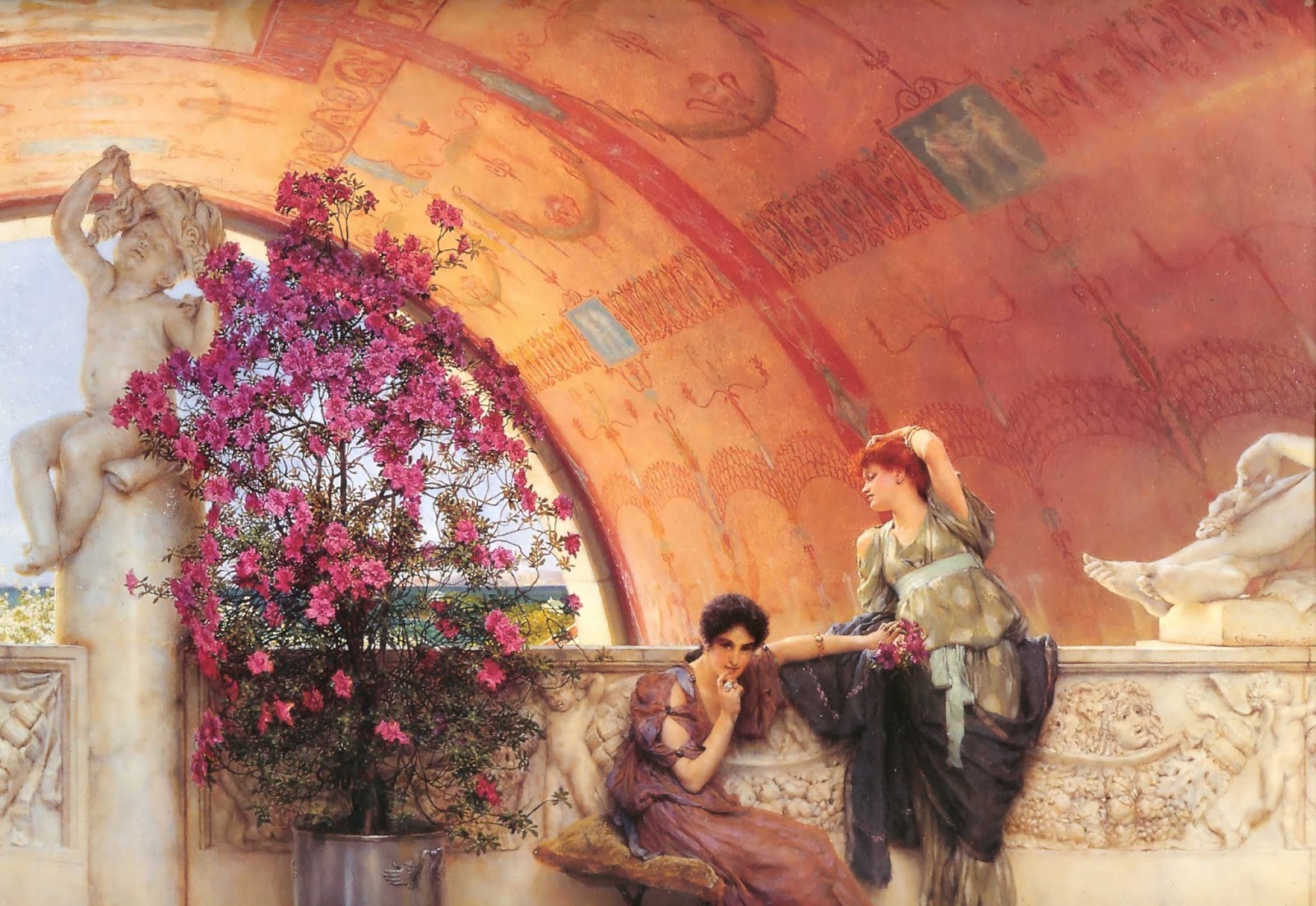
Last November, when AA and I were in Amsterdam, we took a day trip to Leeuwarden to see the new exhibition Alma-Tadema, klassieke verleiding (Alma-Tadema: At Home in Antiquity). My review of the exhibition has just been published in Nineteenth-Century Art Worldwide, which you can read here for free. One painting in the exhibition, that you see above, is Unconscious Rivals, 1893, from the collection of the Bristol Museum & Art Gallery. My own first exposure to Alma-Tadema was through  a reproduction poster of this painting in the mid-1990s, when my mother fell in love with it and we worked together at a framer getting it matted and framed. It thereafter hung in my parents' bedroom for about fifteen years. I was always fascinated by the incredible details in the picture: the glean of the marble benches; the vibrancy of the azaleas; the details in the barrel-vault ceiling. Even more intriguing, however, was the psychological relationship between the two women depicted. I remember my mother and I talking about this when we first saw it, and I think this was the added bonus, in addition to the exquisite details, that sold us on purchasing the poster and framing it.

Regardless of whether or not one likes Alma-Tadema's work, most agree that his attention to detail and ability to paint furniture, drapery, jewelry, architectural settings, etc., are noteworthy. As I write in my review of the exhibition, I was eager to see this particular painting in the show, more so because of my own personal connection to it through that poster. On first seeing Unconscious Rivals in person, however, I admit I was a little disappointed because it is smaller than I had anticipated. This is not an uncommon experience after first engagements through reproductions. But the more closely I examined the painting, the more I could see that it was a jewel of a picture with intricate details like the azaleas, which are almost too hyperrealistic in their depiction.

The scene shows two young women who respond differently to an unseen man with whom each of them, unbeknownst to the other, is in love. (The man, presumably a soldier, is represented by the legs and sword of an ancient statue of a seated gladiator.) This narrative in the picture was part of the tradition of nineteenth-century genre painting, which audiences of the day appreciated and understood well. However, while traditional genre painting offered a moral message, here aesthetics take precedence and the depiction of the two women is more a statement about beauty rather than morality. The viewer (then and now) can identify with them, sympathizing with the shy temperament of the brunette who gazes toward the picture plane with a sheepish smile, or responding sensually to the vivacious red-head (a Pre-Raphaelite trope of the femme fatale) flirting with the lover below the balcony. The painting is a reinterpretation of the allegorical sacred and profane that stretches backward to Titian and forward to Freud. Alma-Tadema’s Unconscious Rivals relies on this form of empathy that transcends time and nationalism to make its point. It appeals to audiences to identify with these women emotionally, regardless if the women or the viewer are ancient Roman, British Victorian, or twenty-first century Dutch or American. It is, indeed, a beautiful painting. You can see more of his paintings, and some gallery views from the exhibition, in my review.

Saturday, February 11, 2017

Gibson and the Watson Taylor Family

A few months ago I had blogged about some John Gibson-related sculpture publications, exhibition, and symposium. The exhibition at the Royal Academy was excellent. It's unfortunate the show was only in two small rooms (we wanted to see more!), but the designers did a wonderful job with the layout (left: one installation view I took), and colleagues Annette Wickham and Anna Frasca-Rath did a nice job with the labels, publication, and overall curatorial selection. The symposium was held in mid-December. The first day was a trek on the actual Gibson Trail. We started at Tate Britain where Greg Sullivan and Anna led discussions, respectively, about a portrait bust and a sculpture by Gibson. We then trekked along the Thames to Pimlico Gardens where I led the discussion about the William Huskisson monument. From there we had a spot of lunch, went to Westminster Abbey for a chat about Gibson's Robert Peel monument, and then went to the Victoria & Albert Museum where Holly Trusted spoke about Pandora and the Copeland miniature of Narcissus. The next day a number of us gave more formal papers. Anna spoke about Gibson's studio practice, I spoke about Harriet Hosmer and the training she received in his studio during the 1850s. We also heard talks about Gibson's working friendships with the 6th Duke of Devonshire, Bertel Thorvaldsen, and Sir Charles Eastlake, ending with Timothy Stevens (former Director of the Walker Art Gallery, now part of National Museums Liverpool) providing an overview of his thoughts about Gibson after many years of engagement with his works. It was a fantastic opportunity for all the Gibsonites and 19th-century sculpture scholars to get together and I appreciated greatly being invited to participate by the RA.

One of the publications I had mentioned in that previous post actually just came out a few weeks ago. It is an essay about Gibson's early career in Liverpool and London before he went to Rome in 1817. The book is a significant collection of what promises to be some quite interesting essays grouped under the title of The British School of Sculpture c.1760-1832, edited by Jason Edwards and Sarah Burnage. I have to say, this was one of the longest publication schedules I've ever been through. We started working on this back in 2010 and it took until 2017 for it to be released. I was a little worried about how dated my essay would seem at this point, but after a quick reread when the book arrived, it seems like it holds up well, although it is extremely dense in its historical details. One component of my essay deals with the Watson Taylor family, who in 1816-17 commissioned six portrait busts from Gibson: Mr. and Mrs., and their four children (there was later a fifth child whose bust was carved by Edward Hodges Baily). In my essay I reproduced only one of the busts (right), which is in the collection of the V&A. This is the son John Walter Watson Taylor. In a footnote I identified the locations of the busts of the father and mother, but noted that the whereabouts of the other children were unknown. But that information has now changed a bit, so I thought I would use this blog post to "reunite" the family through their portrait busts. Alas, the bust of son Simon is still unaccounted for (as is the Baily bust), but the other two have turned up.


Last year, these busts of Isabella and George Jerome turned up in the Christie's auction sale of the collection of artist Claudio Bravo (July 13, 2016, lot 45). Gibson wrote in his memoirs that the baby's bust was "a little thing with no shape at all" (Eastlake 1870, 41), which seems apparent from the round head of the child. Although these two busts were not in great shape at auction, they sold for £2500, more than double the high end estimate (purchaser currently unknown). This connection to Christie's is rather interesting because it also dates back 200 years. James Christie, son of the founder of the auction house, was responsible for introducing Gibson to George Watson Taylor in 1816, who readily commissioned these busts of his family even though Gibson was not yet well-known in London. The sculptor even accompanied the family to the Isle of Wight where they were visiting Lord Spencer's villa, and it was there that he spent some of the time modeling the busts. He completed the children's busts in marble in 1816 and exhibited those of the two older boys at the 1817 Royal Academy exhibition. He finished the busts of the parents in marble in Rome over the next couple of years, exhibiting Mrs. Watson Taylor's bust (left) at the RA in 1819. This bust presumably is still in a private collection, as it was last seen on the market at a Sotheby's auction of November 2-3, 1989 (lot 104), but it did not sell.

At right is the father, George Watson Taylor (1771-1841), M.P. (Member of Parliament) for various locales from 1816-32. He was born George Watson, the son of a Scottish entrepreneur with an estate in Jamaica. In 1810, he married the woman above, Anne Taylor, the daughter of a baronet whose brother was a wealthy sugar planter, also in Jamaica. On the death of Anne’s brother Sir Simon Taylor in 1815, the baronetcy expired and Anne (now Mrs. Watson) inherited the family fortune. Her husband then changed their family name from Watson to Watson Taylor and assumed financial control of their estate, buying properties and furnishing them to great expense. By 1832, Watson Taylor was forced by bankruptcy to sell his estate and belongings, including all of these busts by Gibson, as well as two sculptures of Paris and a nymph that he also had commissioned from him. Mr. Watson Taylor's bust, seen here, is currently owned by Osuna Art & Antiques in Kensington, Maryland. My essay goes into more details about Watson Taylor's friendship with Gibson, including how he tried to entice him not to go to Rome at all, but Gibson was determined to do so. And the art world thereafter was grateful he made that decision. Perhaps one day the other children will turn up, but for now it is interesting to see this family partially united two centuries after the busts were commissioned and made.

(My thanks to Osuna Art & Antiques and Douglas Lewis, who provided me with Lewis's unpublished essay that, along with other original research, helped me in the writing of parts of my essay published in this book.)

Tuesday, September 27, 2016

Gibson Exhibition and Essays

bklynbiblio readers may recall that my doctoral dissertation was on the British sculptor John Gibson (1790-1866), about whom I have blogged a few times over the years. (The image you see here is a ca. 1850 portrait of Gibson by Edwin Landseer, from the collection of the Royal Academy of Arts in London.) My dissertation was the first in the United States--and, I believe, in the United Kingdom--on the artist. Since I finished and defended, I've been working on spin-off essays. One of these was published last December, focusing on Gibson's interest in reproductive media such as prints, statuettes, and cameos as a way to disseminate the classicism for modern audiences.

Last week another essay of mine, entitled "The Sculptor, the Duke, and Queer Art Patronage: John Gibson's Mars Restrained by Cupid and Winckelmannian Aesthetics," was released in the new book Rome, Travel and the Sculpture Capital, c.1770-1825. The book was edited by my colleague Tomas Macsotay, whom I met years ago when we were both in Leeds on different fellowships. This latest essay may seem familiar to some as I have presented different versions of the subject at conferences in Montreal and Storrs, Connecticut. This is standard practice, as it allows for opportunities to "test the waters," so to speak, and see how arguments are received by peers before publishing them. I reread my essay on the subway today and, while I think it still holds up, I confess my chronic (obsessive?) need to re-edit my own work makes me wish I had changed a few things. For instance, I think that in a revised version I would likely not be so "all"-encompassing in certain parts, and qualify matters by saying things like "selective" and "most" instead. Nevertheless, I am hopeful that the essay is a valuable contribution to the literature on the homoerotics of neoclassical sculpture, and that it will add to an increased appreciation on Gibson himself.

Later this year I have another Gibson essay coming out in the book The British School of Sculpture, c.1760-1832. This forthcoming essay relies more on biography and art-historical interpretation to consider the origins of Gibson's training and career before he moved to Rome in 1817 and set up a studio where he lived the rest of his life. That essay should be released around the time I go to a planned study day on Gibson in mid-December. This meeting (details are still under wraps) will be held in association with the new exhibition John Gibson RA: A British Sculptor in Rome, which opened a few weeks ago at the Royal Academy in London. Among the works on display is this one: The Meeting of Hero and Leander, ca. 1842, plaster (Collection: Royal Academy). This exhibition commemorates the 150th anniversary of Gibson's death, but surprisingly it is also the first monographic exhibition of Gibson's work since he died in 1866. Because he had bequeathed a substantial sum of money and numerous plaster casts and drawings to the RA, perhaps there never was a need to hold an exhibition in his memory as his bequest led to the opening of the Gibson Gallery to allow visitors and students to learn directly from his classical figures from the nineteenth century. But of course no one from his day foresaw the decline of classicism and the rise of abstraction, so that by the 1960s it is not surprising to know that the Gibson Gallery was taken down and the works scattered about and kept in storage.

This new exhibition has been curated by my colleagues Annette Wickham and Anna Frasca-Rath. There is a small publication, but to date I have not seen it, or the show, so I cannot comment on them. Anna (who completed her dissertation on Gibson in Vienna about a year or so after me) also has spear-headed the beautifully-designed online digital project The Gibson Trail, which provides images of his works with short essays, as well as a map outlining a 6-mile circle in London where one can view examples of his sculptures at places such as Westminster Abbey, the Tate, Buckingham Palace, and of course the RA. It's all quite impressive. In fact, I admit I'm a little envious of what they've accomplished. When one works so hard on a project, particularly a monographic project, one often becomes possessive over their individual. As a result it is difficult to acknowledge that one doesn't "own" that artist and that others are allowed to do work on him/her as well. In fact, they likely are doing equal (or even better!) work than oneself. So, inevitably, there can be a feeling of competition among us. (Some academics relish in this competition; these same academics also need serious therapy.) That said, one hopes that we still celebrate our collective achievements, because we are all working on the belief and spirit that this artist's masterpieces deserve reexamination and his career reevaluated and triumphed for what he accomplished at a particular moment in time. I am looking forward to seeing this exhibition and participating in the upcoming programs later this year. It will be a great opportunity for all the "Gibsonites" to come together and have a collegial meeting of the classical minds.

Monday, August 29, 2016

Happy 8th Birthday!


I'm writing my annual bklynbiblio birthday post from Provincetown, MA, which is rather appropriate considering that I started this blog 8 years ago today after returning from Provincetown. Among the posts in that first month were a recap of that trip (including a review of a play JM and I saw), a review of the book & then-forthcoming movie about Georgiana, Duchess of Devonshire, and highlights of upcoming Fall exhibitions in NYC (reviews of which subsequently appeared in the months afterward: Ernst Kirchner; Catherine Opie; and Gilbert & George). What amazes me when I look back on those early days and posts is how much more time I apparently had free to write! At least there is an archive, because I admit I sometimes forget that I ever wrote about certain exhibitions, books, films, plays, etc.

And so here we are again, 8 years later, in Provincetown. The photo above was taken by me this very afternoon from the pool area at Wave Bar at the Crown & Anchor, looking out toward Cape Cod Bay. It has been gorgeous since we arrived...in fact, a little too hot--I had high hopes it would be a bit cooler! But it is beautiful and relaxing, and that's why we are here.

Commemorating 8 years of bklynbiblio, we discover that this post is #544, and in tracking my most popular tags it comes as no surprise that things have not changed at all for the past few years, reinforcing the focus of this blog. "New York" still comes in at #1 (146 posts), followed by "19th-century art" (100), "England" (90), "photography" (88), and "art exhibitions" (77). So thank you to all my friends and colleagues who have continued to follow me for 8 productive years now. Your ongoing emails of support do encourage me to keep on blogging...

Wednesday, June 22, 2016

And we're back...


It was comforting and reassuring to have had a few people reach out to me over the past couple of months asking, rather exuberantly, "Why aren't you blogging?!" I guess I did leave people hanging with London, implying more was coming. Admittedly, when I was in London that week, I had every intention of sharing more about that trip. But then the proverbial you-know-what hit the fan at work and it knocked some of my plans out of whack. Some of you will understand right away what I'm talking about, but for others who don't, you can read about it here ... or here ... or ... you get the picture. (No update on the whole thing, I'm afraid. I imagine I'm still unofficially-officially unable to comment.)

But since then, life has continued rather well. I turned 46 (egads!). We had a very fun house re-warming party (because since my arrival in AA's abode, I have re-warmed it!). We went to Florida to visit family, then we had an amazing vacation to Mexico City, and I recently went to Portland (Maine) for work. The job itself, of course, has continued with numerous things taking place, aside from the above-mentioned drama. And I've been writing.

I admit I contemplated whether I should blog anymore. With over 500 posts covering almost 7 years, what more could bklynbiblio possibly say? (Please...you KNOW I always have something to say!) It is true that the "old" days of blogging in general have dissipated. The first "weblog" dates from 1997, so it's now 19 years in. But do people actively read blogs anymore? I actually do still read a few, and you can see the links on this blog, but in general I have a tendency to binge-read them, not read their posts regularly. I don't think, however, that most people active read blogs as they used to. What seems to have happened is that as a plethora of information on the Internet has exploded over the past few years, no one can process anything more than a simple paragraph of "facts" (quotation marks intentional) in one quick read. Reading, let alone writing, an essay online is simply beyond what most people can process or even want to process anymore.

All this made me question if writing new blog posts merited anything. As I said in the beginning, it was absolutely delightful to know that some people missed the posts. (Thank you, AA, PR, JAM, PC, and others.) But does blogging on its own provide the same important outlet for news and general information as it once did? Social media has exploded in creating a multiple-platform means in which to convey "facts" (quotation marks still intentional). In other words, if we have YouTube, apps, notifications, and so on, do we actually need full-text information at all? Curiously, this isn't a situation faced only by bloggers. Newspapers are facing it too, as demonstrated by the fact that they continue to lay off full-time reporters because no one wants to read, or has the time to read, actual reporting anymore.

But this blog isn't really about news like our conflicts with the Islamic State, Zika, terrorists, or the Presidential campaign. This blog has been about the arts in its broadest context, filled with personal reviews and original works of art, interviews and travelogues, and "best of" annual recaps. So it does still serve a purpose. What has changed, however, is me in that I now utilize social media more than this blog to disseminate information. My Instagram and Twitter accounts are both bklynbiblio, for instance. Therefore, if one really wants to keep up with bklynbiblio, apparently one has to follow not just this blog but all my social media outlets!! And if the very idea of doing that infuriates, upsets, or even disheartens you, then you're not alone. I feel the same way! It is, quite frankly, exhausting. Seriously.

Perhaps part of the problem is that we are inundated by the insane drama of Trump-Clinton-Sanders-Rubio-Cruz-whothehellcaresanymore...non-stop, 24/7. Perhaps it is because innocent people are being slaughtered by unbalanced individuals who, instead of being encouraged to get mental health therapy, are allowed to buy assault rifles and take our their anger by shooting whomever they like, and we also hear about it 24/7. Perhaps it is something simpler, that I'm now post-45 and my eyes tire more easily from staring at computer screens, but I can't help checking Facebook one more time. My new, longer commute from NJ means I read many more print books each day, which is great, as I'm reminded how much more enjoyable that active form of reading is for me than ever reading online (even if I have to prop a book on someone's head in the subway to read it!). Worth mentioning at this precise juncture, then, is one of those books I have read on the subway: Jonathan Crary's 24/7: Late Capitalism and the Ends of Sleep. This erudite, short text outright warns us that we need to stop letting corporations control our lives through these online gadgets and media. Their ever-growing capitalist intent fools us into thinking we need the latest technology in order to stay in touch, and that if we aren't online all the time we will miss something important. Hence, the end of sleep, and the utter exhaustion that we are all feeling more and more every single day. (Read the book. It's worth it.)

What I have discovered about myself (and I'm sure others feel this way) is that I struggle between my constant use of various media platforms (as both a browser and a poster), and my desire to pull away from all of them because I can tell how much these various media outlets are exhausting me. And I hope that the latter part of that struggle is winning out. I consciously now try to live "in the moment." I realize that is incredibly cliche, and the quotation marks here are also intentional, but this time not for a negative reason. I really do mean "in the moment." I find myself more and more actually looking at people, admiring who they are and wondering about the lives they live. I look around at buildings and bushes and bodies of water and try to notice what makes each element in life unique or the same. I touch textiles and woods and metals to try to understand what they feel like. I listen for birds singing in trees. I gaze at paintings and walk around sculptures, simply to take in the beauty of what artistic creation. And I actually have grinned when I realize that I have stopped to smell lilacs, jasmine, and, yes, roses. And they smell divine.

Of course writing this blog post right now may seem contradictory to everything I've just written. But not really, because ultimately I've always perceived myself as a writer, and for me this is how I communicate my thoughts and feelings about all these things. So, yes, we are back on the blog! I can't promise how often I will be posting, or whether I will be posting things like I have in the past. But you can be sure: "writing" in some format or another is taking place, simply because living is happening off-line.

Wednesday, December 2, 2015

Gibson the Designer


One of the articles I have been working on for the past few months has now been published in electronic format. Although e-journals still have not garnered the respectability of print journals, particularly in academia, one of their advantages is that the process of writing to publication is much faster than in the traditional print world. (Indeed, another essay I started on back in 2010 still has yet to be released in print format!) A second advantage, in this particular case, is that the article is freely available to the public and is part of the open-access trend in academia, where few ever receive payment or compensation for their scholarly work. bklynbiblio readers will recall my last post about my article in Nineteenth-Century Art Worldwide, another free, open-access e-journal. This latest article is entitled "John Gibson, Designer: Sculpture and Reproductive Media in the Nineteenth Century" (available here for free) and it has just been published in the December issue of the peer-reviewed Journal of Art Historiography. At 50 pages with 138 footnotes, clearly there was much to say; fortunately, e-journals make it easier to publish lengthier essays. This essay discusses the sculptor John Gibson (about whom I have blogged before) by re-contextualizing his body of work from the perspective of reproduction--the making and dissemination of multiples rather than single, unique works of art. In the nineteenth century, it was more common for artists to make copies and repetitions of works (read the article to discover the difference between copies and repetitions) than it is today, although sculpture by its very nature, as numerous scholars have noted, is a reproductive media and needs to be studied as a multiple, taking into consideration every part of the work in various media. Taking this premise further, I demonstrate in the essay how Gibson emphasized his role as a designer by the mid-1800s, enabling his drawings (but conceptually also his ideas) to be reproduced by others in the forms of porcelain statuary, cameos, and engravings. In emphasizing his role as a designer over that of a sculptor (i.e. a maker just of works in stone), Gibson was able to disseminate his subjects to a wider audience with different socio-economic backgrounds, reinforcing his role as one of the most famous sculptors of the nineteenth century.

Back in February 2013 I had written up MWA XII: Gibson's Cupid. Since then, I have made more discoveries about his sculpture Cupid Disguised as a Shepherd Boy, and these are included in the article as a compendium. This statue was commissioned in marble at least 9 times, making it one of the most popular (quantitatively) of all nineteenth-century sculptures. The image you see above, however, is but one example of a work designed by Gibson but made by someone else, in this case the cameo maker Tommaso Saulini. This shell cameo was produced after 1850 and depicts Gibson's design of Phaeton Driving the Horses of the Sun, the original drawing for which is in the Royal Collection, signed and dated 1850. He also made a marble relief sculpture with the same design for Earl Fitzwilliam, and an engraving was made of this design in 1851. A copy of this cameo was exhibited in London at Saulini's booth at the International Exhibition of 1862, for which the cameo maker won a medal. The subject tells the story of Phaeton, the son of Apollo, the sun god, who asked permission to guide the chariot of the sun across the heavens. Apollo feared for the boy's safety and begged him not to do this, but Phaeton insisted. He did his best to control the horses, but inevitably the boy was unable to handle the reins, and he plummeted from the heavens to his death on earth. For the ancient Greeks this myth taught a lesson about obedience and hubris. For Gibson, the story provided him with an opportunity to depict a dynamic scene and spread the idealism of Greek art to his contemporaries, not through a large sculpture but through a work of art that would have been worn by women in their diadems or comb mounts.

(Image: Phaeton Driving the Horses of the Sun, carved by Tommaso Saulini after design by John Gibson, after 1850, shell cameo, approx. 2 x 4 in., London: British Museum)

Sunday, November 1, 2015

Talks and Articles: Fall 2015


Just when I thought I would be getting back to blogging more regularly, a month went by without a post! October turned out to be an incredibly busy month in part because I had a number of presentations to give, not to mention one major meeting at work and a public outdoor sculpture tour. Earlier in the month the first presentation was part of a small group who got together to thank donors for their assistance helping to take care of and conserve an Old Master painting in our collection. I will blog in more detail about this soon enough, when the official press release comes out, but for now rest assured it was a lovely event and the end-product of the project is fantastic. I gave the art-historical talk at that event, discussing the significance of the painting and its provenance, as well as the general conservation procedure that took place.

On October 15, I was the invited keynote speaker for the 41st Annual Stone Circle Luncheon. The Stone Circle is an alumni group for people who graduated from Columbia Law School more than 50 years ago. I had a lovely chat with one gentlemen who was Class of 1941--and still practicing law! I was invited to speak about the art collection and our object-centered educational initiatives. We had some technological glitches just when I was about to start--fortunately it was not my equipment--but they were resolved finally and the show went on. It was quite an honor to be speaking outside my usual circle of art historians and interacting with a number of senior attorneys and judges--I admit I was a bit nervous to be outside my element, but the response since then has been positive. An extension and variation of that same talk took place last week on the 27th when I was invited to give a talk at my alma mater, the CUNY Graduate Center's Department of Art History. It was partly an opportunity to speak about the work we are doing as a curator of an art collection in a non-traditional environment, but also a general "job talk" of sorts with some advice and thoughts for new graduate students thinking about their own futures. And finally, my last major talk this month was my presentation at the Southeastern College Art Conference in Pittsburgh, about which I blogged and shared the abstract a few months ago when I had received word that my paper was accepted, on portraits, travel books, and diplomatic missions between Britain and Persia during the Napoleonic period. Our panel session was late on a Friday, which is never a good sign, so we didn't have too many people in attendance, but I am feeling like this paper needs to be expanded into an article as it covers some new ground involving politics, travel writing, post-colonialism, and portraiture...so stay tuned for more on that.

Speaking of publications, I want to wrap up this post by mentioning that some of my summer writing projects that have come to fruition. My review of Patrick Horrigan's thought-provoking novel Portraits at an Exhibition (2015) has just been published in the November/December issue of The Gay & Lesbian Review. Also just released this weekend is my article "Portraits, Landscapes, and Genre Scenes: New Discoveries in the 19th-Century Paintings Collection at Columbia University" in the peer-reviewed e-journal Nineteenth-Century Art Worldwide. This article is a free and available to read online, or there is a link at the top of the article to download it as a PDF. I enjoyed working on this article, as it gave me an opportunity to explore three important works from the Columbia collection that represent the different thematic groups of painting that were popular in the 19th century. I worked on a portrait of Byron, a landscape painting by Daubigny (which I also used as the MWA for September), and the painting you see at the top of this post, a military scene by the German painter Christian Sell (1831-1883). This painting only measures about 8 x 10 inches, but it is painted like a precious jewel, and the more I explored the story of what you see in the picture, the more I realized it was not just another genre scene but a rich nationalist statement associated with the aftermath of the Franco-Prussian War. No spoilers though, You have to read the article for yourself.

(Image credit: Christian Sell, Military Scene, 1882, oil on panel, approx. 8 x 10 in., Art Properties, Avery Architectural & Fine Arts Library, Columbia University in the City of New York.)

Thursday, August 27, 2015

Happy 7th Birthday!

And we're back!! It certainly has been a while since I last posted any messages, but I decided to take an unofficial hiatus from blogging for the summer so I could concentrate on other writing projects. I'm still in the midst of some of them, but others are completed and will appear in print in the near future. It seemed only appropriate to make the return coincide with the upcoming 7th birthday of bklynbiblio, which takes place this Saturday, August 29th. This post also brings us to #515. Per tradition, I've tracked the top tags for the blog, and things have not changed all that much. "New York" still holds the top spot (137) followed by "19th-century art" (91). "Photography" (80) surpassed "England" (79) by one post, and rounding out the top 5 continues to be "art exhibitions" (73). As always, I appreciate that readers have stuck with me these 7 years, and special thanks to some of you who wrote me asking why I hadn't been blogging. Stay tuned...more posts will be coming soon!

Sunday, November 23, 2014

Fanny Eaton: The "Other" Pre-Raphaelite Model

Art historians and lovers of the Pre-Raphaelite painters and their works know well the names and lives of many of the female "stunners" (as they called them) who modeled for them. These include names like Lizzie Siddall, Jane Morris, Annie Miller, Keomi, Maria Zambaco, and so on. But another model about whom little historically has been known, yet who frequently appears in Pre-Raphaelite art from the late 1850s through the late 1860s, is Fanny Eaton (1835-1924). Born in Jamaica the daughter of a former slave, Eaton is a fascinating study in the art and social politics of Victorian Britain. Her mixed-race identity allowed her to be an exotic in the theatrical sense, enabling her to be depicted in different cultural roles in a number of their paintings. The image you see above is by Joanna M. Boyce Wells (1831-1861). It is a portrait study of Eaton dated 1861 that was meant to be a larger work of her depicted as a sibyl, had the artist not died suddenly (image: Yale Center for British Art). The image below shows Eaton as an Indian ayah in Rebecca Solomon's A Young Teacher, also 1861 (private collection), about which I have blogged before (see my post here).

I am pleased to announce that my article about Eaton, discussing her life and her role as a model, has been published in the Summer 2014 issue of the PRS Review, and the response so far from has been quite positive, leading to the discovery in private collections of a few heretofore unknown drawings depicting Eaton as a model, and a number of "retweets" and "favorites" on Twitter. I have now uploaded a PDF version in the Academic Commons of Columbia University Libraries, so it can be downloaded and read for free by all (available here). I owe Brian Eaton, great-grandson of the model, my gratitude for sharing with me his family research material and for supporting my article on his great-grandmother.

My interest in Eaton stems from her role as a model for Simeon Solomon, most notably his painting The Mother of Moses, 1860, about which I spoke at the Pre-Raphaelitism: Past, Present and Future conference at Oxford University in September 2013 (see blog posts here and here). Biographer and curator Jan Marsh previously had written about Eaton in her Black Victorians exhibition catalogue, and has added a few updates on her blog as well (here and here), the latter highlighting a newly discovered drawing of Eaton by the little-known artist Walter Fryer Stocks. I am hopeful that my article will continue to help increase the identification of Eaton in the works of these and other artists, but more importantly will add to the important dialogue about the role of blacks, slavery, and cultural diverse during the global 19th-century world.

Wednesday, August 27, 2014

Happy 6th Birthday!

Happy Birthday to you!
Happy Birthday, dear bklynbiblio!
Happy Birthday to you!
Can you believe our little blog is 6 years old this coming Friday, August 29th? Wow, we really have grown. This current post is #482, and our most popular tags have surprisingly changed very little. Topping the chart is "New York" (124) and "19th-century art" (84), which retain the top spots. "England" (75) has surpassed "photography" (74), but only by a hair, and jumping up the list is "art exhibitions" (69) followed by "gay" (64). It's interesting to assess these numbers in that it shows the blog has had a consistent focus over the years. My thanks to all my readers for staying in touch with this blog for 6 spectacular years!

Wednesday, December 11, 2013

HBA Interview

I'm pleased to share the news that I was recently interviewed about my interests in British art and my new job at Columbia. The interview has just been published as the first "member profile," a new feature in the Historians of British Art Newsletter (Fall/Winter 2013), with questions posed by Editor Catherine Roach, Asst. Prof. of Art History, Virginia Commonwealth Univ. (You may recall that she was one of the speakers at my Why Victorian Art? symposium back in 2009). The picture you see here was published with the interview and shows me on the campus of Columbia posing with Henry Moore's Three-Way Piece: Points, 1967. For your reading pleasure, here's the interview. I think it gives readers a good overview of my art historical interests and the scope of my job as Curator of Art Properties. Enjoy!

Member Profile:
Roberto C. Ferrari, Curator of Art Properties
Avery Architectural & Fine Arts Library, Columbia University

What drew you to the field of British art? I’ve always been an Anglophile. Although my father is Italian, my mother’s side of the family is of English descent and I credit Nana (my maternal grandmother) as the source of my interest in all things British. Her parents were Victorian immigrants from Lancashire and, despite only an eighth-grade education, she was surprisingly well-read. We would partake of tea and biscuits while she told me stories about Elizabeth and Essex or the King and Mrs. Simpson. From there I gradually discovered British art, and like many a young Romantic fell for the art of the Pre-Raphaelites. (Rossetti’s La Ghirlandata and Burne-Jones’s Beguiling of Merlin are still two of my favorite paintings.) Once I began studying the Pre-Raphaelites, I discovered the underappreciated art and life of Simeon Solomon and began doing work on him. My interest in British art soon expanded to nineteenth-century sculpture as well. My interest in British art has been a gratifying experience.
Where did you do your graduate work, and on what topic? I earned my M.A. in Humanities from the University of South Florida, where I wrote my thesis on the fatal woman motif in paintings by Rossetti and poetry by Swinburne. I also earned my M.A. in Library and Information Science from USF. After many years as a librarian, I went back to school and earned an M.Phil. degree and my Ph.D. in Art History from the Graduate Center, City University of New York, graduating in May 2013. My dissertation was on the Anglo-Roman sculptor John Gibson, best known for reintroducing polychromy in sculpture with his Tinted Venus, although I go beyond his interest in polychromy to consider other aspects of his long, productive career.

What projects are you currently working on? Two essays from my dissertation on Gibson will be published in book collections over the next few years. I recently gave a presentation at the Pre-Raphaelite conference in Oxford on Solomon’s 1860 painting The Mother of Moses, discussing issues of race and religion. I am turning that into an article, with a related spin-off article focusing just on his mixed-race model Fanny Eaton. My colleague Carolyn Conroy (University of York) and I continue to update the Simeon Solomon Research Archive (http://www.simeonsolomon.com), adding more digital images of his work and exploring the possibility of publishing his correspondence on the site as well.

Tell us about your current post as Curator of Art Properties at Columbia University. As Curator of Art Properties, I oversee the art collections at Columbia. Few people are aware that Columbia even has a permanent art collection. Unlike other ivy-league schools, Columbia decided not to establish an art museum, but they did collect art from the time of its foundation as King’s College in 1754. By the 1950s an administrative body known as Art Properties was established to oversee the art collections, and the first curator was hired soon afterward. When the Wallach Gallery was established in the late 1980s, Art Properties was merged with it, but with the retirement of my predecessor it was decided that the two departments would be separated. This has allowed my department to revitalize interest in the art collections for educational and display purposes. The collection contains nearly 15,000 objects and ranges from Etruscan pottery and Buddhist sculpture to hundreds of portrait paintings and nearly 900 photographs. With my two full-time staff members and occasional interns, we are responsible for the organization and care of the collections, including inventory, exhibition and loan programs, conservation, photographic services, and so on. An educator at heart, I am pleased that we have begun new initiatives bringing art objects into the classroom, allowing students the rare opportunity to study closely and handle objects in a way they never could in other settings.
Are there any British works in the Columbia collections that you'd like to highlight? The art collections at Columbia are culturally diverse and include a few great examples of British art. Henry Moore’s bronze sculpture Three-Way Piece: Points, 1967, a gift from the Miriam and Ira D. Wallach Foundation (1967.20.1), is a highlight in our public outdoor sculpture. We have some wonderful portraits in the grand manner tradition, including Joseph Highmore’s King George II, ca. 1750 (C00.62), and Joshua Reynolds’s Sir George Grenville, ca. 1764 (C00.442). The Plimpton bequest in 2000 added to the collection about 60 portraits of noteworthy British men and women by painters such as Thomas Lawrence and Martin Archer Shee. We also have a number of prints by William Hogarth and other British artists.

Do you have any advice for student members who might want to follow a similar career path? The job market for art historians is very challenging right now. My advice to any prospective student member is to follow her/his dream in studying what s/he wants in British art, but to be aware of the bigger picture in the art world, particularly trends and names in modern and contemporary art. Apply for lots of grants and fellowships, network as much as possible, and keep one’s mind open to alternative career choices. One never knows how things will evolve.