Just over a month ago, I blogged about the new exhibition about four British portraits that we have on view at Avery Architectural & Fine Arts Library. The paintings are from Columbia's permanent collection. I'm pleased to share the news that the pamphlet-type catalogue we've published is now available for free to download from Columbia's Academic Commons network (click here). I'm incredibly pleased with this came out, which is a testament to the incredible design skills of Katherine Prater, one of my co-workers. The essays are extended versions of the didactic panels Mateusz and I wrote.
Ten days ago, on April 4th, we hosted an invitation-only Evening at Avery to celebrate the exhibition and bring more paintings out to show. Dr. Meredith Gamer was our keynote speaker, and my co-curator MM and I also gave brief talks that were well-received. My thanks to Paul Jeromack for sending me pictures he took from the evening, which I am posting here.
thoughts, reviews, and random musings on art, books, movies, music, pets/nature, travel, the occasional television show, plus gay/queer culture, genealogy, libraries, New York City, my photography and writing...and basically whatever else comes into my head
Showing posts with label 19th-century art. Show all posts
Sunday, April 14, 2019
Saturday, March 16, 2019
Review: Beyond the Face (and Carrie Mae Weems)
Earlier this month, ARLIS/NA Reviews published my short review on the new book Beyond the Face: New Perspectives on Portraiture, which was published in 2018 by the Smithsonian Institution, National Portrait Gallery, as part of its 50th anniversary celebration. Edited by curator emerita Wendy Wick Reaves, the book includes her introduction and sixteen essays by junior and established scholars on aspects of American portraiture. You can read my review here. The book truly does offer new insights into thinking about American portraiture, historical and modern/contemporary, with a particular emphasis on non-white artists and representations thereof. The essays on photography were among the most interesting, and I mentioned in the review that one scholar's take on a photograph by Carrie Mae Weems was brilliant. I thought I would engage with that a little more here.
Nikki A. Greene's essay, "Habla LAMADRE: Maria Magdalena Campos-Pons, Carrie Mae Weems, and Black Feminist Performance," focused on these two women artists, but more importantly engaged with the way that women of color have been excluded historically as makers of art from the great museum collections and exhibition programs. Weems's 2014 exhibition at the Guggenheim Museum was unprecedented, as she was the first African-American woman to have a show there. I remember the exhibition well; it was incredibly moving and powerful. Weems's photographs from her Museums series position the artist as a Ruckenfigur, displaying her body shrouded in black to the viewer as she stands outside the great cultural institutions and museums worldwide as an outsider. In her essay, Greene writes of the image you see here, Guggenheim Bilbao, 2006, as follows:
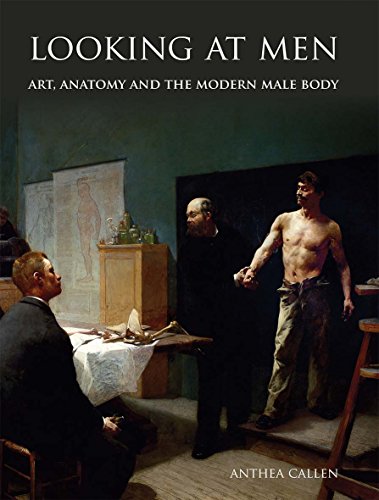
The next book I'm scheduled to review for a publication is this: Looking at Men: Art, Anatomy and the Modern Male Body by Anthea Callen (2018). The book focuses on the nineteenth century. It should prove an interesting read, incorporating issues of science and medicine along with artistic practice, framed by the development of heterosexual, homosocial, and homosexual identities over the course of the century. Or so I hope!
Nikki A. Greene's essay, "Habla LAMADRE: Maria Magdalena Campos-Pons, Carrie Mae Weems, and Black Feminist Performance," focused on these two women artists, but more importantly engaged with the way that women of color have been excluded historically as makers of art from the great museum collections and exhibition programs. Weems's 2014 exhibition at the Guggenheim Museum was unprecedented, as she was the first African-American woman to have a show there. I remember the exhibition well; it was incredibly moving and powerful. Weems's photographs from her Museums series position the artist as a Ruckenfigur, displaying her body shrouded in black to the viewer as she stands outside the great cultural institutions and museums worldwide as an outsider. In her essay, Greene writes of the image you see here, Guggenheim Bilbao, 2006, as follows:
Weems journeyed to northern Spain ... to encounter the seduction of the sweeping, undulating, titanium walls of the Guggenheim Museum Bilbao, designed by Frank Gehry and completed in 1997. In the photograph Guggenheim Bilbao, Weems stands as a dark silhouette in her black, long-sleeved dress with her back to the viewer .... Weems stretches her arms outward to rest her hands on a white railing that heightens the chasm between her and the museum as water gently ripples below her. The framing of this photograph plays on the building's ship-like forms, with stern-like triangular peaks making Weems appear as if she is viewing the museum across a body of water from her own ship. Weems's serenity in the face of the immensity of the museum's presence grounds the viewer, encouraging a pause as the two ships purportedly confront each other. This moment of recognition of each other's position in space acknowledges their unreachability. (pp. 294-95)What Greene also intimates with this ship-like allusion is the history of the transatlantic slave trade and the ongoing legacy of slavery as a hindrance to people of color, in this instance in an art world dominated by white privilege and the 1%. Greene's reading of this image is wonderfully intuitive.
The next book I'm scheduled to review for a publication is this: Looking at Men: Art, Anatomy and the Modern Male Body by Anthea Callen (2018). The book focuses on the nineteenth century. It should prove an interesting read, incorporating issues of science and medicine along with artistic practice, framed by the development of heterosexual, homosocial, and homosexual identities over the course of the century. Or so I hope!
Saturday, March 2, 2019
British Portraits at Columbia Exhibition
On February 11th, we officially opened a new exhibition at work that I curated with PhD art-history student Mateusz Mayer. The show is entitled Hoppner, Beechey, Fisher, Lavery: Researching Columbia's Portraits, and is on view in Avery Architectural & Fine Arts Library, Wallach Study Center for Art & Architecture, until May 10th. It is open to the public Mon-Fri, 9am-5pm. This focused exhibition showcases four rarely-seen historical British portraits from the permanent collection, and transforms them into objects of study rather than present them as traditional museum-style masterpieces by these artists. The portraits were painted between the years 1800 and 1927, and the show highlights new discoveries that we have made about them, ranging from biography to provenance to political propaganda. As examples of British portraits, the show also seeks to query the idea of "British-ness," both in its historical context and in the age of Brexit.
One of the paintings on view is the work you see here, a portrait of King George III by Sir William Beechey and his studio. The portrait depicts the king wearing a field marshal's uniform, his bicorn hat and Star of the Order of the Garter prominent ornaments to his outfit. The painting is an artist's copy of his life-sized portrait of the king that he exhibited at the 1800 Royal Academy exhibition, now in the Royal Collection. The painting became so popular (arguably a form of political propaganda) that Beechey's studio produced numerous replicas and copies, some with various backgrounds and in half-size and portrait-bust versions. In the background of this portrait is Windsor Castle, the king's primary residence, where Beechey likely painted the original version. This painting was a gift to Columbia in 1943 by Mrs. Mary Hill Hill. Her doubled surname is not an accident: her father and husband, both of whom were railroad magnates, had the same last names, but there were no family relations between them. Although originally from Minnesota, Mrs. Hill Hill lived at the time of the donation in Tarrytown, NY, and auction catalogs after her death show that she was an avid collector of 18th-century British portraits and George III silver.
A free accompanying exhibition catalog will be made available very soon, so I'll post a link to the PDF version when it's ready.
One of the paintings on view is the work you see here, a portrait of King George III by Sir William Beechey and his studio. The portrait depicts the king wearing a field marshal's uniform, his bicorn hat and Star of the Order of the Garter prominent ornaments to his outfit. The painting is an artist's copy of his life-sized portrait of the king that he exhibited at the 1800 Royal Academy exhibition, now in the Royal Collection. The painting became so popular (arguably a form of political propaganda) that Beechey's studio produced numerous replicas and copies, some with various backgrounds and in half-size and portrait-bust versions. In the background of this portrait is Windsor Castle, the king's primary residence, where Beechey likely painted the original version. This painting was a gift to Columbia in 1943 by Mrs. Mary Hill Hill. Her doubled surname is not an accident: her father and husband, both of whom were railroad magnates, had the same last names, but there were no family relations between them. Although originally from Minnesota, Mrs. Hill Hill lived at the time of the donation in Tarrytown, NY, and auction catalogs after her death show that she was an avid collector of 18th-century British portraits and George III silver.
A free accompanying exhibition catalog will be made available very soon, so I'll post a link to the PDF version when it's ready.
Wednesday, October 17, 2018
Statue of a Countess
I am pleased to share the news that my latest article, "Between Venus and Victoria: John Gibson's Portrait Statue of the Hon. Mrs. Murray, Later Countess Beauchamp," has just been published in Nineteenth-Century Art Worldwide (along with a number of other very interesting essays by some colleagues I know that I look forward to reading). My essay discusses for the first time the portrait statue you see here that Gibson made for the 3rd Baroness Braye of her widowed daughter Catherine, who later married Earl Beauchamp (pronounced "Beecham").
The statue was commissioned in 1842 when the Baroness and members of her family were on their grand tour in Rome, and it was completed in 1846. Gibson exhibited the marble statue at the Royal Academy that year, where it received mostly positive feedback, but one critic rather surprisingly compared it to the Hottentot Venus. (You'll have to read the article to learn why!) The Baroness and her daughter were friends with Gibson for many years, and he often visited them at their London home and at Stanford Hall, where the statue is on view as part of the family's art collection to this day. What makes the story of this statue even more remarkable is that Catherine made the bold decision to have Gibson tint it while it was still in the early days of his own experiments with polychrome sculpture (i.e. Tinted Venus). As I discuss in my essay, she received sharp criticism afterward for having done this, but Gibson urged her to "fight it out" and not give in to the critics. (Wise words I need to remember myself many days!)
I am incredibly grateful to the current Baroness Braye and her family for their generosity and hospitality in giving me access to unpublished family papers and their homes, and to the staff at Stanford Hall for responding to all my inquiries along the way. Without their encouragement and support, this article never could have come to fruition.
The statue was commissioned in 1842 when the Baroness and members of her family were on their grand tour in Rome, and it was completed in 1846. Gibson exhibited the marble statue at the Royal Academy that year, where it received mostly positive feedback, but one critic rather surprisingly compared it to the Hottentot Venus. (You'll have to read the article to learn why!) The Baroness and her daughter were friends with Gibson for many years, and he often visited them at their London home and at Stanford Hall, where the statue is on view as part of the family's art collection to this day. What makes the story of this statue even more remarkable is that Catherine made the bold decision to have Gibson tint it while it was still in the early days of his own experiments with polychrome sculpture (i.e. Tinted Venus). As I discuss in my essay, she received sharp criticism afterward for having done this, but Gibson urged her to "fight it out" and not give in to the critics. (Wise words I need to remember myself many days!)
I am incredibly grateful to the current Baroness Braye and her family for their generosity and hospitality in giving me access to unpublished family papers and their homes, and to the staff at Stanford Hall for responding to all my inquiries along the way. Without their encouragement and support, this article never could have come to fruition.
Thursday, July 12, 2018
New Solomon Records
This painting has often been considered his best work, not so much by reviewers at the time, but by his colleagues and friends like William Michael Rossetti and Algernon Charles Swinburne, and subsequent art historians. Painted and then exhibited at the Royal Academy in 1865, the picture depicts a group of ancient Roman women having different reactions to a gladiator fight in the arena. The painting's first owner was Charles P. Matthews, a brewer who had homes in London and Essex, England, and it was sold at the auction of his estate after his death at Christie's London on June 6, 1891. It was sold then for 21 guineas. Around a century ago, it was purchased by the grandparents of the owner who sold it today, and surprisingly was actually "lost" for most of the 20th century, having only been "found" in the mid-1990s. Today that same family sold the painting, and it earned £370,000 including premium. As I've mentioned in the past, as compared to his fellow Pre-Raphaelite and Victorian painters, this is still relatively low (some major paintings by Edward Burne-Jones and Dante Gabriel Rossetti go for over £1m these days). Nevertheless, this was a satisfactory acknowledgment of his work and has helped reaffirm his importance in this canon of Victorian painters.
Also by Solomon up for sale today was this picture, the 1867 watercolor version of Bacchus, that he painted when he was in Rome, finishing it in London once he was home. In some ways this painting best epitomizes Solomon's style and subject matter, showing the god of wine as a sensual youth half-dressed, basking in the sun. The homoerotics of this painting are self-evident, and in many ways has become an important subject in discussing Solomon's own homosexual identity and how he frequently depicted youthful males as objects of beauty at this time. The picture was estimated to sell for £50,000-£70,000, but I knew it would sell for much more. It set the record for the second-highest work by Solomon sold at auction, coming in at £237,500 including premium. Two works on paper did not sell at today's auction, because they didn't meet their minimum estimate, but I think between these two big-ticket items and all the works sold yesterday at Christie's there was a sense of exhaustion. I don't think there's ever been this many Solomons up for sale at the same time, so this certainly made for an interesting two days of sales. To read more posts on this blog about the Solomon family painters, click here.
Monday, July 9, 2018
Call for Papers: Transnationalism and Sculpture
Transnationalism and Sculpture in the Long Nineteenth-Century (ca. 1785–1915)
Session Organizers:
Roberto C. Ferrari (Columbia University)
Tomas Macsotay (Universitat Pompeu Fabra, Barcelona)
The history of nineteenth-century art is frequently presented as the product of revolutions and socio-political changes. The Zeitgeist for nationalism and imperial expansion generated by these historic events inevitably fostered interest in national schools of art criticism and artistic practice. But rising interest in global studies has led to more and more evidence of the transnational as a major impact on artistic practice of the nineteenth century, specifically in association with the creation and dissemination of narratives of national identity, and the interests of economic and colonial expansion. The transnational is defined as crossing national boundaries, but for this session transnationalism also refers to culturally blended nexuses of artistic creativity and engagement during the century.
Wednesday, June 20, 2018
Gibson and Portraiture Essay
Back in 2016 I had blogged about the new exhibition at the Royal Academy on the sculptures and drawings of John Gibson (1790-1866). Toward the end of the exhibition's run, there was a study day held at Tate Britain, and I was honored to be invited as one of the speakers for this event. We also did a local London version of the Gibson Trail and examined closely a selection of his figures and busts in the UK capital. About two months afterward, our host for that day, M. G. Sullivan, announced that some of us had been invited to submit articles associated with that study day in Tate Papers, the peer-reviewed, free online journal published by the museum. Sullivan and I decided to collaborate and co-author an article on Gibson's portraits, basing a portion of the essay on the bust of William Bewick that is in the Tate's collection. Our essay--and three others--have now been released (click here), and I must say that I am pleased to see this one in print.
Our essay is the first to focus on his portraits, and I think we managed to convey well how, despite Gibson's general distaste for portraits, he still made quite a number. We tapped into his extant account books to record prices and heretofore unknown commissions, and examined a number of these works chronologically and culturally. The image you see above is a detail from the back of the bust of an unidentified woman, dated to the 1820s, by Gibson; the work is in the collection of the Yale Center for British Art and is a rather magnificent bust, particularly in the carving of the sweeping hairdo. The title of our essay is "'Men thinking, and women tranquil': John Gibson's Portraiture Practice." I'm looking forward to reading the other essays on Gibson's studio practice by Anna Frasca-Rath and his association with the Duke of Devonshire by Alison Yarrington (a subject I've written about as well, from a queer context, but Yarrington is the world expert on Devonshire's sculpture gallery). I read the other day Susanna Avery-Quash's essay on Gibson's friendship with Sir Charles Eastlake, which was excellent. So take a look, and if you feel inclined, enjoy the reading!
Tuesday, March 13, 2018
19thC Graduate Student Symposium 2018
This coming Sunday, March 18th, is the 15th annual Graduate Student Symposium in the History of Nineteenth-Century Art, co-sponsored by the Association of Historians of Nineteenth-Century Art (AHNCA) and the Dahesh Museum of Art. It will be held at the Dahesh in NYC. The Mervat Zahid Cultural Foundation has generously provided the Dahesh Museum of Art Prize of $1,000 for the best paper, and the prize also carries with it the opportunity for publication in Nineteenth-Century Art Worldwide. I was among the jury members who selected the papers this year, and I will be chairing one of the groups of papers. Below is the list of papers, with summary abstracts of each available for reading on the AHNCA website. One of the papers addresses this important, fantastic painting: Edouard Manet's Mademoiselle V ... in the Costume of an Espada, 1862, oil on canvas, in the collection of The Metropolitan Museum of Art. Other papers are on topics like harems, tigers, pickaxes, and Caribbean exoticism. It promises to be a great day of papers!
- Lucie Grandjean, Université Paris Nanterre, “John Vanderlyn and the Circulation of Panoramic Images in Nineteenth-Century America: Promoting and Diffusing ‘a love and taste for the arts’”
- Remi Poindexter, The Graduate Center, City University of New York, “Martinique's Dual Role in Alcide Dessalines d'Orbigny's Voyage Pittoresque”
- Alexandra Morrison, Yale University, “Unfaithful: Julie Duvidal de Montferrier’s Copies”
- Siddhartha V. Shah, Columbia University, “Tooth and Claw: Chivalry and Chauvinism in the Jungles of British India”
- Clayton William Kindred, Ohio State University, “The Harem in Absentia: Analyzing Race, Gender, and Sexuality in Jean Lecomte du Nouÿ’s The Gate of the Harem”
- Jennifer Pride, Florida State University, “The Poetics of Demolition: The Pickax and Spectator Motifs in Second Empire Paris”
- Kathryn Kremnitzer, Columbia University, “Tracing Mlle Victorine in the Costume of an Espada”
- Galina Olmsted, University of Delaware, “’Je compte absolument sur vous’”: Gustave Caillebotte and the 1877 Exhibition”
- Maria Golovteeva, University of St. Andrews, “Photography as Sketch in the Works of Fernand Khnopff”
- Isabel Stokholm, University of Cambridge, “Fathers & Sons? Two Old Peredvizhniki and a New Generation of Russian Artists, 1890–1914”
Sunday, October 29, 2017
The Passing of Linda Nochlin
Linda Nochlin, one of the great art historians who influenced more than one generation of scholars, died this past weekend at the age of 86. I first met Linda about 12-13 years ago when I was exploring graduate programs. She kindly met with me in her tiny, book-crammed office at NYU's Institute of Fine Arts, where she worked for decades before retiring a few years ago, and we chatted about Simeon and Rebecca Solomon and my interests in Pre-Raphaelite art. I wound up not going to IFA, so I never had an opportunity to take a class with her, but my adviser at the CUNY Graduate Center, Patricia Mainardi, was one of Nochlin's students, so I feel as if she was my academic-adviser-grandmother of sorts. I saw Nochlin every once and a while afterward through the years at various events, and even though she didn't remember me she always graciously reconnected with me about the Solomons when we spoke again. She was the adviser for a few friends of mine who went to the IFA and they remained close to her through the years.
It is her art-historical scholarship, however, that will live on. Nochlin's pioneering essay "Why Have There Been No Great Women Artists?" (1971) was a watershed moment that changed art history and practically initiated women's and gender studies in the arts and humanities. This evening, Mainardi posted on Facebook that her mentor's essay "was a game-changer, a paradigm-shifter, a breath of fresh air that blew through the art world like a tornado and changed everything and everyone in it. We are all her progeny." If that essay wasn't enough, Nochlin also was a specialist in 19th-century art, particularly that of Courbet, and she wrote an incredible number of social-historical essay about art that are still relevant and worth reading. Among some of my favorites are:
I have gone back to Nochlin's scholarship time and time again because of its insightfulness, but also because of its erudition. She never had to rely on abstruse literary and cultural theory to make her point. She always returned the reader back to the work of art. Some scholars may have gone on to challenge some of her suppositions through the years (that is part of the job, anyway), but everyone who has studied art history since the 1980s has had to contend and acknowledge her contributions to the field and recognize how her work changed things.
Nochlin will be best remembered for "Why Have There Been No Great Women Artists?" Her conclusion ultimately was that because institutions and thus individuals prohibited women from studying properly as men had, it inhibited their ability to become the artistic geniuses their fellow male artists often became. At the end of her essay, Nochlin charged scholars to learn from this mistake of the past and change things for the future. Her words seem prescient for all forms of scholarship that consider minorities and otherness, although at the time she was inspiring women.
(Photo of Linda Nochlin by Adam Husted.)
It is her art-historical scholarship, however, that will live on. Nochlin's pioneering essay "Why Have There Been No Great Women Artists?" (1971) was a watershed moment that changed art history and practically initiated women's and gender studies in the arts and humanities. This evening, Mainardi posted on Facebook that her mentor's essay "was a game-changer, a paradigm-shifter, a breath of fresh air that blew through the art world like a tornado and changed everything and everyone in it. We are all her progeny." If that essay wasn't enough, Nochlin also was a specialist in 19th-century art, particularly that of Courbet, and she wrote an incredible number of social-historical essay about art that are still relevant and worth reading. Among some of my favorites are:
- "The Imaginary Orient" in which she applied Edward Said's groundbreaking post-colonial theories about literature and history to visual art, teaching us how to really look at exotic pictures of the Middle East;
- "Manet's Masked Ball at the Opera" in which she tackled prostitution and misogyny in Second Empire France through images of fragmented female bodies and the visual representation of sexual aggression by men;
- "Degas and the Dreyfus Affair" in which she explored whether one can find evidence of the Impressionist artist's anti-Semitism in his art, and then forced us to consider whether we could look past his anti-Semitism and still appreciate Edgar Degas as a great artist (I've always called this "Michael Jackson syndrome"--can you still like his music if you are disgusted by his actions toward children?--and was inspired to think of this by her article);
- and "Morisot's Wet Nurse" in which she examined Berthe Morisot's painting of her nurse breastfeeding the painter's infant daughter, considering everything from subject to facture in an attempt to explore the challenges of women having children and careers.
I have gone back to Nochlin's scholarship time and time again because of its insightfulness, but also because of its erudition. She never had to rely on abstruse literary and cultural theory to make her point. She always returned the reader back to the work of art. Some scholars may have gone on to challenge some of her suppositions through the years (that is part of the job, anyway), but everyone who has studied art history since the 1980s has had to contend and acknowledge her contributions to the field and recognize how her work changed things.
Nochlin will be best remembered for "Why Have There Been No Great Women Artists?" Her conclusion ultimately was that because institutions and thus individuals prohibited women from studying properly as men had, it inhibited their ability to become the artistic geniuses their fellow male artists often became. At the end of her essay, Nochlin charged scholars to learn from this mistake of the past and change things for the future. Her words seem prescient for all forms of scholarship that consider minorities and otherness, although at the time she was inspiring women.
What is important is that women face up to the reality of their history and of their present situation, without making excuses or puffing mediocrity. Disadvantages may indeed be an excuse; it is not, however, an intellectual position. Rather, using as a vantage point their situation as underdogs in the realm of grandeur, and outsiders in that of ideology, women can reveal institutional and intellectual weaknesses in general, and, at the same time that they destroy false consciousness, take part in the creation of institutions in which clear thought--and true greatness--are challenges open to anyone, man or woman, courageous enough to take the necessary risk, the leap into the unknown.You can read more about Nochlin's life and work here, here, and here.
(Photo of Linda Nochlin by Adam Husted.)
Wednesday, October 25, 2017
Thinking about Rodin
This coming Friday, October 27th, at 5pm, I'm giving a talk (free & open to the public) entitled "Thinking about Rodin: A Century Later." The image here of Rodin's Thinker is a bronze commissioned by Columbia University in 1930 from the Musée Rodin and installed outside Philosophy Hall the next year. (One of my students this past Spring semester wrote a paper about this sculpture and its placement on campus, which you can read here.) I find The Thinker riveting, not just because of its execution as a figure in the round, but also because it is subject to so many different interpretations. I believe Rodin would have agreed with that assessment. It was clearly a significant work for him: another large-scale version of the statue gazes down on the grave of Rodin and his wife.
My talk will be held at the Florence Academy of Art based in Mana Contemporary, Jersey City (basically right next door to where AA and I live). I gave a talk there earlier this year about Gibson, and Rodin could be seen as a nice antithesis ... or is he? Auguste Rodin (1840-1917) is considered by most to be the proverbial "father" of modern sculpture, but when I look at his sculpture I see more of a reinterpretation of art-historical precedents. When you read some accounts of his life and work (e.g. Bernard Champigneulle and Albert Elsen), you sense from these authors an intentional insistence that Rodin broke away from the past to be original and unique. While that may be true to some extent--for just about every artist who strives to be recognized for her/his accomplishments--I don't think it's so "black or white." Successful artists absorb what they have learned and synthesize it with other life experiences to generate something that may seem new or original to viewers. But that doesn't mean their "teachers" should be forgotten or, even worse, elided from interpretations of their work in an attempt to portray them as artistic geniuses.
My talk on Friday will discuss some of this, as well as explore a few interpretations of Rodin's life and work with the numerous centenary-of-his-death exhibitions that have been taking place this year. The picture below is one gallery view I took when we visited the exhibition at the Grand Palais in Paris. It was quite comprehensive and informative, but I questioned whether the connections/influence of Rodin on other sculptures thereafter was perhaps pushing the exhibition theme itself a little too far.
My talk will be held at the Florence Academy of Art based in Mana Contemporary, Jersey City (basically right next door to where AA and I live). I gave a talk there earlier this year about Gibson, and Rodin could be seen as a nice antithesis ... or is he? Auguste Rodin (1840-1917) is considered by most to be the proverbial "father" of modern sculpture, but when I look at his sculpture I see more of a reinterpretation of art-historical precedents. When you read some accounts of his life and work (e.g. Bernard Champigneulle and Albert Elsen), you sense from these authors an intentional insistence that Rodin broke away from the past to be original and unique. While that may be true to some extent--for just about every artist who strives to be recognized for her/his accomplishments--I don't think it's so "black or white." Successful artists absorb what they have learned and synthesize it with other life experiences to generate something that may seem new or original to viewers. But that doesn't mean their "teachers" should be forgotten or, even worse, elided from interpretations of their work in an attempt to portray them as artistic geniuses.
My talk on Friday will discuss some of this, as well as explore a few interpretations of Rodin's life and work with the numerous centenary-of-his-death exhibitions that have been taking place this year. The picture below is one gallery view I took when we visited the exhibition at the Grand Palais in Paris. It was quite comprehensive and informative, but I questioned whether the connections/influence of Rodin on other sculptures thereafter was perhaps pushing the exhibition theme itself a little too far.
Sunday, October 22, 2017
Nationalist Sculpture: AAH 2018 Call for Papers
The National in Discourses of Sculpture in the Long Modern Period (c. 1750-1950)
Session Convenors:
Tomas Macsotay, Universitat Pompeu Fabra, Barcelona, Spain (tomas.macsotay@upf.edu)
Roberto C. Ferrari, Columbia University, New York, US (rcf2123@columbia.edu)
Are specific histories of national ‘schools’ of sculpture premised by the codifying of national identities? What role has been reserved for modern European languages and their historical networks of cultural transfer in enabling or inhibiting this circulation of nationalism in sculpture criticism? From the veneration of Greek art by Winckelmann, to the Romantic idea of a Northern spirit in the work of Thorvaldsen; from the imperial narratives of display at the World’s Fairs, to constructions of allegory in French Third Republic art; from monuments to fallen heroes after World War I, to Greenberg’s and Read’s critical biases for national sculptors – varieties of imaginary geographies in the long modern period have congealed into a fitful history where sculpture is entrenched in projections of the national.
Discourses of exclusion and inclusion became part of how sculptors were trained, public spaces were ornamented, and audiences were taught to read sculpture. These discourses also played a role in the strengthening (and dissimulation) of increasingly border-crossing networks of industrial production, globalised art trade, and patterns of urban infrastructure and design.
This panel seeks papers that offer critical explorations of the national and its tentative ties to the cosmopolitan in sculptural discourse, or consider a transdisciplinary dialogue between sculpture and its texts (e.g. art school writings, criticism, memoirs and biographies, etc.). We particularly welcome papers addressing the role of translation and circulation in fledgling modern criticism, as well as papers engaging recent accounts of cultural transfer in the construction of national and modern artistic identifiers (e.g. Michel Espagne, Béatrice Joyeux-Prunel).
INSTRUCTIONS:
- Please email your paper proposals directly to the session convenors.
- You need to provide a title and abstract (250 words maximum) for a 25-minute paper (unless otherwise specified), your name and institutional affiliation (if any).
- Please make sure the title is concise and reflects the contents of the paper because the title is what appears online, in social media and in the printed programme.
- You should receive an acknowledgement of receipt of your submission within two weeks.
- Deadline for submissions: 6 November 2017
Sunday, April 2, 2017
MWA XLVII: Alma-Tadema's Rivals
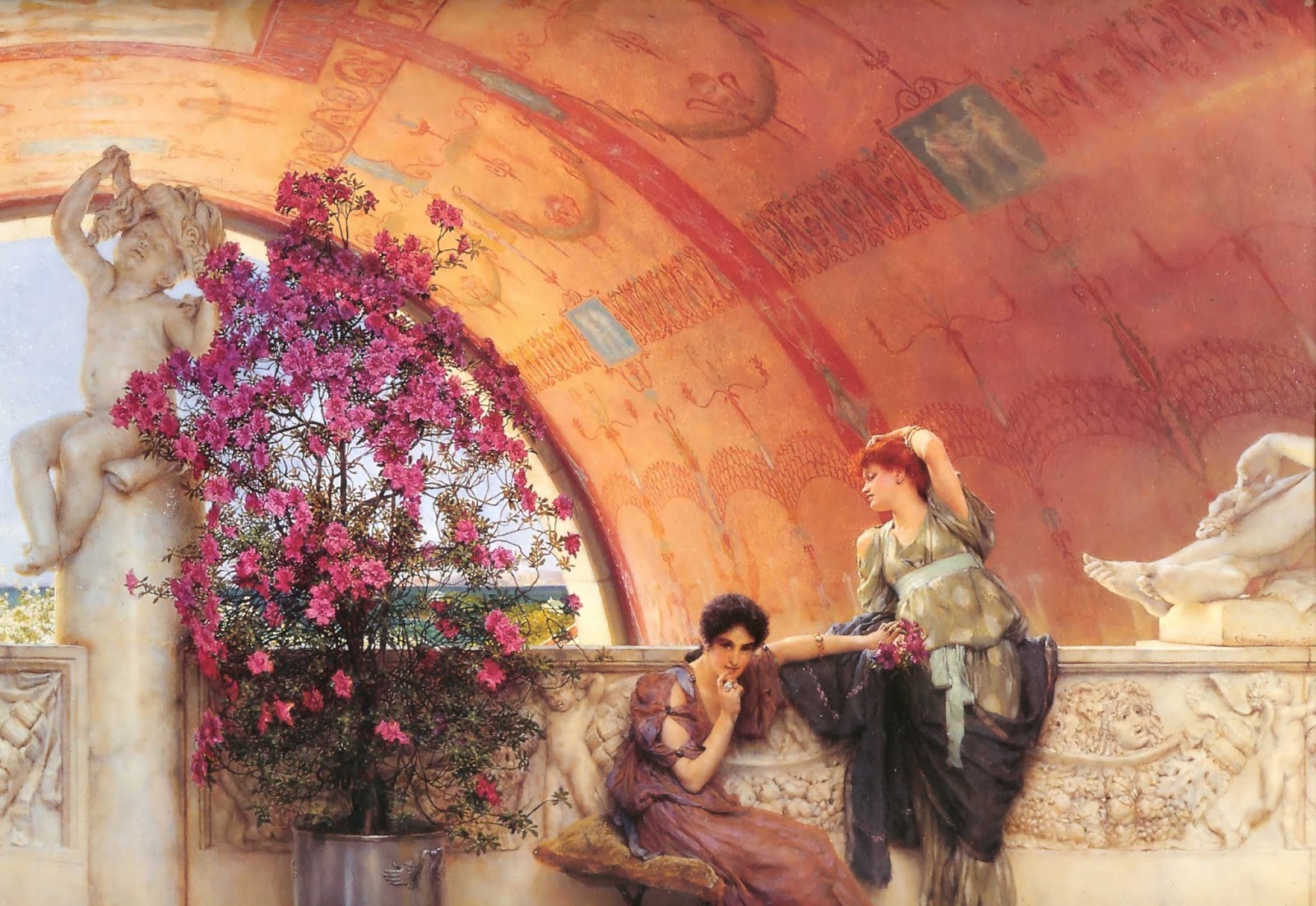
Last November, when AA and I were in Amsterdam, we took a day trip to Leeuwarden to see the new exhibition Alma-Tadema, klassieke verleiding (Alma-Tadema: At Home in Antiquity). My review of the exhibition has just been published in Nineteenth-Century Art Worldwide, which you can read here for free. One painting in the exhibition, that you see above, is Unconscious Rivals, 1893, from the collection of the Bristol Museum & Art Gallery. My own first exposure to Alma-Tadema was through a reproduction poster of this painting in the mid-1990s, when my mother fell in love with it and we worked together at a framer getting it matted and framed. It thereafter hung in my parents' bedroom for about fifteen years. I was always fascinated by the incredible details in the picture: the glean of the marble benches; the vibrancy of the azaleas; the details in the barrel-vault ceiling. Even more intriguing, however, was the psychological relationship between the two women depicted. I remember my mother and I talking about this when we first saw it, and I think this was the added bonus, in addition to the exquisite details, that sold us on purchasing the poster and framing it.
Regardless of whether or not one likes Alma-Tadema's work, most agree that his attention to detail and ability to paint furniture, drapery, jewelry, architectural settings, etc., are noteworthy. As I write in my review of the exhibition, I was eager to see this particular painting in the show, more so because of my own personal connection to it through that poster. On first seeing Unconscious Rivals in person, however, I admit I was a little disappointed because it is smaller than I had anticipated. This is not an uncommon experience after first engagements through reproductions. But the more closely I examined the painting, the more I could see that it was a jewel of a picture with intricate details like the azaleas, which are almost too hyperrealistic in their depiction.
The scene shows two young women who respond differently to an unseen man with whom each of them, unbeknownst to the other, is in love. (The man, presumably a soldier, is represented by the legs and sword of an ancient statue of a seated gladiator.) This narrative in the picture was part of the tradition of nineteenth-century genre painting, which audiences of the day appreciated and understood well. However, while traditional genre painting offered a moral message, here aesthetics take precedence and the depiction of the two women is more a statement about beauty rather than morality. The viewer (then and now) can identify with them, sympathizing with the shy temperament of the brunette who gazes toward the picture plane with a sheepish smile, or responding sensually to the vivacious red-head (a Pre-Raphaelite trope of the femme fatale) flirting with the lover below the balcony. The painting is a reinterpretation of the allegorical sacred and profane that stretches backward to Titian and forward to Freud. Alma-Tadema’s Unconscious Rivals relies on this form of empathy that transcends time and nationalism to make its point. It appeals to audiences to identify with these women emotionally, regardless if the women or the viewer are ancient Roman, British Victorian, or twenty-first century Dutch or American. It is, indeed, a beautiful painting. You can see more of his paintings, and some gallery views from the exhibition, in my review.
Sunday, February 5, 2017
Art Details: 11-15
Image Credits: All images taken by bklynbiblio/Roberto C. Ferrari. Top to bottom:
- Adriaen van Utrecht, Still Life, ca. 1644, oil on canvas, Rijksmuseum, Amsterdam.
- Johan Christian Dahl, Dresden Seen from Pieschen, March Haze, 1844, oil on canvas, Ny Carlsberg Glyptotek, Copenhagen.
- Monument of Tizoc, Aztec/Mexica, 1480s, basalt, National Museum of Anthropology, Mexico City.
- James Thornhill after Raphael, Peter and John Healing a Lame Man, ca. 1730, oil on canvas, Columbia University, New York.
- Luigi Lucioni, Portrait of Rose Hobart, 1934, oil on canvas, Pennsylvania Academy of Fine Arts, Philadelphia.
Labels:
15th-century art,
17th-century art,
18th-century art,
19th-century art,
20th-century art,
art details,
Columbia,
England,
landscapes,
Mexico,
New York,
Pennsylvania,
portraits,
sculpture,
still lifes
Monday, January 30, 2017
Poem #2
Not like the brazen giant of Greek fame,With conquering limbs astride from land to land;
Here at our sea-washed, sunset gates shall stand
A mighty woman with a torch, whose flame
Is the imprisoned lightning, and her name
Mother of Exiles. From her beacon-hand
Glows world-wide welcome; her mild eyes command
The air-bridged harbor that twin cities frame.
"Keep, ancient lands, your storied pomp!" cries she
With silent lips. "Give me your tired, your poor,
Your huddled masses yearning to breathe free,
The wretched refuse of your teeming shore.
Send these, the homeless, tempest-tost to me,
I lift my lamp beside the golden door!"
-- Emma Lazarus, "The New Colossus" (1883)
I took the image you see above in Jersey City this evening, at a rally that AA, AG, and I attended to help support the rights of immigrants, refugees, and Muslims who should be welcomed, not rejected, to America. This poem was written by Lazarus to help raise funds for the pedestal for the Statue of Liberty (image: Elcobbola, Public Domain, https://commons.wikimedia.org/w/index.php?curid=11136558).
Sunday, January 29, 2017
MWA XLVI: Dalou's Wisdom
The Ackland Art Museum at the University of North Carolina at Chapel Hill has come into the news lately because of the incredibly generous gift of benefactors Sheldon and Leena Peck, who have given the institution a gift worth $25m, including $8m in endowed funds and a collection of 134 Dutch and Flemish drawings, including 7 by Rembrandt. This is "once-in-a-lifetime" philanthropy that successfully raises the profile of this institution beyond its current popular status as an important university art museum. The art work is not yet on display, but DE and I visited anyway for the first time, since we were in that area for a conference.
Wandering through the galleries, I saw the bronze statuette you see here. It struck me as being something one might normally pass by with hardly a glance, but it made me stop and examine it closely, so powerful was its composition and allegorical message. The sculpture is entitled Wisdom Supporting Liberty.
In our current administration with anti-immigration and discrimination policies at work, this work of art struck me as having a powerful message that is as relevant today as ever. The strength of education, knowledge, and experience will always sustain and reinforce liberty, democracy, and freedom, not matter how it is attacked.
The sculptor is the French artist Jules Dalou (1838-1902). The work was modeled in 1889 and this cast was made after 1905. Because the three-dimensionality of the dark bronze statuette is difficult to see in photographic images, I've included the b/w image above from the museum's online collection, and my own color images taken with my iPhone from different angles.
Tuesday, November 29, 2016
MWA XLIV: Roelofs's Windmill
Better late than never, as they say! I realize I've been offline with the blog the past few months, but it's largely because I have been so busy and working on a few writing projects in my non-job time. As I mentioned in a previous post, AA & I took a week-long vacation over Thanksgiving to go to Amsterdam and Copenhagen: two cities I had never visited before. It was quite a nice trip. The weather was cool and it rained a lot in Amsterdam, but I truly enjoyed the canals and the charming architecture in Amsterdam, and the majesty of the Nordic palazzo and upscale fishing village feel one finds in Copenhagen. We hit just about every major museum, not surprisingly. It was at the Rijksmuseum where I discovered this gem of a painting from the 19th century: Willem Roelofs, Meadow Landscape with Cattle, ca. 1880. We did not venture to the picturesque regions of The Netherlands where one can see old, working windmills such as the one in this painting, so this will have to suffice for me for the time being...until I get back and see them live.
Roelofs was a member of The Hague School, a group of artists who were inspired by the French Barbizon school of painters, such as Rousseau, Millet, and Corot. These artists began painting the naturalistic landscape of the French countryside as early as the 1830s but came into their own by mid-century, thereafter helping to alter the respectability of landscape painting from something dismissed as a lesser art in prior generations. This idea of depicting the naturalistic landscape as it actually appears, rather than as an idealized scene for a narrative event, arguably goes back to British artists such as Constable and Turner, but in The Netherlands the most obvious source of inspiration goes back even further to the 17th century with the naturalistic Dutch landscapes by artists such as Ruisdael. You can read more about The Hague School here.
While there is an incredible charm to this painting because of the windmill and the beautiful, soft lighting and fluffy clouds, what is striking is how the windmill dominates the space in this vertical painting. Normally one expects to see landscapes as horizontal compositions, panoramic views that show sweeping swathes of nature. Here, however, by reverting to a vertical format, Roelofs transforms the windmill into a portrait, or at least a narrative composition. The pyramidal structure of the windmill and its arms dominate the center point and then moving out diagonally toward the lower left and right lines, creating a pseudo-head-and-shoulders figure. Although the title references the cattle, both they and the man are diminished by the monumentality of the windmill itself, a man-made machine that for the 19th-century viewer demonstrated the development of technology, i.e. man's dominance over nature. Even the arms of the windmill seem to be moving the air and clouds themselves with a superior strength--which is exactly what they are meant to. This interpretation may seem rather droll because the painting is quite beautiful. But this is where Roelofs succeeds. He portrays the power of the windmill as an object of beauty, conveying both its picturesque qualities and the harmonizing of man with nature.
Roelofs was a member of The Hague School, a group of artists who were inspired by the French Barbizon school of painters, such as Rousseau, Millet, and Corot. These artists began painting the naturalistic landscape of the French countryside as early as the 1830s but came into their own by mid-century, thereafter helping to alter the respectability of landscape painting from something dismissed as a lesser art in prior generations. This idea of depicting the naturalistic landscape as it actually appears, rather than as an idealized scene for a narrative event, arguably goes back to British artists such as Constable and Turner, but in The Netherlands the most obvious source of inspiration goes back even further to the 17th century with the naturalistic Dutch landscapes by artists such as Ruisdael. You can read more about The Hague School here.
While there is an incredible charm to this painting because of the windmill and the beautiful, soft lighting and fluffy clouds, what is striking is how the windmill dominates the space in this vertical painting. Normally one expects to see landscapes as horizontal compositions, panoramic views that show sweeping swathes of nature. Here, however, by reverting to a vertical format, Roelofs transforms the windmill into a portrait, or at least a narrative composition. The pyramidal structure of the windmill and its arms dominate the center point and then moving out diagonally toward the lower left and right lines, creating a pseudo-head-and-shoulders figure. Although the title references the cattle, both they and the man are diminished by the monumentality of the windmill itself, a man-made machine that for the 19th-century viewer demonstrated the development of technology, i.e. man's dominance over nature. Even the arms of the windmill seem to be moving the air and clouds themselves with a superior strength--which is exactly what they are meant to. This interpretation may seem rather droll because the painting is quite beautiful. But this is where Roelofs succeeds. He portrays the power of the windmill as an object of beauty, conveying both its picturesque qualities and the harmonizing of man with nature.
Sunday, October 30, 2016
MWA XLIII: Carpeaux's Ugolino
Previous Monthly Work of Art posts around Halloween have included dark works by Goya and Caravaggio. In 19th-century sculpture it is often difficult to find what one can call a "Romantic" work, i.e. a figure who conveys more emotion in its representation, rather than an example of austere beauty or naturalism. One exception is the disturbing and arguably frightening group statue crafted by the French sculptor Jean-Baptiste Carpeaux (1827-1875) entitled Ugolino. Designed to be his 4th-year work while a student at the French Academy in Rome, the large-scale figural group took longer than anticipated. He began in 1857 and completed the large-scale plaster cast in 1861. He himself was uncertain whether the subject would be better appreciated in bronze or marble, and both were eventually made. A bronze cast is in the Musée d'Orsay, but personally I prefer the marble version made in 1865-67 and now at The Met.
The marble sculpture measures almost 2 meters (78 inches) in height and weighs almost 5,000 pounds. The subject comes from Dante's Inferno, Book XXXIII, recounting the story of Ugolino (ca. 1200-1289), the tyrant of Pisa whom Dante and Virgil meet in the Underworld:
... When I beheld
My sons, and in four faces saw my own
Despair reflected, either hand I gnawed
For anguish, which they construed hunger. Straight
Arising all they cried, "Far less shall be
Our sufferings, sir, if you resume your gift;
These miserable limbs with flesh you clothed;
Take back what once was yours."
Ugolino had been imprisoned by his enemies, along with his 2 sons and 2 grandsons, all of whom died while in prison. Ugolino reportedly ate the flesh of his sons and grandsons in order to survive. Here, though, Dante has Ugolino claim that these men pleaded with him to eat them out of filial piety. Dante is not read by most people today, so at first seeing this sculpture in person one may not understand its context. However, once the viewer discovers the subject, there is an immediate sense of horror, but also sympathy. Carpeaux convinces the viewer of Ugolino's anguish as he contemplates survival in a desperate situation, while these men and boys around him die. This work is one of the most haunting sculptures of the 19th century.
The work was inspired by the ancient sculpture of the Laocoön and owes a great deal to the influence of Michelangelo. In the recent exhibition catalogue on Carpeaux, Edouard Papet writes: "Carpeaux's Ugolino remains a work of profoundly Romantic and pictorial inspiration. ... Like all of Carpeaux's monumental works, Ugolino was the product of a complex integration of disparate sources, both literary and visual, the latter absorbed on-site or in reproductions. This synthesis was combined with a nervous curiosity and irrepressible desire for formal renewal, which, in the days of eclecticism, in no way meant starting from a tabula rasa. ... Ugolino presented all the necessary features: structural complexity, narrative, terribilità , and a variety of expressions. ... Carpeaux's composition closes in upon themselves the open forms of the antique drama of Laocoön and turns it in on itself, while retaining its fundamental elements: nudity, a central paternal figure, conspicuous muscularity, the dying adolescent on the right, and the contrast between a body in its prime and youthful anatomies."
(Translation from Dante and quote: Edouard Papet, "Ugolino," in The Passions of Jean-Baptiste Carpeaux [New York: Metropolitan Museum of Art, 2014], 66-69.)
The marble sculpture measures almost 2 meters (78 inches) in height and weighs almost 5,000 pounds. The subject comes from Dante's Inferno, Book XXXIII, recounting the story of Ugolino (ca. 1200-1289), the tyrant of Pisa whom Dante and Virgil meet in the Underworld:
... When I beheldMy sons, and in four faces saw my own
Despair reflected, either hand I gnawed
For anguish, which they construed hunger. Straight
Arising all they cried, "Far less shall be
Our sufferings, sir, if you resume your gift;
These miserable limbs with flesh you clothed;
Take back what once was yours."
Ugolino had been imprisoned by his enemies, along with his 2 sons and 2 grandsons, all of whom died while in prison. Ugolino reportedly ate the flesh of his sons and grandsons in order to survive. Here, though, Dante has Ugolino claim that these men pleaded with him to eat them out of filial piety. Dante is not read by most people today, so at first seeing this sculpture in person one may not understand its context. However, once the viewer discovers the subject, there is an immediate sense of horror, but also sympathy. Carpeaux convinces the viewer of Ugolino's anguish as he contemplates survival in a desperate situation, while these men and boys around him die. This work is one of the most haunting sculptures of the 19th century.
The work was inspired by the ancient sculpture of the Laocoön and owes a great deal to the influence of Michelangelo. In the recent exhibition catalogue on Carpeaux, Edouard Papet writes: "Carpeaux's Ugolino remains a work of profoundly Romantic and pictorial inspiration. ... Like all of Carpeaux's monumental works, Ugolino was the product of a complex integration of disparate sources, both literary and visual, the latter absorbed on-site or in reproductions. This synthesis was combined with a nervous curiosity and irrepressible desire for formal renewal, which, in the days of eclecticism, in no way meant starting from a tabula rasa. ... Ugolino presented all the necessary features: structural complexity, narrative, terribilità , and a variety of expressions. ... Carpeaux's composition closes in upon themselves the open forms of the antique drama of Laocoön and turns it in on itself, while retaining its fundamental elements: nudity, a central paternal figure, conspicuous muscularity, the dying adolescent on the right, and the contrast between a body in its prime and youthful anatomies."(Translation from Dante and quote: Edouard Papet, "Ugolino," in The Passions of Jean-Baptiste Carpeaux [New York: Metropolitan Museum of Art, 2014], 66-69.)
Tuesday, September 27, 2016
Gibson Exhibition and Essays
bklynbiblio readers may recall that my doctoral dissertation was on the British sculptor John Gibson (1790-1866), about whom I have blogged a few times over the years. (The image you see here is a ca. 1850 portrait of Gibson by Edwin Landseer, from the collection of the Royal Academy of Arts in London.) My dissertation was the first in the United States--and, I believe, in the United Kingdom--on the artist. Since I finished and defended, I've been working on spin-off essays. One of these was published last December, focusing on Gibson's interest in reproductive media such as prints, statuettes, and cameos as a way to disseminate the classicism for modern audiences.
Last week another essay of mine, entitled "The Sculptor, the Duke, and Queer Art Patronage: John Gibson's Mars Restrained by Cupid and Winckelmannian Aesthetics," was released in the new book Rome, Travel and the Sculpture Capital, c.1770-1825. The book was edited by my colleague Tomas Macsotay, whom I met years ago when we were both in Leeds on different fellowships. This latest essay may seem familiar to some as I have presented different versions of the subject at conferences in Montreal and Storrs, Connecticut. This is standard practice, as it allows for opportunities to "test the waters," so to speak, and see how arguments are received by peers before publishing them. I reread my essay on the subway today and, while I think it still holds up, I confess my chronic (obsessive?) need to re-edit my own work makes me wish I had changed a few things. For instance, I think that in a revised version I would likely not be so "all"-encompassing in certain parts, and qualify matters by saying things like "selective" and "most" instead. Nevertheless, I am hopeful that the essay is a valuable contribution to the literature on the homoerotics of neoclassical sculpture, and that it will add to an increased appreciation on Gibson himself.
Later this year I have another Gibson essay coming out in the book The British School of Sculpture, c.1760-1832. This forthcoming essay relies more on biography and art-historical interpretation to consider the origins of Gibson's training and career before he moved to Rome in 1817 and set up a studio where he lived the rest of his life. That essay should be released around the time I go to a planned study day on Gibson in mid-December. This meeting (details are still under wraps) will be held in association with the new exhibition John Gibson RA: A British Sculptor in Rome, which opened a few weeks ago at the Royal Academy in London. Among the works on display is this one: The Meeting of Hero and Leander, ca. 1842, plaster (Collection: Royal Academy). This exhibition commemorates the 150th anniversary of Gibson's death, but surprisingly it is also the first monographic exhibition of Gibson's work since he died in 1866. Because he had bequeathed a substantial sum of money and numerous plaster casts and drawings to the RA, perhaps there never was a need to hold an exhibition in his memory as his bequest led to the opening of the Gibson Gallery to allow visitors and students to learn directly from his classical figures from the nineteenth century. But of course no one from his day foresaw the decline of classicism and the rise of abstraction, so that by the 1960s it is not surprising to know that the Gibson Gallery was taken down and the works scattered about and kept in storage.
This new exhibition has been curated by my colleagues Annette Wickham and Anna Frasca-Rath. There is a small publication, but to date I have not seen it, or the show, so I cannot comment on them. Anna (who completed her dissertation on Gibson in Vienna about a year or so after me) also has spear-headed the beautifully-designed online digital project The Gibson Trail, which provides images of his works with short essays, as well as a map outlining a 6-mile circle in London where one can view examples of his sculptures at places such as Westminster Abbey, the Tate, Buckingham Palace, and of course the RA. It's all quite impressive. In fact, I admit I'm a little envious of what they've accomplished. When one works so hard on a project, particularly a monographic project, one often becomes possessive over their individual. As a result it is difficult to acknowledge that one doesn't "own" that artist and that others are allowed to do work on him/her as well. In fact, they likely are doing equal (or even better!) work than oneself. So, inevitably, there can be a feeling of competition among us. (Some academics relish in this competition; these same academics also need serious therapy.) That said, one hopes that we still celebrate our collective achievements, because we are all working on the belief and spirit that this artist's masterpieces deserve reexamination and his career reevaluated and triumphed for what he accomplished at a particular moment in time. I am looking forward to seeing this exhibition and participating in the upcoming programs later this year. It will be a great opportunity for all the "Gibsonites" to come together and have a collegial meeting of the classical minds.
Last week another essay of mine, entitled "The Sculptor, the Duke, and Queer Art Patronage: John Gibson's Mars Restrained by Cupid and Winckelmannian Aesthetics," was released in the new book Rome, Travel and the Sculpture Capital, c.1770-1825. The book was edited by my colleague Tomas Macsotay, whom I met years ago when we were both in Leeds on different fellowships. This latest essay may seem familiar to some as I have presented different versions of the subject at conferences in Montreal and Storrs, Connecticut. This is standard practice, as it allows for opportunities to "test the waters," so to speak, and see how arguments are received by peers before publishing them. I reread my essay on the subway today and, while I think it still holds up, I confess my chronic (obsessive?) need to re-edit my own work makes me wish I had changed a few things. For instance, I think that in a revised version I would likely not be so "all"-encompassing in certain parts, and qualify matters by saying things like "selective" and "most" instead. Nevertheless, I am hopeful that the essay is a valuable contribution to the literature on the homoerotics of neoclassical sculpture, and that it will add to an increased appreciation on Gibson himself.
Later this year I have another Gibson essay coming out in the book The British School of Sculpture, c.1760-1832. This forthcoming essay relies more on biography and art-historical interpretation to consider the origins of Gibson's training and career before he moved to Rome in 1817 and set up a studio where he lived the rest of his life. That essay should be released around the time I go to a planned study day on Gibson in mid-December. This meeting (details are still under wraps) will be held in association with the new exhibition John Gibson RA: A British Sculptor in Rome, which opened a few weeks ago at the Royal Academy in London. Among the works on display is this one: The Meeting of Hero and Leander, ca. 1842, plaster (Collection: Royal Academy). This exhibition commemorates the 150th anniversary of Gibson's death, but surprisingly it is also the first monographic exhibition of Gibson's work since he died in 1866. Because he had bequeathed a substantial sum of money and numerous plaster casts and drawings to the RA, perhaps there never was a need to hold an exhibition in his memory as his bequest led to the opening of the Gibson Gallery to allow visitors and students to learn directly from his classical figures from the nineteenth century. But of course no one from his day foresaw the decline of classicism and the rise of abstraction, so that by the 1960s it is not surprising to know that the Gibson Gallery was taken down and the works scattered about and kept in storage.
This new exhibition has been curated by my colleagues Annette Wickham and Anna Frasca-Rath. There is a small publication, but to date I have not seen it, or the show, so I cannot comment on them. Anna (who completed her dissertation on Gibson in Vienna about a year or so after me) also has spear-headed the beautifully-designed online digital project The Gibson Trail, which provides images of his works with short essays, as well as a map outlining a 6-mile circle in London where one can view examples of his sculptures at places such as Westminster Abbey, the Tate, Buckingham Palace, and of course the RA. It's all quite impressive. In fact, I admit I'm a little envious of what they've accomplished. When one works so hard on a project, particularly a monographic project, one often becomes possessive over their individual. As a result it is difficult to acknowledge that one doesn't "own" that artist and that others are allowed to do work on him/her as well. In fact, they likely are doing equal (or even better!) work than oneself. So, inevitably, there can be a feeling of competition among us. (Some academics relish in this competition; these same academics also need serious therapy.) That said, one hopes that we still celebrate our collective achievements, because we are all working on the belief and spirit that this artist's masterpieces deserve reexamination and his career reevaluated and triumphed for what he accomplished at a particular moment in time. I am looking forward to seeing this exhibition and participating in the upcoming programs later this year. It will be a great opportunity for all the "Gibsonites" to come together and have a collegial meeting of the classical minds.
Sunday, August 14, 2016
MWA XLI: Solomon's Song
If it were not for Dinah Roe's post on Twitter, I might have missed today as the 111th anniversary of Simeon Solomon's death in London. Tragically, he died after living in and out of workhouses and on the street, impoverished and in a destitute state, on August 14, 1905, despite having at one time tremendous success as an artist. As discussed and noted on this blog and on the Simeon Solomon Research Archive that I co-manage with Carolyn Conroy, it was after Solomon's arrest in 1873 for homosexual crimes that his public career largely ended, although he did have ups and downs over subsequent decades depending on his health and the support he was receiving from family and friends. A report of the inquest into his death appeared in the Times on August 18, 1905, and reads as follows:
Mr. Walter Schroder held an inquest at St. Giles's Coroner's Court yesterday regarding the death of Simeon Solomon, aged 63, bachelor, an oil-painter, who was described as of the pre-Raphaelite school and at one time an associate of Rossetti and Burne-Jones. Solomon, according to his cousin, Mr. G. J. Nathan, of late years had led an intemperate and irregular life. The witness last saw him alive in May, when he gave him an outfit of clothes and money. He also gave him a commission for a drawing which was never executed. People highly placed in society would have liked him to paint pictures for them, but he could not be relied on to execute any commission. Other evidence showed that Solomon had been "off and on" an inmate of St. Giles's Workhouse during the past five years. On Wednesday, May 24 last, after the visit to his cousin, he was found lying on the footpath in Great Turnstile, High Holborn. He complained of illness and was conveyed to King's College Hospital, whence he was transferred to St. Giles's Workhouse. He was then suffering from bronchitis and alcoholism. He remained in the house, and on Monday morning last suddenly expired in the dining hall from, as Dr. A. C. Allen, the medical officer testified, heart failure consequent on aortic disease of that organ and other ailments. The jury returned a verdict accordingly. It was stated that a picture by the deceased recently sold at Christie's realised 250 guineas and that in former days several of his paintings were exhibited at the Royal Academy.It's interesting that the author laments that a picture by him had sold recently for 250 guineas at Christie's, considering just last month at the same Christie's, a record was broken when the picture above by Solomon sold for £182,500 ($242,500), the highest price ever paid for one of his pictures. Compared to his contemporaries, the aforementioned Rossetti and Burne-Jones whose works now sell in the millions of pounds, this amount is still a small sum. Nevertheless, considering Solomon was still barely acknowledged as a significant figure in the Pre-Raphaelite circle just fifteen years ago, this shift in the sale of his work is an incredible change in the market and appreciation for his work.
Painted in 1868, measuring 17 x 25 in., entitled A Prelude by Bach, Solomon's watercolor was first exhibited at the Dudley Gallery in London in February 1869 under the more generic title of A Song. It was largely disregarded by critics, the Times dismissing it as "a bevy of young men and maidens in the Watteauish costumes ... grouped round a lady at the piano," suggesting a subject that was either in the spirit of an 18th-century a fete galante or had randy Regency tendencies. Whatever the costumes, the picture seemed to be overtly sensual in its presentiment and lacking in the moral meaning preferred by those critics interested in mid-century Victorian narrative paintings. (To be clear, she is playing a harpsichord, not a piano, a perhaps important historical point if she is playing a Prelude by J.S. Bach.)
A Song was exhibited with Solomon's (now-lost) Sacramentum Amoris and A Saint of the Eastern Church (Birmingham Museums and Art Gallery, image right), single-figure works that respectively celebrated pagan and Christian rituals, all done in watercolors, a medium with which most always agree Solomon excelled. Both the Saint and the Amoris carry myrtle branches, as does the boy in A Song. Clearly this suggests there was intent to unite them as a trinity with meaning, but that understanding now seems to be lost. Indeed, the problem with A Song at the time of its exhibition was its lack of meaning, either grouped with the other two pictures or on its own. The 1860s were a time of transition in British art, as the radical medievalism and social consciousness of the Pre-Raphaelites evolved into the luscious Venetian colors and subjects of the Aesthetic Movement, subjects and meaning typically dissipated in favor of sheer expressions of beauty. Another key shift in this transition was the merging of the arts so that one form could express that of another, i.e. art with music, poetry with art, music with poetry. This stylistic development appeared not just in Solomon's pictures but also those of his colleagues and friends Rossetti, Albert Moore, and J.A.M. Whistler (think Symphony in White, No. 1). These pictures blended the arts, poetry/music/painting united in subject-less works. Whistler arguably succeeded in this goal more than his colleagues and friends, to the point that he took the critic John Ruskin to court for libel and defended what this aesthetic sensibility actually meant. And yet, after all this time, viewers today still seek out meaning in pictures such as these.
In the 2005 Solomon exhibition catalogue, Colin Cruise argued that A Prelude by Bach echoed the representation of figures in Botticelli's Primavera, with the lady at the harpsichord substituting Venus, and the boy on the left representing Mercury, holding instead of the caduceus a myrtle branch. I'm not convinced this interpretation is completely accurate, because Solomon made a number of pictures throughout his career depicting groups of people arranged as if they were part of a bas-relief, and I'm not sure this one is any different from the others that it is less or more like the Primavera. That said, I do agree with Cruise that the depiction of the two women embracing in Solomon's picture conveys another instance of his exploration of lesbian desire, something he began exploring at least five years earlier with his pictures of Sappho. I would go even further and say that almost all of the couplings depicted in this work exhibit a sense of decadent sensuality. Their lassitude suggests post-coital intercourse, as if listening to the Prelude has somehow satiated their sexual drives. The power of music indeed.
This picture is a simple work upon first seeing it, but gazing at it in more depth, and attempting to read the imagery, symbols, and pairings more closely, it leads to that deeper enigma that one finds in so many of Solomon's pictures. His was a coded language all his own, and one wonders if we will ever be able to fully comprehend all the meaning in his works. Sadly, he died 111 years ago today taking most, if not all, of those secrets with him to his grave.
Subscribe to:
Posts (Atom)