Sunday, November 14, 2010

More Teenage Dreaming

Was it already 2 months ago that I was writing about Katy Perry's "Teenage Dream"? Believe it or not, the song is still one of my iPod favorites. I'm glad I haven't tired of it yet, because now there's a version from Glee. This one goes all-male a capella, has some really adorable guys in it, and hints at a possible love interest for Kurt, so what's not to love? Check it out here.


UPDATE 11/15/10: Just when you thought an all-male "Teenage Dream" couldn't get any better, DJ DigiMark has done a fantastic remix of it, turning it into a dance track.

Glee Cast - Teenage Dream (DJ MichaelAngelo's Sing Mix)(DJ DigiMark Remix Video) from DJ DigiMark on Vimeo.

Friday, November 12, 2010

Random Musings 3 (UK Edition)

The picture you see here is what I emptied out of my wallet and pocket tonight. Lots of coins! Does anyone really like them? Some women have change purses, but others just throw them in their bags. Men have to lug them around in their front pocket, putting them off-balance and making them sound a walking sleigh bell music box. I’ve seen some men with wallets that have little change purses, but of course that just creates a giant lump in their back pocket. I know who likes coins: coffee and sandwich shops, where you can leave your spare change at the register as a tip. And people do because they don’t want to carry the change around with them. Here in the UK, if you do that, you must be careful or you may accidentally give them more than you wanted to. In the US we use paper currency for $1 and the ever-rare-but-still-valid $2. We don’t mind carrying that around and rarely would we ever dump that in a tip jar. But in the UK, they use £1 and £2 coins. The US government tries to get us to use $1 coins, but no one likes them, even when they’re pretty and distinctive like the heavier gold-colored £1 coins you see in the picture above. In case you’re wondering, there was £9.97 in my pocket: a £5 note (with the lovely Liz smiling at you) and four £1, three 20p(ence), one 10p, two 2p, and three 1p coins. Based on today’s exchange rate, that’s $16.10 on the table. The point to all this is that while one has to get adjusted to foreign currency units, one of things I discovered being here is that rounding things with coins so as to leave with fewer coins than when you came in, which I do in the US, just doesn't work the same way here. For instance, if my grocery bill comes to $12.67, I might give the cashier $15 in bills and $.67 in spare change, so that I get three crisp $1 bills back, and thus leave feeling less weighed down. Here, though, if my grocery bill were the same in pounds and I gave the cashier £15 in notes and 67p in change, I would still leave with coins—three £1 coins, or a £2 and a £1 coin—which sometimes weighs more than the spare change I might have carried normally. It's funny, the things you learn in other countries.

For instance, another thing I’ve learned is that it is absolutely critical to learn your right from your left, especially when crossing the street. Now, we all know that the Brits drive on the “wrong” side of the road (and I can say that because almost everyone else in the world drives the same way Americans do...something to do with Napoleon, I think, but I’ll let my friend CF, a Napoleon devotee, chime in on that one). What we don’t realize is that they also love one way streets, and they don’t necessarily like to tell you in plain language when it is a one way street. Needless to say, the lesson here is that once you think you’ve got it down, that you should look RIGHT before looking LEFT when crossing, don’t get cocky, because you may suddenly turn out to have stumbled upon a one way street, and you may almost get run over by a bus, which is exactly what happened to me this morning. Fortunately, Brits are too polite to laugh aloud at my stupidity.

Remember my commentary about public drunkenness not too long ago? Well, I’ve had some feedback from my British friends about that. Of course one of them was taken aback that I had made it seem so pandemic, but then the more we spoke about it the truth came out: it is a nationwide problem. The truth is that the drinking age here is 18, not 21, most pubs close earlier than bars do in the US, and few young adults have cars that they drive everywhere like in the US. As a result, there is a greater visibility of drunk young adults stumbling through the streets at night. The good news is that I haven’t been accosted by said partiers since that blog post, so maybe the word got out to avoid me. By sheer coincidence, too, this morning on the BBC there was a report about pub owners and clients having huge issues with families who bring their children into pubs and allow them to treat the place as if it were a family-oriented zone, when in fact it is, truly, a bar. I was actually stunned to hear that children were even allowed in pubs. Who knew? I admit though that a part of me was grinning about it too, having commented once about strollers and screaming babies disturbing my peace in a once-quiet coffee shop in NYC (for which I got seriously reprimanded by my cousins who are young mothers!).

Finally, I thought it was worth mentioning that the TV in my flat has a number of channels to choose from. The problem is that only 4 of them work. Of course the UK has cable and satellite TV, but the flat only has basic programming. It took me the first 2 weeks to figure out what channels they actually were: BBC1, BBC2, ITV1, and Channel 4. Gratefully, there are guides online for the channels, so I’ve been able to avoid all the American shows like Friends and Frasier and stick with British soap operas like Hollyoaks and raunchy comedy like The Graham Norton Show (unedited! hurrah!). But for anyone who loves historic reality programs, wait until The High Street arrives in the US. It’s brilliant! The premise is that different families are put in charge of shops reliving periods from the past. Situated in an English village whose historic center has died out, their job is to bring people back to the city center, while living as if they were in the past. The first episode, for instance, had them living in the 1870s. The butcher had to deal with no refrigeration for his meat, and the baker had to prepare loaves of bread using lard and a brick oven. The second episode took place in the 1910s, and dealt with social issues like women’s rights and the impact of World War I on shopkeepers when men had to leave women in charge of businesses. I have to confess: that is one kind of reality show I would love to be on.

And, of course, the big news out of London is that Harry Potter and the Deathly Hallows premiered there last night with all the stars on the red carpet. Am I the only one surprised by how chic Emma Watson looks these days? You go, girl! I can't wait to see the movie, probably when I'm in London, which will be soon. Yes, believe it or not, my time in Leeds is almost done, but then I’m on to Liverpool and London, so there is more to come. Before I depart from Leeds though, I’ll have to stop by the German Christmas Village which just opened. Maybe tomorrow...

Thursday, November 11, 2010

50 UK Days: Week 4.5

Last Friday, on Guy Fawkes Day, CC and I took a trip to Lincoln, which is about 2 hours southeast of Leeds in the area of England known as the Midlands. My main interest in going related to my research. Here I am posing beside one of John Gibson’s best sculptures, The Hunter and His Dog. He modelled this work in 1839, but the marble version you see here, from ca. 1846, was commissioned by Lord Yarborough. The Art-Union in March 1847 wrote that it “commands admiration by the symmetry of the bending figure of the hunter, and the characteristic expression of the animal.” In short, the work merges the idealization of ancient Greek classicism with a close observation of nature. The subject was in fact inspired by Gibson watching a Roman holding his dog back from chasing another dog. Considering how much the Victorians loved their dogs, it’s no surprise that this work was tremendously popular and touted after Gibson's death as one of the best pieces he had ever made. This and 2 other statues by him were donated in 1930 to the city of Lincoln by the 4th Earl, and they are now in the Usher Gallery.

The Gallery also showed an exhibition of finalists from the BP National Portrait Award 2010, an annual competition organized by the National Portrait Gallery. The number of expressionistic portraits of children were less cute and more creepy to both CC and me. Of the works, I found Daphne Todd’s Last Portrait of Mother to be the most visceral of those on display. With her mother’s permission, Todd painted her for 3 days following her death while her body decomposed on her bed. The painting is a no-holds-barred presentation of rigor mortis, her mother’s face frozen with the cackling grin of death. The work follows the historic tradition of death masks and 19th-century deathbed photography, and thus becomes a metaphor for the spectre of Death. But the lush colors of the work create original tonalities that show the fluids and fluidity of life and death layered one over the other. Painted on two conjoined wood panels, the work becomes a diptych, a devotional piece, that honors the memory of her mother who had just celebrated her 100th birthday. In Googling for an image of the painting, I discovered that Todd actually one first prize for this painting, which on reflection does not surprise me. It is truly a moving subject. This photograph of her holding the award as she stands before the painting presents an even more uncanny take on how her emblem of death has become a high point of her life.

Whilst we were in Lincoln, we made a point of stopping at 2 tea shops for our required tea and cakes. The city center looks a lot like a stereotypically lovely English village. The earliest city walls date from the Norman period, but one shop owner allowed us to see parts of the ancient Roman road that date back almost 2000 years visible behind the walls of his shop. Parts of the city are built on the side of a hill, so pedestrians are forced to hold on to the railings as they climb up or down the brick-paved roads. Of course we visited Lincoln Cathedral. I took the picture above showing the nave from the entrance. The present church was first constructed in the 11th century and dedicated to the Virgin Mary (this is pre-Protestant days), but the building as it appears now with all of its Gothic tracery was largely in place by the mid-1400s. Pop culture fans will be surprised to discover that this was the church where they filmed scenes from The Da Vinci Code. The church is beautiful. The Gothic elements of pointed arches, stained glass windows, and lit candles were enhanced by the gloomy afternoon and minimal number of tourists. Our feet echoed on the stone floor as we walked around as if on a pilgrimage.

One highlight of the cathedral was the Russell Chantry, a chapel for a Renaissance bishop that has painted murals from the 1950s by the Bloomsbury artist Duncan Grant. I was frustrated at first because I couldn’t figure out how to turn the lights on, but CC in all her brilliance found the light switch outside the chapel and around the corner on a large column. I took a few pictures of the chapel, and show you one detail here. I leave the reader to determine whether it seems overtly homoerotic or not. Grant was a homosexual after all. I’ve added more pictures of Lincoln, as well as additional shots from Leeds (Royal Armouries Museum and waterfront), to my photostream, which you can access by clicking here.

Sunday, November 7, 2010

50 UK Days: Week 4

In November 1605 a man named Guy Fawkes and his followers planned to blow up and assassinate King James I and members of Parliament using explosives they had stored under the House of Lords. As Catholics, they wanted to restore England to the Church of Rome and overthrow the Protestant Church of England reinstated since Elizabeth I’s rise to the throne in 1558. Their so-called Gunpowder Plot was discovered, and Fawkes was arrested on November 5 protecting the ammunition. Although he was only 1 of 13 men involved in the plot, he became the face of the assassination attempt. Ever since then, the British celebrate Guy Fawkes Day and Bonfire Night on November 5, with fireworks, candy treats, and the burning of an effigy of Fawkes on a bonfire, like the one you see here (image: Daily Mail). Curiously, at various points in British history, the effigy wasn’t always Fawkes. For a long time it was the Pope because he had been a sympathizer to the Gunpowder Plot. My friend CC filled me in on much of the celebratory information regarding these festivals, and I saw at least one large bonfire from the train back to Leeds this past Friday night. The burning of an effigy of a man on a bonfire does disturb me though. It suggests a violent means to an end and reminds of us less civilized practices from the past. Indeed, Fawkes was hanged for his crime in January 1606, and although he jumped off the platform so that he broke his own neck in the noose, his body still was drawn and quartered, a common practice at the time. Teresa Kundsen here points out that it may not be coincidental that James I ordered celebratory bonfires. They may have related to the already prevalent practice among harvesters of burning effigies of the spirit of vegetation for the Celtic festival of Samhain, the holiday we now associate with Halloween and All Saints Day. Nevertheless, in our day and age, do we still need to burn a straw man to remember the event? Wouldn’t the bonfire alone be enough?

I ask in part because my own personal pacifism and innate sensitivity to death has risen to the surface the past few days. A family friend, someone close to the Padre, died this past week, and his death has been bothering Padre, and me. After all, the death of an individual one knows makes mortality ever more present by the hour. Perhaps then this was a bad emotional state to be in when visiting the Royal Armouries Museum in Leeds today. I am glad I went though, for many reasons, even though the dark tone of this post may convince you otherwise. The museum itself is a new building, a rather gulag-looking construct in tones of grey concrete that, surprisingly, is not unattractive. The glass tower with an inside spiral staircase and ornate displays of historic weaponry help make the building appealing. It also sits on the River Aire in the historic waterfront district that has been rejuvenated with post-modern residential buildings and restaurants. The installations in the museum itself are impressive, to the point where I was less interested in the objects than in the displays. The Asian section, for instance, was dazzling in its focus on the decorative elements and beauty of much of their arms and armor. In the tournament area, there was a live demonstration of 15th-century two-handed sword fighting by two very charming and attractive young British men. The sporting section educated viewers about everything from dueling to one of my favorites, fencing. These parts of the museum fascinated me and I found them quite enjoyable. Other parts were more disturbing.

The section on crime weaponry was disturbing. In one section that focused on gun control, which you can see here, I was shocked to discover that 1 out of every 5 firearms is owned by someone in the US, the highest ratio in the world. Each of the guns in the display case had a price tag in US dollars as well, demonstrating how much easier it is to purchase firearms in the US, whereas in the UK they are illegal. The hunting and war displays in the museum also filled me with dread. I found it challenging to walk through galleries where the triumph of man over beast was celebrated, with classical music piped through the spaces as if to conjure the image of the hunter as a civilized sportsman. The mannequins of hunters shooting stuffed boars and rhinos were just silly too. The section on war certainly was interesting for those interested in the development of weaponry, uniforms, or military strategies. But the sections on the the Crimean War, the Zulu Wars, etc., were more of interest to me because they tried not to sanitize or show bias when examining the historical past. For instance, my interest was piqued when I entered the section for the India Revolts of the 1850s and saw wall texts from different scholars that demonstrate different ways the events could be interpreted. But as I read more about the outright villainous slaughtering that took place both on the part of the Indians and the British, using weapons like those displayed in the glass cases, and I learned that more than 800,000 people were executed in the most heinous ways out of anger and revenge, it started to become too much for me. Tears welled in my eyes and I had to control myself not to cry in front of the other people in the room. To imagine people could be that closed-minded, that filled with hatred, that deterministic in a system of blind beliefs, that they would be willing to desecrate the lives of other human beings, innocent civilians and soldiers, wipe them away so that they are lost to us as nothing more than grains of sand blowing on a beach, that level of inhumane sentiment is incomprehensible and unjustified, no matter what the reasons for why warfare must exist at all.

As if this cathartic experience wasn’t enough, tonight on Channel 4 was the last episode of a multi-part special called The Genius of British Art. Of course I would be drawn to watch this, but as much of an Anglophile that I am, even I can readily admit that the word “genius” in this context is purposely self-inflating. Why not “importance” or “relevance” or even “beauty”? Simply put, “genius” appeals to the intellect and thus tells the viewer this series is about the mental process of making art. More importantly, it implies that the “genius” behind British art is nationalism. Only a series such as this could be shown and successfully received in the UK, for only a handful of people in the US, for instance, actually study British art and know maybe half of the artists discussed in this series.
But what made this last episode so particularly relevant today was that it focused on how British artists in the past century responded to war. Former war correspondent Jon Snow explored the work of post-World War I artists like Richard Nevinson (e.g. left: A Star Shell, 1916, image: Tate) who revealed the harshness of war through scenes of death and destruction that challenged assumptions about patriotism and the war effort. In contrast Stanley Spencer could only reconcile the horror of his own experiences by memorializing fallen soldiers as a resurrection scene with the men carrying crosses floating upward to heaven in the Sandham Memorial Chapel. The episode ended with Steve McQueen, a conceptual artist who went to Iraq in the early 2000s to make art in response to the war effort. His highly controversial work, Queen and Country, commemorates soldier after soldier who died in battle, placing their faces on sheet of stamps. Dead men and women from 18 years and up stare back at the viewer from these stamps. McQueen tells us their names, but he wants to remind us visually who they were as well, so we remember all of them, the fallen dead. These stamps, however, have no value, and despite McQueen’s hope that they will become postage stamps, this has not happened. And so they remain unknown soldiers, victims of a war that, in truth, neither you nor I can explain anymore, to a future generation, to ourselves even, right now.

But commemorating these veterans isn’t completely a lost cause, I imagine. In the US we have holidays like Veteran’s Day coming up on November 11, which is called Remembrance Day in the UK. Here, for the first few weeks of the month, people wear red poppy flowers on their lapels and dresses, in memory of fallen soldiers throughout the centuries. The use of the poppy may seem unusual, as it is the flower that produces opium, a drug that makes you forget. But of course that is exactly the point. The poppy reminds us not to forget. We may not know all of their names or why they died, but we know they died for a cause that seemed right at the time, whether it was defending the honor of nations, or for freedom and liberty, or for their own home. Regardless of why they died, they must be remembered, and each new generation should know that someone, somewhere, had lived before them and made a difference. This doesn’t just go for veterans, but for everyone, because we all make a difference whether we realize it or not. Lest we forget. And in a strange, personal twist of fate, it is only right that I also mention here that a new baby was born into my family this weekend as well, a blessing for which we are all very happy. And so, it is true, for every death there is new life, and for every end there is a beginning. It’s more than just a cycle; it’s the very essence of being human.

Thursday, November 4, 2010

50 UK Days: Week 3.5

I am so glad I like to walk, and that there are 17 stairs in the flat, because I would have gained 10 pounds by now from all the cake I’ve been eating. As CC recently pointed out to me one windy afternoon, as we were about to gorge on our 3rd piece of cake in a 4-hour period, “This is England! We do tea and cakes!” Curiously, this is exactly how I was raised. We had tea and cakes as a dessert after every meal, plus as a snack mid-morning, midday, and before going to bed. Basically we ate breakfast, lunch, and dinner around tea and cakes. If you’re wondering why none of us were ever grossly obese, it’s because we were completely neurotic living in panic mode all the time, such that our metabolism burned the calories away. My family can attest to this. So the English tea-and-cakes syndrome definitely is in my blood, and in celebration I thought I would share this picture I took the other day whilst I enjoyed a spot of tea in the Victorian Tiled Hall Cafe at the Leeds Art Gallery. That’s a pot of Earl Grey and a lovely chocolate cupcake made by Cupcakes in the City. It was a delightful midday break that reinvigorated me to go on with my research.

Speaking of research, it occurred to me that it might be worth writing a little about what I’m actually doing on a daily basis during my fellowship. As bklynbiblio readers know, my dissertation project is John Gibson (1790-1866), a British sculptor who was born in Wales, grew up in Liverpool, and made his way to Rome in 1817, where he studied under the master sculptor Antonio Canova and proceeded himself to become one of the great Neoclassical artists of the 19th century. At one time he represented the latest thing in contemporary art. Of course, since then, with the onset of modernism, abstraction, and conceptual art, people have forgotten all about him. The last book published on him was an edition of his memoirs in 1911. Thus, one part of my project is to research his life and work so as to help us better understand why he is important and relevant to the history of art today. Much of his sculpture is quite beautiful and it was very well received while he was alive.

The work you see here, for instance, is an engraving published in the Art-Journal after a lifesize sculpture that he exhibited at the 1848 Royal Academy exhibition. The subject is Aurora, the Roman goddess of the dawn, stepping onto the earth to spread morning dew on the grass. The way she touches down with a single foot is a tour de force in marble carving, a stylistic attribute I’ve since discovered that Gibson excelled at in a number of works. This touch gave his statues a sense of vitality, presence, and temporality, which people highly admired at the time.

But while I have been doing things like turning the pages of the Art-Journal from the mid-1800s, I also have been exploring books and journal articles to support my ideas about Gibson, his colleagues and critics, and the cultural historical events of his day. Examples of this include polychrome sculpture, homoerotic subjectivity, patronage, Realism, and so on. I also am looking at his work in museums. Tomorrow, for instance, I’m going to Lincoln to see 3 of his sculptures at the Usher Art Gallery. Pictures and digital images can never replace the experience of seeing art objects in person, and with 3D objects like freestanding sculpture, which you must walk around to truly appreciate, it is important for me to visit collections throughout the UK to do this. A close examination of the sculptures also is important because it was common in the 19th century to make variants for different patrons. What becomes an interesting challenge is to distinguish in the same subjects the details that sculptors changed, which could have great significance depending on the individual patron’s interests and desires. I also have been meeting with other art historians, which is always beneficial, as it gives you the opportunity to discuss ideas and gain some feedback. Networking is important is every field, but in an economically-challenged discipline like art history, networking is absolutely essential. You never know where it may lead.

Monday, November 1, 2010

50 UK Days: Week 3

All Hallow's Eve--a.k.a. Halloween--has only become a big deal in the UK in the past few years. The majority of people I saw celebrating did so this past Saturday night, and almost everyone was in the 18-25 year range. They were all dressed in “sexy knickers” too. I don’t think I saw a single scary costume out there. But my favorite explanation as to why Halloween is so much more significant in the US than here came from a ITV newscaster this morning who claimed it was because America has huge pumpkins, like the large ones in the picture above (photo: Mark Boster, L.A. Times). In the UK they never get that big. I guess it's true then...size does matter.

Choosing to ignore most of the drunken revelry, I spent the weekend exploring more of Leeds (and doing research of course). On Saturday I shopped at the City Market, which basically is a flea market meets meat/fish/produce market. With all the possible shopping options here, my mother would have been ecstatic. If we had come to England on a visit, I could have dropped her off in Leeds for 2 weeks so I could go site-seeing, and she would have been like a bluejay in a birdbath flittering from one shop to the next in sheer delight.

On Sunday, I spent a few hours at the Leeds City Museum. Living in NYC, it’s difficult to visit museums in smaller cities and be open-minded about their collections and installations, but occasionally you can be impressed. The City Museum did just that, in particular with their displays on the history of the city. I took the digital photograph you see here of one part of this installation focusing on mid-Victorian history. You can see display cases of historic clothing and everyday objects, and between the cases are videos of people reenacting the lives of Leeds citizens from the past, using their actual words and real-life scenarios taken from surviving personal diaries and correspondence. The domes hanging from the ceiling are where you stand to hear the videos. The history section goes from Anglo-Saxon days to the present, but of course my favorite parts were from the late 1700s to the early 1900s. The displays all show an awareness of the Disneyfication of museums, which in the US are geared for children. Here I was surprised to see adults enchanted by the flip-charts, games, trivia, and whatnot, to the point that I found myself joining them in pulling on levers and pressing buttons too, just to learn more about the city’s history. Did you know, for instance, that the population grew from 17,000 in the 1770s to more than 89,000 by the 1840s? This exponential growth in population was because of the industrial revolution, which made Leeds one of the most important wool manufacturing production centers in the world.

Other parts of the museum were less thrilling. The section on the ancient world has a requisite exposed mummy in the Egyptian section and a few insignificant examples of Greco-Roman marbles and vases. The natural history section has lots of taxidermied animals, which always freak me out, so I ignored that section. They did have a special exhibition on that was interesting though: Heroes & Heroines: Fashion from Film. The show included outfits worn by actors in different historic films made for the cinema and television. In part, the exhibition is seen as relevant for an area rich in the history of wool and textile manufacturing, and a countryside (Yorkshire) where many historical dramas have been either set or filmed. It included things like Cate Blanchett’s coronation gown when she played the Tudor queen Elizabeth and Kate Winslet’s evening gown as Sylvia Llewelyn Davies in Finding Neverland. The curators juxtaposed this with true historical clothing from the represented time period, to show how costume designers base their work on original styles, but modify them for the camera. Of all the outfits on display, I found myself chuckling over those worn by Colin Firth as Mr. Darcy in Pride and Prejudice. There was the banyan robe he wore after stepping from a bath, and the outfit he stripped out of before diving into the lake. The outfits and text labels for these couldn’t help but remind us how much we loved Firth’s watery scenes. Even the label for an historical white linen shirt from the early 1800s noted that it was “typical of the kind of garment the BBC’s Mr. Darcy would have worn when taking a dip in the lake. It is a lot longer than shirts worn today...because, in the past, men did not wear underpants! Instead men would simply tuck their shirt between their legs.” You can almost hear the giggle in-between the words, can’t you? On that note, it seemed only appropriate to end with that classic scene of Mr. Darcy’s dip in the lake and said linen shirt. If you’ve never seen this miniseries, you must. It is one of the best BBC literary adaptations ever made, and Firth really is quite sexy.

Saturday, October 30, 2010

BQH Conference Recap

The image you see here is a portion of a surviving manuscript from 1516 in which one Christopher Hewitson of Over Poppleton, England (near York) was accused of the “detestable sodomitical sin against human nature” with a number of men over a 14-year period. The manuscript is held by the Borthwick Institute for Archives at the University of York. You can read more here about Hewitson, the people called to testify against him with regard to the sexual acts performed, and his penance, walking in procession around church during services wearing a sheet over his head. Hewitson’s case was discussed in detail and analyzed in the context of social history and sexual practices at the time by Derek Neal (Nipissing University) at the recent British Queer History Conference I attended at McGill University the weekend of October 14th. Aside from my ambivalence about Montreal itself, the conference did have some interesting presentations, the Hewitson case being one of the most informative.

The conference began with keynote speaker Jeffrey Weeks’s presentation “Queer(y)ing the ‘Modern Homosexual,’” which was a historiography of the evolution of gay and lesbian history and queer theory, with a particular emphasis on what he has labeled Queer 1 (pre-Stonewall), Queer 2 (queer theory), and Queer 3 (present-day conflated sexual identities). Weeks is a pioneer in the field of gay and lesbian history, and his book Coming Out: Homosexual Politics in Britain from the Nineteenth Century to the Present (1977) was an excellent introduction when I read it more than a decade ago. What startled me, however, was that there were nearly 300 people in the room to hear his talk, and it made me realize how relevant and important this area of study still is for people.

Derek Neal’s talk I’ve already noted, but what was interesting to me was how a panel session on medieval Britain could turn out to be one of the most interesting. Nancy Partner (McGill) discussed the reception of John Boswell’s groundbreaking book Christianity, Social Tolerance, and Homosexuality: Gay People in Western Europe from the Beginning of the Christian Era to the Fourteenth Century (1980), noting how the development of queer theory as a form of literary analysis actually relates to Boswell’s work, despite the criticism by social constructionists of his work as essentialist, because of his focus on textual analysis, and how this revised understanding of his work can help medieval scholars work on queer topics today. The third (provocative and hilarious) paper by Karma Lochrie (Indiana) dealt with pilgrimage badges from ca.1400 that showed sexual genitalia in anthropomorphic form, such as penises carrying a vaginal figure on a dais. She considered them as objects with both spiritual and satirical elements, comparing them to religious icons and rituals from this time.

Matt Cook (Birkbeck) spoke about the late Victorian Aesthetic couple Charles Shannon and Charles Ricketts, and Morris B. Kaplan (SUNY Purchase) discussed Sir Edmund Trelawny Backhouse’s queer adventures in the Far East. Amy Tooth Murphy (Glasgow) gave a fascinating presentation on her work conducting oral histories of lesbians after World War II, playing some of the recordings of the women’s experiences during her talk. Will Fisher (Lehman) talked about the popularity of what he calls “thigh-sex” in 17th-century English literature. Katie Hindmarch-Watson (Johns Hopkins) spoke about the homosexual prostitution underworld of London telegraph boys in the 1870s. Finally, David Minto (Yale) discussed the global impact of the Wolfenden Report, which led to the nationwide decriminalization of homosexuality in the UK in 1967. There were plenty of other talks; you can see the whole program here.

As for the panel session I had organized, Carolyn Conroy unfortunately could not make the conference, so I read her paper for her on Simeon Solomon’s 1873 arrest for attempted sodomy. My own paper on John Gibson, the Duke of Devonshire, and queer art patronage seemed to be received well, although it seemed to be an area (art) in which many of those present were less familiar. Jongwoo Kim’s (Louisville) paper on Henry Scott Tuke and social realism, however, was very well received, I believe because of the modern implications of his work and the interest of the historians and sociologists in the room. All in all the conference was interesting and I am glad I went, but being there made me realize more than ever before that, while I have an interest in gay cultural history, I am nowhere near as committed to the debates surrounding the social construction of queer identities as these people are. They can argue those issues all they want. I prefer to focus on art.

Thursday, October 28, 2010

50 UK Days: Week 2.5

I took an opportunity this past Monday to stroll through the Leeds Art Gallery. I had been wanting to do this for quite some time, because they have a few important Victorian paintings by artists like Holman Hunt, Waterhouse, and Leighton. Alas, work by the first two was not on display, but Leighton’s painting Persephone, 1891, was, which I was glad to see. However, the picture that struck me most was the one you see above: Retribution by Edward Armitage, 1858 (image: romanticism-in-art). The painting is larger than life in size. On first examination, even in digital form, one might find it somewhat bizarre. A fierce she-man is about to slay a tiger, while a woman and child lie dead in the foreground near an open Bible, and another woman looks on from behind waiting to be rescued. In the background are palm trees and, behind the main figure, a domed building that resembles the Taj Mahal. The juxtaposition of Western classicism with Eastern exoticism tells you this is a painting about Western colonialism. Indeed, anyone who is familiar with Edward Said’s book Orientalism or Linda Nochlin’s essay “The Imaginary Orient” would be quick to point out that this picture shows the oppression of the East. The date and title of the picture, however, tell you much about its historical origins. In 1857 the Sepoy Rebellion in India led to a massacre of numerous British women and children affiliated with the British East India Company. Their bodies were violated, dismembered, and tossed into wells. This shocking news of barbarism led to the immediate governmental order to suppress the rebels and overtake the country. It was then that India officially was annexed by the British Empire, and subsequently led to Queen Victoria being named Empress of India in 1876. This painting then admittedly can be seen by us today as Orientalist oppression, but in its day it was a symbol of patriotism. The she-male is Britannia, the allegorical representation of the British Empire, and the tiger, fear now evident in its eye, is India, aware of its impending demise against the British. The picture was intended for a British public angry about the treatment of its people by an inferior, savage race, and were determined to exact retribution. A picture like this easily could be dismissed by viewers today as melodrama or kitsch, but in fact the story behind it demonstrates how powerfully political a painting could be then, and how its message can still resonate today.

In an inversion of the West-East divide, I went to a talk on Wednesday evening given by artist Marie Redmond, whose work has been influenced by Japanese Ukiyo-e prints. Redmond is a graduate of the School of Art in Glasgow (as a native Scot, her accent was so strong I had to listen very closely for the first few minutes until I became accustomed to it!). Redmond has a few pieces in the current exhibition Undone at the Henry Moore Institute. Now, as bklynbiblio readers know, I’m not typically a fan of contemporary art. I’ve been known, in fact, to call it on more than one occasion Self-Indulgent Crap. I freely admit, however, it’s because I don’t “get” it, and I do believe many of these artists are purposely ridiculing us Philistines for attempting to appreciate the idea behind their art-capital-A (call me cynical). However, I have a much greater appreciation for—and can even say I like—contemporary artists whose work connects with the art historical past or relates to the presence of the body (e.g. see my laudatory reviews on Yinka Shonibare and Marina Abramovic). Redmond explained how “The Floating World,” Japanese Ukiyo-e and Shunga (erotic) prints, influenced the making of her art. She discussed how issues of viewing (peeping/spying), interiors/exteriors, gender, and bodily forms (e.g. kimonos as sculptured objects) inspired her in the creation of specific sculptures. Her art is comprised of both found everyday objects, from corrugated metal to bamboo, and crafted objects, such as tie-dyed fabrics. What struck me as she spoke was that even though the physical body as one perceives it in Japanese prints does not appear directly in her sculptures, the suggestion of bodily presence is seen through the arrangement of the objects, and narrativity become apparent through her titles and use of specific materials. One reviewer of her work (Sarah Lowndes) described it as “stories masquerading as objects,” which I think is apt, especially when you see how she installs it in a gallery space. The pathway that is created through and among each of the objects makes you realize that they are like chapters in a story unfolding spatially around you. It many ways it is not unlike Japanese prints or Chinese scroll paintings, which are unfolded or unrolled, giving you bits of a story, and inviting you to continue to the next stage. Redmond is represented by The Modern Institute, but you can see a few images of her work when she won the 2009 Paul Hamlyn Foundation Award. Considering the picture we began with, I couldn’t help but close with one of the more titillating Shunga prints Redmond showed us, an amusing erotic scene entitled Woman Holding Umbrella Throwing a Snowball from Outside at Lovers in an Interior by Suzuki Harunobu, from about 1765-70 (image: British Museum). And, yes, they are doing what you think they’re doing.

Sunday, October 24, 2010

50 UK Days: Week 2

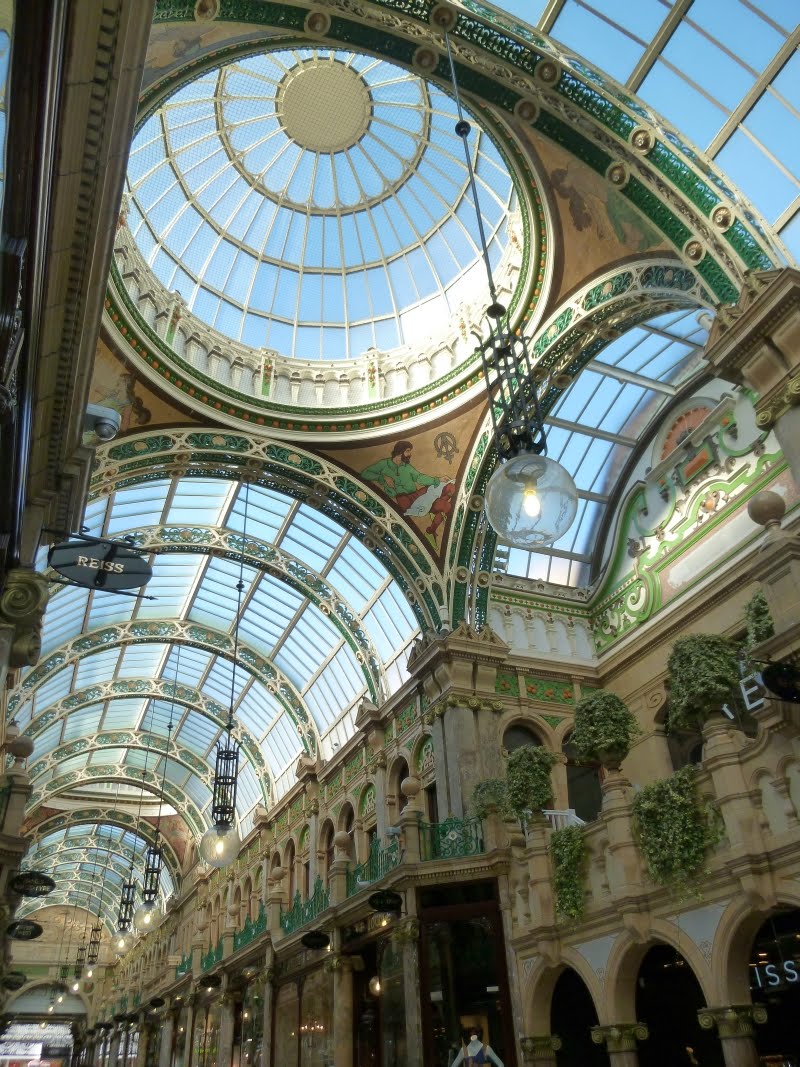
It’s natural to assume that northern England would be grey and overcast this time of year, so imagine my surprise today when the sun was shining so brightly that I needed to wear sunglasses. It was hardly cold, about 7 degrees Celsius (I’m working on my conversions; that’s mid-40s Fahrenheit). It was a perfect day to stroll through Leeds and take pictures. Here is a link to my photostream of architectural facades and other views in Leeds. The picture you see here is just one example of the exquisite Victorian architecture that still flourishes here. It is the glass-and-iron ceiling of County Arcade in Victoria Quarter, an enclosed shopping district designed by Frank Matcham in 1900. It houses today some rather posh shops. In some ways, the city center of Leeds seems like a giant shopping mall. There are numerous department stores and boutiques everywhere, and more than 1 million square feet of new retail space is under construction. But if you’re looking for “ye olde shoppes” that conjure visions of the medieval past, you need to go to a tourist-like town such as York. Here things are more working- and middle-class capitalism. I only wish it was more culturally diverse (too many white people!). There’s certainly more to explore and discover in Leeds though, including areas by the University and near Clarence Dock, so I’m sure I’ll have more to say in the weeks to come.

Despite my fascination with this city so far (and England in general), I’ve had more than one reminder this week that not everyone is as regal as Queen Elizabeth II. Perhaps the most noticeable thing is the number of people who drink at the pub. Now, don’t misunderstand me, I have nothing against having a pint at the pub. I’ve already done it myself more than once since I’ve been here (including having had a few during a burlesque show for a charity event, but I digress). I can understand why people drink here. It’s so cold, damp, and grey for most of the year, drinking probably helps warm (if not numb) the body. My cousin SG in Milano used to live in London and, as much as she loved it, she once told me she couldn’t understand why the English were always drunk (because Italians, as you know, never get drunk). Public drunkenness does seem to happen a lot here and, worse, seems to be tolerated in a way I don’t think I’ve ever seen in New York. I’m sure my English friends who read this will object to what I’m writing (some in fact may point out the recent deathly hangover I suffered while I was with them in New York last month, but again I digress). Consider, however, a few things that have happened to me in the past week alone related to this. I have witnessed someone vomiting in the street, I have had someone slam into a window and scream at me while I was eating dinner at GBK (Gourmet Burger Kitchen…amazing burgers & fries, by the way), and I have watched a crew of people stumble through the train and fall into one another, this last occurrence taking place last night as I traveled back from York. The highlight of that train ride, however, was when a young women sitting 2 rows behind me kept wailing at her boyfriend in tears wanting to know why he treated her so badly, especially with (and I quote) “me carryin’ ya baby in me belly!”, to which he kept telling her to fuck off and leave him alone, that he “weren’t cheatin’ on her!” Between their harsh working-class accent and their slurred drunkenness, it was worse than an episode of Jerry Springer. Yes, the American South isn’t the only place where there is white trash. I finally got up and moved to another part of the train. Interestingly, 4 other people followed me, as if they were waiting for someone to make the first move. Leave it to the New Yorker to lead the pack!

Saturday, October 23, 2010

Cooper & Gaga in London

I couldn't resist posting the above picture. Ultra hottie Anderson Cooper tweeted this a few hours ago, showing him and Lady Gaga in a pub in London. He's doing a series of interviews with her for 60 Minutes...no word yet when it will air though. Now...you think they'll make it up to Leeds for a pint???

Thursday, October 21, 2010

50 UK Days: Week 1

For the past 2 days, the big news in the United Kingdom has been the Tory government’s announcement that they were making cuts of over £80 billion from the national budget, a decision that will affect every aspect of life from education to welfare. (Note that the image you see here is a gilded coach owned by the royal family. I talk more about it below, but I realize now it seems sardonic to juxtapose it against a story about draconian budget cuts.) More startling though is that almost 500,000 national public sector jobs have to be cut by 2014. According to World Bank, the UK’s population is about 61.5 million, so this cut amounts to just under 1% of the population. That may not seem like a lot, but when you add it to the number of individuals currently unemployed here that will raise the national unemployment rate to 8.5%. The current United States unemployment rate is just under 10%, and the US population is 310.5 million, therefore 31 million people are unemployed in the US. That would suggest that unemployment is worse in the US, but if you compare the population ratio between our countries—-i.e. the UK is 5 times ‘smaller’ than the US—-it stands to reason that unemployment here should be only about 2%. (DISCLAIMER: I am not an economist, and as an art person I basically suck at numbers, so if anyone thinks I’m wrong with this, please feel free to comment.) In any case, the point to all this is that people are not happy with the financial cuts that will be happening here. Unlike the US where individual states handle budgets, the smaller size of the UK shows how national decisions like this will quickly affect every aspect of the nation itself.

It’s not like me to start off a post with economics, but I figured it was a good beginning for a post on my extended visit to the UK. I arrived on Monday at nearly noon, considering my flight left JFK 3 hours late. My luggage almost went to Tel Aviv, but fortunately I managed to figure out their mistake before it was too late. (I would have been devastated to have lost some of the new sweaters I had just bought!) I checked into the flat here in Leeds that afternoon and got myself settled into the area by walking around and going food shopping at Tesco. Leeds is actually a lovely small city. The juxtaposition of Victorian architecture with modern and contemporary trends blends well here. I’ll take pictures and post a few soon.

Tuesday morning I took a train down to London where I met up with my friend, the always fashionable RL. We checked into the Landmark, a former Victorian railway hotel near Marylebone Station that has been fabulously reconditioned and renovated. Thanks to the perks he’s acquired from all his traveling, we were upgraded to a junior suite, drank mimosas, and spent time relaxing in the indoor swimming pool and jacuzzi (after getting drenched in pouring rain during the afternoon hours).

We went to Buckingham Palace in the afternoon to visit the Royal Mews, the stable and coach area for the royal family, which was interesting. The picture you see at the top is the historical Gold Coach carved in 1762 by Joseph Wilton which has been used as the coronation coach, and the picture you see here is one of the beautiful Windsor Grey horses bred for the royal family’s use. We also went to the Queen’s Gallery to see the exhibition Victoria & Albert: Art & Love, a show with an array of about 300 objects on view ranging from portraits of their family by Winterhalter and Landseer to works they purchased and commissioned by contemporary painters and sculptors, as well as displays of jewels and personal items. Their love of photography was self-evident in the display of carte-de-visite photograph albums with numerous images for which they posed. The photograph you see here is by Roger Fenton and taken of them in May 1854. The theme of the exhibition is the role that Queen Victoria and Prince Albert played in the history of British art collecting and patronage practice from ca. 1840 to his death in 1861. Their love for one another and the conscious representation of their family as just another rising bourgeois family underlies the idea of the show as well, drawing in part on the rejuvenated popular interest in the couple following on the heels of the movie The Young Victoria, which bklynbiblio readers will remember me having reviewed and loved.

Last night at the Henry Moore Institute, I attended a lecture given by Glenn Adamson, a curator for modern design at the Victoria & Albert Museum. His talk was entited “Affective Objects: The Re-Invention of Craft,” and focused on both how some artists (known and unknown) have managed to instil emotion or feeling through production, whether it is referencing the anonymity and detritus of abandoned ceramic production in sculptural installation work by Claire Twomey, or through subject, as in Felix Gonzalex-Torres asking viewers to take away pieces of candy from an installation that represented his lover wasting away as he died from AIDS. Adamson also spoke about how “craft” was only invented as a concept in the 1700s, and reinvented in the 1800s by people like John Ruskin and William Morris, when the industrial revolution threatened handmade production by replacing it with machine-made goods. He also noted how craft workers today use new technologies to reinvent craft for a new age. It was an interesting talk and there was engaging discussion afterwards about sculpture as craft and the anonymity of the craft worker as compared to the ‘artist.’

That’s been my first week so far, and it’s only Thursday!

Monday, October 18, 2010

Ugh Canada!

"You’ll love Montreal!" I heard it from at least half a dozen people in the weeks before I left for my trip. I only wish it had been true. From my last post before I was on my way, I had mentioned that I had not done any research into what would be happening while I was there. It turned out that I needn’t have worried. I was so busy with the British Queer History Conference that I barely had any energy to do anything else. (I’ll write more about the conference in another post.) Certainly the weather had something to do it, since it rained most of the time, although on the day I arrived it was actually quite pleasant.

That first afternoon I made my way to the Montreal Museum of Fine Arts to see the permanent collection. That, admittedly, was worth it. Their 19th-century collection has a few interesting works, including James Tissot’s October, 1877, appropriately Aesthetic Movement as a vertical portrait of a flirtatious young woman in black surrounded by a profusion of orange and yellow autumn leaves (image courtesy of Artcyclopedia.com). In the same room was John William Waterhouse’s Saint Cecilia, 1895, which I had seen before at the Royal Academy retrospective exhibition of the artist’s work, but it’s always a refreshing surprise to see such a lovely work again. (Oddly enough, neither of these works appear on the museum’s website. Could there be an embarrassment about Victorian painting?) The museum also has one room dedicated to the arts of Napoleon, which was interesting. Some of the works were from the private collection of Ben Weider, a “Nap”-ophile who amassed not just art but also personal artifacts like his hat, boots, and a lock of his hair. The Thorvaldsen Apotheosis of Napoleon memorial bust may seem a bit over the top, but it is a brilliant Neoclassical example of how Napoleon was immortalized after his death. There was also a special exhibition of works by the German Weimar painter Otto Dix, which had been in New York not too long ago. Sadly, I have missed both versions of the show, because I had no time to see it here either.

This opening may make you think that I actually did enjoy the city. OK, so the museum was fine. But then that was it. The rest of my experience with the city wasn’t all that thrilling. The architecture is disappointing. I think I had in my mind something akin to Quebec City, but this wasn’t the case. There is Beaux-Arts style architecture for sure, but it has been swallowed and blocked by gulag-like modernist monstrosities that make you think they wanted to be Paris then New York and never made it in either direction. In contrast, Vancouver’s modernist architecture is quite beautiful (note: been there twice; love it!). I managed to get down to Old Montreal on Sunday morning, but even that disappointed me. There is construction everywhere, and the few “old”-style buildings are bizarrely juxtaposed near Chinatown, so you look in one direction and see a classical dome and turn around and see pagodas. Only when I took a taxi back from a lovely visit to see a fantastic private collection of Neoclassical books and a wonderful brunch (merci, LG!) did I finally see the Latin Quarter, and that area was delightful with its shops, restaurants, bars, etc., all of which reminded me New Orleans.

So I’m being overly harsh. I did have a wonderful dinner with JJK and CR at a Belgian restaurant one night. I also did see some go-go boys at Campus [nsfw!]...certainly always a fun experience doing that, especially considering Canadian bars allow their boys to dance sans sous-vêtements. I am glad the hotel had an indoor swimming pool, because I took advantage of that as well. One of the more interesting features of a city like Montreal is the complete comfort with which everyone interacts bilingually (French/English). If nothing else, seeing everything written in both languages helped improve my French a bit. So, who knows, maybe I’ll give Montreal another go in the future...but it will have to be in nicer weather. Perhaps with some sunshine and flowers in bloom, it may turn out to be a more pleasant city to visit.

[I wrote the above blog post while I was at JFK airport waiting for my plane to take off...3 hours late. I am posting it from Leeds, England, where I am now. More anon!]

Wednesday, October 13, 2010

Oh Canada!

It seems like ages ago when I was blogging that I would be giving a paper at the British Queer History conference at McGill University in Montreal, Canada, and that I would be going to England for my dissertation fellowship at the Henry Moore Institute. Believe it or not, the time has arrived: I leave in the morning. I'm usually fully prepared to visit museums or do specific things when I go to a new city, but this time around I haven't had time to do any research on Montreal. The picture you see here is the facade of their Musée des Beaux-Arts (Museum of Fine Arts; image: Bruce Aleksander & Dennis Milam on Flickr), but I haven't even looked at the museum website yet to know what's on at the moment. I've never been to Montreal before. I've been to Vancouver twice, and loved it, but this French city should be a wonderful experience, assuming the weather holds up. But what is there to do in Montreal? If anyone out there has been and wants to make recommendations, please let me know! In the meantime I need to brush up on my "s'il vous plait" and "merci." Time also to practice my favorite safety-net phrase: "Je suis desole, mais je ne parl pas francais." A little bit of humility in Paris helped me tremendously in Paris. I wonder if Montreal will be the same?

Friday, October 8, 2010

Auction Results: Attics and Dags

You'll recall not too long ago I had blogged about Chatsworth: The Attic Sale, a Sotheby's auction of architectural features and household goods owned by the Duke of Devonshire's family for the past few centuries. That 3-day auction ended today. The total amount earned at the sale (including buyers' premiums) was £6,486,782, which converts to $10,319,821.48. The most expensive item sold for £565,250, more than double its estimated value. It was a white marble chimneypiece from ca. 1735. Located in what was the Grand Entrance Hall of Devonshire House, it measures nearly 6' x 8' and would have been quite impressive in the entryway. The image you see here is a detail of it, showing the exquisite carving.

Following up on my last post about the daguerreotypes up for auction at Christie's, the 3 particular works I cited all sold today as well. Girault de Prangey's building with palm trees in Egypt sold for $62,500, and his gardens of the Villa Medici sold for $68,500. As for the anonymous dag of the two women, it sold under its estimated value for $1,000. That's actually a reasonable price, and it only makes it even more discouraging that I didn't bid on it.

As an aside, I learned from RL after my last post that while it was true that dags showed a mirror image of the sitter, thus altering the truth of their left/right sensibilities, that only lasted for a few years. An advancement in the development of cameras was the inclusion of an internal mirror, which corrected the image so that it would show on the dag plate exactly as an individual truly appeared. The inclusion of this mirror is still a part of all film cameras today.

Tuesday, October 5, 2010

Dags at Christie's

This morning, I accompanied RL to Christie’s auction house at Rockefeller Center to see the exhibition of photographs going up for sale tomorrow and Thursday. There are nearly 300 items in the one sale, with work by everyone from Carleton Watkins (1829-1916) to Richard Avedon (1923-2004). We were most interested in the daguerreotypes though. Dags (as I will hereafter call them) are copper plates that have been sensitized to light with a combination of mercury, silver, and iodine. (RL, pardon my oversimplified explanation!) They were first announced to the public in Paris in January 1839 as the invention of Louis Daguerre (1787-1851) based on his experiments with Joseph Nicéphore Niépce (1765-1833), and thus are considered by most today as the first stable form of photography. The incredible details that dags captured had critics declaring they were mirrors with permanent reflections. Their one deficiency was that it was a one-off. William Henry Fox Talbot (1800-1877) in England announced that the same year the invention of the calotype, a paper-based negative from which he could print positive prints. This easier reproducibility of images eventually led to Talbot’s process becoming the model for photography thereafter. But dags were still extremely popular because of the incredible clarity and detail seen in the shiny plates. Dag portraits were popular up to about 1860 because of the "photorealistic" quality seen in the portrayal of the sitter. Curiously though, because a dag is the negative of an figure or object, when you look at a dag you are actually seeing a mirror reflection of the subject as it truly appeared. In other words, a flower held in a woman’s left hand will appear in her right hand in the dag.

The image above is the cover of the catalog for the auction on October 7th of 73 dags by the French aristocrat Joseph-Philibert Girault de Prangey (1804-1892). An artist interested in architectural details and landscapes, he used dags on his trips to Italy, Turkey, Greece, and the Middle East to capture beautiful images with his own custom sized plates. He then would create drawings and watercolors and use them to make lithographs. Most remarkably, all of his dags were put in storage by him and only rediscovered in 1920, complete and intact. About a decade ago the owners began to auction some of this material off, and it’s only since then that photographic historians have been able to examine his dags and acknowledge Girault de Prangey’s place in the history of early French photography. (I owe a debt of thanks to RL for his photographic genius and for teaching me all about Girault de Prangey today!) Among the dags I particularly liked were this 1842 image capturing a large house and palm trees in Egypt, and this vista of the Villa Medici in Rome from the same year. What are their estimated selling prices? $30,000-$70,000.

My personal taste in art leans more toward figurative work, so the inclusion of a few portrait dags in the $2000-$3000 price range for the October 6th sale were of interest to me. Admittedly, they may not be perceived as great works of art, but they fascinate me as products of visual culture and social history. One in particular that interested me was the work you see here from ca. 1855 by an unknown photographer. It shows two young women holding a dag in their hands. Because the women wear the same dress, seemingly homemade in its design, it stands to reason they are working class or lower middle class. They are probably Americans and sisters. The dag they hold is surely that of a relative, perhaps their mother, whose absence is recreated in their lives using the "photorealistic" dag held firmly in their hands. Undoubtedly their dag shows someone who is deceased. It was not uncommon in the 19th century to capture the dead in photographic form so as to remember them as they appeared. Such was the power of photography once it was made widely available. But remembrance here is not just about the dag-within-the-dag. It is also present in the image of the two women themselves. This is layered memory in action, a photorecording of two sisters who are preserving their own existence, just as their relative before them had attempted to do the same at an earlier date. And yet, ironically—and sadly—, we know nothing about who these women were. They are nameless. This dag as we see it today thus becomes false memory, unsubstantiated remembrance. It presents to us simply what we see: two women from the mid-1800s trying to hold on to a glimpse of their past and preserve it for their future. It makes me wonder: should we dwell so much on recording the facts of our own past, or is it simply enough to leave behind a visual recording of our existence? I don’t know the answer, but I’m suddenly tempted to bid on the dag just for thinking about it this much.

If you want to know more about dags and the power of memory, read Geoffrey Batchen’s brilliant exhibition catalog Forget Me Not: Photography and Remembrance (2004).

Sunday, October 3, 2010

World Habitat Day 2010

Monday, October 4th, is World Habitat Day, whose "purpose is to call attention to the current global state of the human habitat and push toward adequate housing for all. We hope that by raising awareness and advocating for universal decent housing we can dismantle and alter the systems that reinforce and entrench poverty housing. In doing so, we can make an affordable, decent place to live a reality for all." The United Nations has declared the first Monday of October to be World Habitat Day. According to Jonathan Reckford, the CEO of Habitat for Humanity International, this day is "an opportunity for us to raise our voices together and speak out against the lack of decent, affordable shelter that challenges so many families here in our country and around the world." Habitat for Humanity is one of the charities I support. After the devastations of Hurricane Katrina in New Orleans and the earthquakes in Haiti, groups like Habitat for Humanity stepped in to assist in establishing basic housing needs for everyone. In their last fiscal year, they helped an estimated 63,000 families worldwide. What I especially like is that they utilize not just volunteers, but also team with local businesses, governments, and individuals so that they too are involved in the rebuilding of their own communities. I believe this instills a sense of pride in individuals to know they had a hand in helping construct their own housing. At some point in the near future, I intend to volunteer and help participate in a housing project somewhere in the world. (Care to join me? Let me know!) For now, though, a donation will do, especially since Habitat for Humanity has secured an anonymous donor who will match any donation made through the end of the day tomorrow.